

Peptide supplements explained: Benefits, risks, and real science


TL;DR:
- Peptide supplements encompass a wide range of substances, from dietary peptides to unapproved research compounds and prescription drugs. Only prescription peptides like semaglutide and tirzepatide have proven effectiveness for weight loss, while many marketed products are investigational drugs with no verified efficacy. Consumers should critically evaluate the product’s category, regulation, and safety information before use to avoid health risks and legal issues.
Walk into any supplement store or scroll through a fitness forum, and you’ll find “peptide supplements” everywhere, promising everything from rapid fat loss to faster muscle recovery. But here’s the problem: the term “peptide supplement” covers wildly different substances, from collagen powders to investigational drugs marketed under the same umbrella. Understanding what you’re actually buying, and what it can realistically do for your body, is one of the most important decisions you can make as a fitness-focused consumer.
Table of Contents
- Understanding peptide supplements: Types and terminology
- Peptides for weight loss: What’s proven and what’s hype?
- Peptides and fitness: Collagen, recovery, and performance claims
- Risks, regulation, and what to watch out for
- Why the peptide supplement conversation needs more clarity
- Explore evidence-based peptide solutions for fitness and wellness
- Frequently asked questions
Key Takeaways
| Point | Details |
|---|---|
| Not all peptides are supplements | Most products called peptides range from legal supplements to unapproved drugs and require careful scrutiny. |
| Evidence-backed weight loss needs a prescription | Only GLP-1/GIP receptor agonist peptides, prescribed by doctors, have proven impact in clinical trials for weight loss. |
| Collagen peptides have modest fitness benefits | Collagen helps joints and skin but does not greatly enhance muscle growth or recovery over regular protein. |
| Regulation and safety matter | Many peptide products online are not FDA approved, so always check testing and sourcing before buying. |
| Demand clarity and transparency | Learning to identify types, sources, and claims is key for making smart, safe peptide supplement choices. |
Understanding peptide supplements: Types and terminology
Peptides are short chains of amino acids, the same building blocks that make up proteins. Think of a protein as a full novel and a peptide as a single chapter. Shorter chains mean faster absorption and more targeted biological activity, at least in theory. But not all peptides work the same way, and the term “peptide supplement” groups together products that are fundamentally different in how they’re made, regulated, and used.
The three main categories you’ll encounter are:
- Dietary peptide supplements: Legally sold products like collagen peptides, creatine-adjacent peptides, or food-derived bioactive compounds. These are regulated as food supplements, not drugs.
- Gray-market or research-use peptides: Compounds sold online under labels like “for research purposes only.” These are often unapproved drugs in disguise, not intended for human use, and carry real legal and health risks.
- Prescription injectable peptides: Clinically approved drugs like semaglutide (Ozempic, Wegovy) and tirzepatide (Mounjaro, Zepbound). These are GLP-1 or GLP-1/GIP receptor agonists, proven in clinical trials, and only available through a licensed prescriber.
Understanding peptide vs protein differences helps clarify why these categories exist. The bioactivity of a peptide depends heavily on its sequence, length, and delivery method. A collagen peptide taken orally behaves very differently from an injectable GLP-1 agonist.
Here’s a quick comparison to make the landscape clearer:
| Category | Legal status | Regulation | Typical use |
|---|---|---|---|
| Collagen peptides | Legal dietary supplement | FDA food safety rules | Skin, joint, bone support |
| Research peptides | Unapproved/gray market | Minimal to none | Sold “not for human use” |
| Prescription peptides | FDA-approved drugs | Full drug approval | Weight loss, diabetes |
The mislabeling problem is real. Many products sold as peptide supplements are actually investigational products or even GLP-1/GIP receptor agonists repackaged for the supplement market. Consumers browsing online often have no idea they’re purchasing something that legally qualifies as a drug, not a supplement. Knowing the difference protects both your health and your wallet. You can also explore bioactive peptide benefits to understand which naturally occurring compounds have the strongest evidence behind them.
Peptides for weight loss: What’s proven and what’s hype?
Weight loss is where peptide marketing gets loudest, and where the gap between evidence and hype is widest. Let’s be direct: the most effective peptides for weight loss are prescription drugs, full stop.
Clinical trial data is unambiguous. GLP-1 receptor agonists like semaglutide and tirzepatide are the best-supported peptides for weight loss, with participants in major trials losing 15 to 22 percent of their body weight over 72 weeks. These results are not achievable with any supplement currently on the market. Tirzepatide, which targets both GLP-1 and GIP receptors, outperformed semaglutide in head-to-head trials, making it the current frontrunner in medically supervised weight loss.
Here’s how the clinical data stacks up:
| Peptide | Mechanism | Average weight loss | Prescription required |
|---|---|---|---|
| Semaglutide (Wegovy) | GLP-1 agonist | ~15% body weight | Yes |
| Tirzepatide (Zepbound) | GLP-1/GIP agonist | ~20-22% body weight | Yes |
| Collagen peptides | Amino acid source | Minimal to none | No |
| “Research peptides” | Varies/unproven | Unverified | No (but should be) |
Now contrast that with the supplement aisle. Many products marketed for weight loss as “peptides” are investigational drugs, not supplements, and they carry no clinical proof of efficacy in humans. Some are outright dangerous because they haven’t gone through safety testing.
The FDA has been actively debating how to handle the growing market for unproven peptides, including pressure from advocacy groups pushing for broader access. This regulatory uncertainty means the landscape is shifting, but it doesn’t mean unregulated products are suddenly safe.
Pro Tip: If a weight loss peptide product doesn’t require a prescription and promises dramatic fat loss, treat that as a red flag. The compounds that actually deliver meaningful weight loss require medical oversight for good reason.
For a deeper breakdown of what actually works, the best peptides for weight loss guide covers evidence-based options alongside recovery support. If you’re considering a medically supervised route, understanding prescription peptides for weight loss is an essential first step before talking to your doctor.
Peptides and fitness: Collagen, recovery, and performance claims
Beyond weight loss, the fitness world is saturated with peptide claims around muscle building, joint recovery, and athletic performance. Some of these have merit. Many don’t.
Here are the most common fitness peptide categories and what the evidence actually says:
- Collagen peptides: The most widely used and legally sold fitness peptide. Research supports their role in joint and bone health, particularly for people with osteoarthritis or connective tissue injuries. However, collagen peptides do not significantly boost muscle protein synthesis compared to free amino acids alone. If your goal is muscle growth, collagen is not your best protein source.
- BPC-157 and TB-500: Popular in the gray-market space for recovery and tissue repair. Anecdotal reports are everywhere in fitness communities, but human clinical data is essentially nonexistent. These compounds are sold as research peptides, not supplements, and using them carries real legal and health risks.
- Growth hormone secretagogues (like ipamorelin or CJC-1295): Marketed aggressively for muscle gain and fat loss. These stimulate the pituitary to release growth hormone. They are not FDA-approved for these uses, and their safety profiles in healthy adults are poorly studied.
- Creatine-adjacent peptides: Some companies market peptide-bonded creatine, claiming superior absorption. The evidence here is mixed at best, and standard creatine monohydrate remains the gold standard for performance.
“Not all peptides are created equal, and the fitness industry’s habit of grouping them together does a disservice to consumers who deserve accurate information about what they’re putting in their bodies.”
The doping angle is worth flagging. Several performance-focused peptides, including growth hormone releasing peptides, are banned by WADA (World Anti-Doping Agency). Competitive athletes who use these compounds risk not just health consequences but career-ending sanctions.
Pro Tip: For joint and connective tissue support, collagen peptides taken with vitamin C around training sessions show the most consistent evidence. Don’t expect them to replace whey or casein for muscle protein synthesis.
For a more complete picture of what’s actually backed by research, explore muscle performance and recovery resources and the muscle growth and recovery guide that separates real science from marketing copy.
Risks, regulation, and what to watch out for
The regulatory picture around peptide supplements is messier than most consumers realize, and that messiness creates real danger.

The FDA does not approve most peptide products beyond food-derived proteins like collagen. Injectable peptides that aren’t FDA-approved drugs fall into a legal gray zone, and the agency has been increasingly aggressive about enforcement. The FDA has issued formal warning letters against companies selling unapproved new drug peptides, specifically targeting businesses that market these compounds as supplements while making drug-like claims.
Here’s what puts you at risk when buying peptides from unverified sources:
- Contamination: Research-grade peptides are not manufactured under pharmaceutical-grade conditions. Bacterial endotoxins, heavy metals, and incorrect dosing are documented problems.
- Mislabeling: Products may contain different peptides than advertised, or concentrations that don’t match the label.
- Legal exposure: Purchasing unapproved drugs, even for personal use, can carry legal consequences depending on your jurisdiction.
- Unknown long-term effects: Many peptide products have not been adequately studied for safety or efficacy in humans, meaning you’re essentially running an uncontrolled experiment on yourself.
“The supplement industry’s light regulatory touch means that a product can reach store shelves or online carts without any premarket safety review. That’s a fundamentally different standard than what prescription drugs go through.”
The performance peptides safety research landscape reinforces this concern. Even among fitness professionals who use these compounds regularly, the honest answer is that long-term safety data simply doesn’t exist for most gray-market peptides.
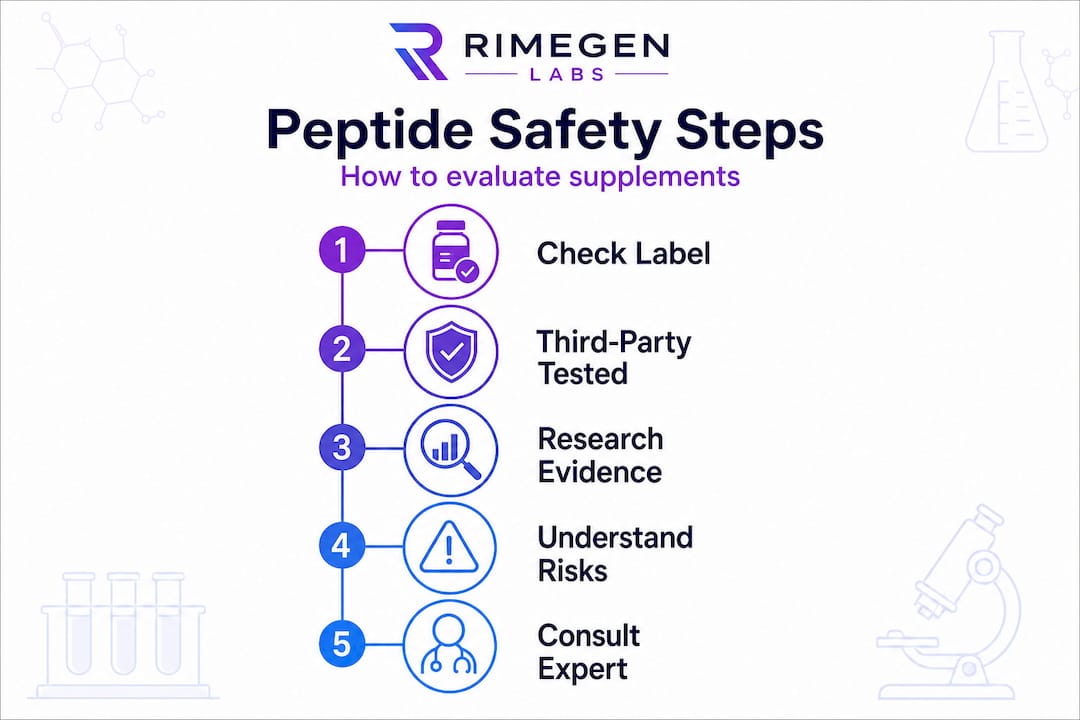
What should you actually look for when evaluating any peptide product? Start with third-party testing certificates, clear ingredient sourcing, and a company that doesn’t make drug-like claims. Avoid anything that promises to “replace” prescription medications or claims clinical-trial-level results without clinical-trial-level evidence. The peptide safety tips resource covers practical steps for protecting yourself, and staying current on 2026 peptide regulations helps you understand what’s changed in the legal landscape this year.
Why the peptide supplement conversation needs more clarity
Here’s the honest take after years of watching this space: the fitness and wellness community has a serious problem with peptide literacy.
Most people buying peptide supplements don’t know which category they’re buying from. They see “peptide” on a label, read a few glowing forum posts, and assume the product is both safe and effective. That assumption is wrong more often than it’s right.
The weight loss space is the clearest example. Meaningful, clinically validated fat loss from peptides requires a prescription GLP-1 or GLP-1/GIP agonist, medical supervision, and a realistic timeline. No supplement on the market replicates those results. Yet the marketing language used by gray-market sellers deliberately blurs this line, using clinical-sounding terminology to imply equivalence with drugs that have gone through rigorous trials.
Expert commentary consistently reinforces this point: “peptides” in fitness can mean dietary supplements, investigational drugs, or research-use compounds, and treating them as interchangeable is a mistake that costs people money and, in some cases, their health.
The fitness-focused consumer deserves better. The starting point should always be: what type of peptide is this, what is the evidence, and who is overseeing its production and sale? Skipping those questions because a product has a clean label and a confident Instagram influencer behind it is how people end up taking unnecessary risks.
We’d also push back on the idea that “natural” means safe. Collagen peptides are natural. Venom-derived peptides are also natural. The source doesn’t determine the safety profile. For those looking to genuinely improve peptide outcomes, the path forward is always evidence first, marketing second.
Explore evidence-based peptide solutions for fitness and wellness
Navigating the peptide landscape doesn’t have to be overwhelming. Whether you’re researching weight loss options, recovery support, or performance optimization, starting with credible, science-backed information makes every decision sharper.

At Primegen Labs, we’ve built resources specifically for fitness enthusiasts who want to cut through the noise. From peptide performance evidence that breaks down what’s real versus overhyped, to a science-backed peptide guide that covers the fundamentals without the marketing spin, the goal is always clarity over hype. Browse the full peptide archive for in-depth articles, safety guides, and product context that helps you make informed choices and get real results from your investment in peptide-based health strategies.
Frequently asked questions
Are peptide supplements safe for weight loss?
Prescription peptides like semaglutide and tirzepatide are proven effective for weight loss but require medical supervision and carry known side effects; most over-the-counter peptide supplements lack human safety data and regulatory oversight, making them a risky alternative.
Can collagen peptides help build muscle or aid recovery?
Collagen peptides support joint and bone health, but research shows they don’t outperform free amino acids for muscle protein synthesis, so they’re better suited as a joint support tool than a primary muscle-building supplement.
What are the risks of buying “research peptides” online?
Most online research peptides are unapproved drugs not intended for human use, and purchasing them exposes you to contamination, mislabeling, unknown long-term effects, and potential legal consequences depending on where you live.
How can I tell if a peptide supplement is legitimate?
Look for third-party testing certificates, transparent ingredient sourcing, and avoid any product making drug-like claims; supplements face far less premarket scrutiny than drugs, so the burden of verification falls on you as the buyer.