

Peptide signaling: the key to fitness and recovery


TL;DR:
- Peptide signaling is a complex biological process where peptide hormones transfer information to induce specific cellular responses, crucial for fitness goals like fat loss and muscle recovery. Understanding receptor types, signaling pathways, and individual variability is essential for effective and personalized peptide use, avoiding common misconceptions. Success depends on optimizing lifestyle factors alongside peptide protocols, as environmental context shapes the signaling environment and long-term outcomes.
Most people assume that taking a peptide supplement works like flipping a switch. You add the compound, the body responds, and results follow. That mental model is wrong, and it’s why so many fitness enthusiasts are disappointed. The real process involves peptide signaling, the precise chain of events where a peptide hormone transfers information from outside a cell to trigger a highly specific cellular response. Understanding that chain is what separates people who get results from those who just spend money. This article breaks down exactly how that process works, why it matters for fat loss and muscle recovery, and what you need to know to apply it intelligently.
Table of Contents
- What is peptide signaling?
- How peptide signaling works: From receptors to cellular responses
- Peptide signaling pathways: Impacts on fitness, weight loss, and recovery
- Nuances of peptide effects: Why context and customization matter
- What most people get wrong about peptide signaling in fitness
- Explore advanced peptide solutions for your fitness journey
- Frequently asked questions
Key Takeaways
| Point | Details |
|---|---|
| Peptide signaling basics | Peptide hormones communicate with cells through specific receptors to trigger changes vital for fitness and health. |
| Different pathways, different results | Each peptide’s effect depends on the receptor and tissue, meaning one-size-fits-all thinking leads to ineffective strategies. |
| Impacts on weight and muscle | Peptide signaling shapes appetite, metabolism, and muscle recovery—both desired and unintended effects matter. |
| Customization is key | Personalizing your approach based on peptide type, diet, exercise, and timing leads to superior results. |
| Expert insight | Optimizing peptide outcomes means tuning your nutrition, training, and supplement choices together, not in isolation. |
What is peptide signaling?
Peptide signaling isn’t a buzzword. It’s a real biological process that governs nearly every major function your body performs, from regulating blood sugar to repairing torn muscle fibers after a hard training session.
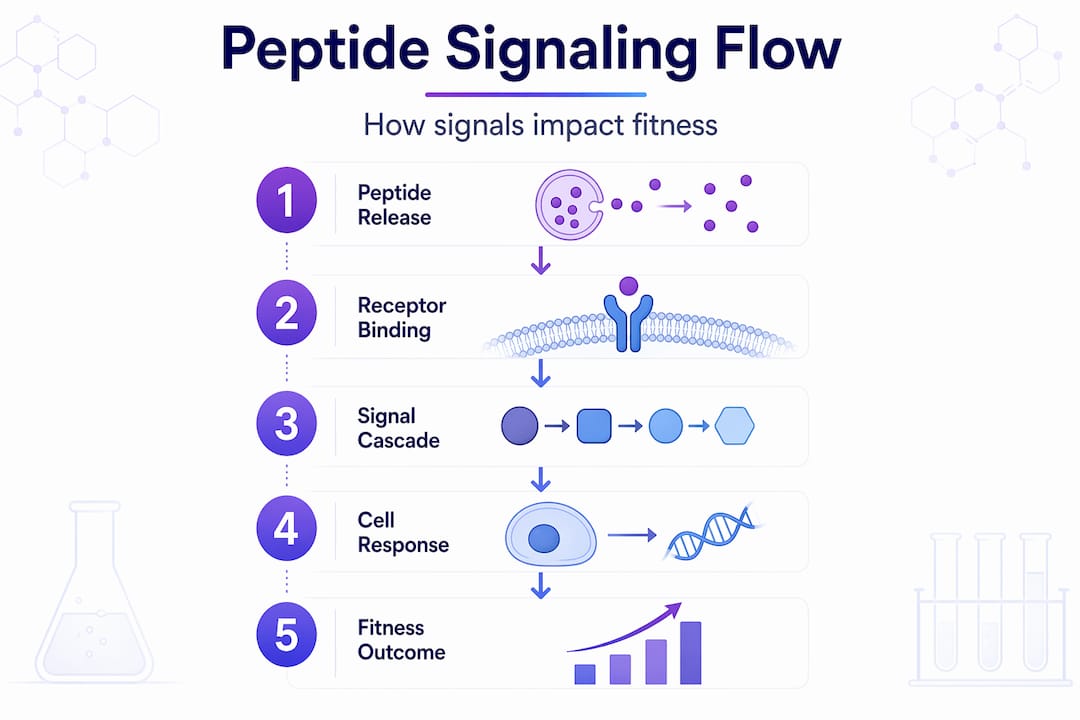
In plain terms, a peptide hormone is a short chain of amino acids released by one tissue that travels through the bloodstream to deliver a message to another tissue. That message is only received by cells that carry the matching receptor, much like a key fitting a specific lock. Once the peptide binds to its receptor, the receptor changes shape, triggering an internal cascade of molecular events that eventually produce a measurable outcome, such as increased glucose uptake, reduced appetite, or accelerated tissue repair.
“Peptide signaling is the process by which peptide hormones transfer information from outside a target cell to elicit a cellular response after binding to specific receptors.” Peptide hormone signal transduction and regulation
This is why signal transduction matters so much for fitness. It’s not the peptide itself that produces the result. It’s the cascade of reactions that follows. Knowing what peptides are is the entry point, but understanding what they trigger is where the real value lives.
Common peptide hormones relevant to fitness:
- Insulin: Drives glucose into muscle cells, supports glycogen replenishment after training
- GLP-1 (glucagon-like peptide-1): Regulates appetite in the brain and controls gastric emptying in the gut
- Secretin: Stimulates the pancreas and small intestine, playing a role in digestive coordination
- Glucagon: Mobilizes stored energy between meals, balancing blood sugar when muscle demand increases
- IGF-1 (insulin-like growth factor 1): Supports muscle protein synthesis and cellular repair
Each of these molecules operates through distinct receptor systems. The downstream results can be wildly different even when two peptides share a similar structural profile. This is the nuance most fitness content ignores entirely.
| Peptide hormone | Primary target tissue | Fitness-relevant outcome |
|---|---|---|
| Insulin | Muscle, liver, fat cells | Glycogen storage, nutrient delivery |
| GLP-1 | Brain, gut, pancreas | Appetite control, energy regulation |
| Secretin | Pancreas, gut | Digestive efficiency, pH balance |
| IGF-1 | Muscle, bone | Repair, hypertrophy support |
| Glucagon | Liver | Energy mobilization, glucose release |
How peptide signaling works: From receptors to cellular responses
Now that you understand what peptide signaling is, let’s see exactly how it unfolds inside your muscles, gut, and brain, starting with the cell receptors that set everything in motion.
Most peptide hormones act through cell-surface receptors, and the class of receptor determines which signaling pathway gets activated. There are three major receptor classes:
- G protein-coupled receptors (GPCRs): The largest and most diverse family. A peptide binds, the receptor shifts shape, and an associated G protein is activated. That G protein then triggers downstream messengers like cAMP or calcium ions, which alter cell behavior.
- Enzyme-coupled receptors: Binding the peptide directly activates an enzyme on the inner surface of the receptor, often a kinase that phosphorylates target proteins. Insulin works this way, through the insulin receptor tyrosine kinase.
- Ion channel-coupled receptors: Less common in classic hormone signaling but critical in neural contexts. Peptide binding opens or closes ion channels, changing the electrical state of the cell.
For fitness, the GPCR class is arguably the most important to understand. Peptide-binding GPCRs include class A and class B receptors such as GLP-1R (the glucagon-like peptide-1 receptor) and PTH1R. When GLP-1 binds to GLP-1R, it triggers a conformational change that activates a Gs protein, which then stimulates adenylate cyclase to produce cAMP. That cAMP acts as a second messenger, relaying the “reduce appetite and slow gastric emptying” signal deep inside the cell.
Pro Tip: Two peptides can bind receptors from the same class and still produce opposite results. Receptor subtype, tissue location, and even time of day all shape what happens next. Treating all GPCR-acting peptides as interchangeable is one of the most common and costly mistakes in applied peptide use.
Here’s how the cascade typically unfolds, step by step:
- A peptide hormone is released from its source tissue in response to a trigger (food intake, exercise, stress)
- It travels through the bloodstream to a target tissue that expresses the matching receptor
- The peptide binds to the receptor’s extracellular domain, inducing a conformational change
- The receptor activates intracellular signaling proteins (G proteins, kinases, or ion channels)
- Those proteins generate second messengers (cAMP, IP3, calcium) that amplify the signal
- The amplified signal activates transcription factors or enzymes that produce the final cellular response
- Feedback mechanisms gradually dampen the signal, returning the cell to baseline
Understanding how peptides guide recovery requires knowing which step in this cascade is being targeted. Peptide bioavailability and fitness outcomes are also tightly linked, because a peptide that’s degraded before it reaches its receptor never triggers any cascade at all.
Peptide signaling pathways: Impacts on fitness, weight loss, and recovery
Now you’ve seen how receptors and cascades work. Let’s examine how key peptide signaling pathways influence the results you care about most: body composition, energy, and recovery.

GLP-1 is the peptide pathway that’s received the most attention in recent years, and for good reason. GLP-1 receptor agonist signaling affects both central appetite pathways and peripheral energy metabolism00059-2/fulltext), including mechanisms tied to delayed gastric emptying and changes in energy expenditure. In practical terms, this means a single molecular pathway can simultaneously make you feel full faster, slow the rate at which food leaves your stomach, and shift how your body burns calories at rest.
That’s a powerful combination. But it comes with a complication that most fitness content glosses over.
GLP-1 receptor agonism can be associated with reductions in lean mass, meaning the rapid weight loss these pathways produce may come at the cost of muscle tissue if you’re not actively protecting it. For anyone prioritizing body composition over raw scale weight, this is a critical consideration that changes how you structure your nutrition and training around peptide use.
Key benefits and risks of major peptide signaling pathways:
- GLP-1 pathway benefits: Appetite suppression, improved insulin sensitivity, reduced caloric intake, favorable shifts in energy expenditure
- GLP-1 pathway risks: Potential lean mass reduction, nausea at higher doses, gastrointestinal adaptation period
- Insulin pathway benefits: Efficient glycogen replenishment, enhanced nutrient delivery to muscle, support for post-workout recovery
- Insulin pathway risks: Hypoglycemia if mistimed, fat storage when calories exceed needs
- IGF-1 pathway benefits: Direct support for muscle protein synthesis, accelerated tissue repair, anti-catabolic effects during caloric restriction
- Appetite regulation pathways: Intersection with ghrelin, leptin, and neuropeptide Y creates complex feedback that responds to sleep, stress, and training load
Understanding appetite peptides and weight management gives you a much clearer picture of how these competing signals interact in the real world. And if you’re actively researching the best peptides for weight loss while maintaining muscle, knowing which pathways you’re activating is the starting point for a smart strategy.
Pro Tip: Pairing peptide protocols focused on fat loss with adequate protein intake (at minimum 0.7 to 1.0 grams per pound of body weight) and consistent resistance training is the most evidence-supported way to preserve lean mass during weight-loss therapy. The peptide opens the metabolic door. Your training and nutrition decide which room you walk into.
Nuances of peptide effects: Why context and customization matter
You’ve learned how peptide signaling influences your body’s most important fitness and weight goals. Personalization is what unlocks the real power, and here’s why a customized approach matters more than most people realize.
The same peptide delivered to two different people, or even to the same person at two different points in the day, can produce measurably different outcomes. This happens because peptide effects are not one-size-fits-all. Different peptides can bias signaling through different GPCR activation states or receptor subtypes, so translating mechanisms into fitness outcomes requires peptide-specific and tissue-specific thinking.
A practical example: GLP-1R density is higher in some brain regions than others, and the ratio of GLP-1R to other related receptors varies between individuals based on genetics, prior diet history, and metabolic health status. This is why two people on the same GLP-1 protocol report dramatically different appetite responses. Neither person is wrong. Their receptor landscapes are just different.
Muscle recovery optimization intersects with insulin and glucagon signaling and nutrient sensing networks, meaning that caloric and protein intake, as well as training context, actively change hormone signaling dynamics and the outcomes you get. A hard training session upregulates certain receptors. A low-calorie phase downregulates others. These shifts mean the peptide environment is constantly in flux.
Factors that shape your personal peptide signaling outcomes:
- Diet and macronutrient composition: Protein intake directly influences IGF-1 and insulin signaling; carbohydrate timing shapes the post-training anabolic response
- Training volume and intensity: Resistance training increases receptor sensitivity in muscle tissue, amplifying anabolic peptide signals
- Sleep quality: Growth hormone-releasing peptides depend heavily on sleep architecture; poor sleep blunts the signal
- Genetics and receptor density: Individual variation in receptor expression explains why population averages don’t always predict individual results
- Peptide purity and delivery route: Oral, subcutaneous, and intranasal administration each produce different bioavailability profiles that alter how much peptide reaches target tissue
- Stress hormones: Elevated cortisol competes with anabolic peptide signals, often winning in chronically stressed individuals
Pro Tip: Before changing your peptide protocol, audit your training, nutrition, and sleep first. The signaling environment you create through lifestyle choices is the platform every peptide performs on. Optimizing that foundation consistently outperforms chasing the newest compound.
Exploring improving peptide outcomes through lifestyle integration and understanding bioactive peptides and muscle health are two directions worth pursuing once you have the fundamentals locked in.
What most people get wrong about peptide signaling in fitness
Before you walk away with a surface-level understanding, here’s what most people, and even some experts, miss when applying peptide science to real life.
The fitness world has a persistent obsession with finding the single best peptide, the magic compound that overrides everything else. It’s understandable. The science sounds impressive. The marketing sounds even more impressive. But the entire framework is backwards.
Peptide signaling is not a vending machine where you input a compound and receive a predetermined output. It’s a dynamic, feedback-sensitive system where the same input produces different results depending on dozens of interacting variables. The people who consistently get the best outcomes from peptide strategies aren’t the ones who found the hottest compound. They’re the ones who learned to read and shape their signaling environment.
Here’s what that looks like in practice. Two people use the same real science for muscle recovery protocol. One is sleeping seven to eight hours per night, eating adequate protein, and training with progressive overload. The other is sleeping five hours, eating in a significant caloric deficit with low protein, and doing mostly cardio. The first person sees genuine body recomposition benefits. The second sees marginal fat loss and loses muscle in the process. Same peptide, radically different signaling environments, completely different results.
Signal tuning, meaning the deliberate adjustment of when you train, what you eat, how much you sleep, and how you time your peptide use, is the real skill in applied peptide science. The compound is a tool. The environment determines whether that tool builds or does nothing at all. Experienced practitioners understand that obsessing over dosing precision while ignoring sleep and nutrition is like tuning a race engine in a car with flat tires.
Long-term results also require understanding that peptide signaling is not permanent. The body adapts. Receptor downregulation, changes in endogenous hormone production, and feedback loop adjustments all modify how effectively a peptide strategy works over time. Cycling protocols, adjusting lifestyle variables, and staying educated on the evolving research are all part of the process.
Explore advanced peptide solutions for your fitness journey
Understanding peptide signaling is a powerful first step, but putting it into practice requires more than theory.
At Primegen Labs, we translate the science behind peptide signaling into practical, evidence-based education and research-grade products designed specifically for fitness, weight loss, and recovery goals. Whether you’re building your first strategy or refining an advanced protocol, we have the resources to help you move forward with confidence. Explore peptides and performance evidence to understand the clinical landscape, go deeper with our muscle growth and recovery guide, or revisit the foundations with our science-backed peptide guide. Your signaling environment starts with what you know.
Frequently asked questions
What are examples of peptide hormones relevant to fitness and weight loss?
GLP-1, insulin, and secretin are among the most important peptide hormones, each playing distinct roles in appetite regulation, energy metabolism, and post-exercise muscle recovery.
Can peptide signaling supplements help preserve muscle during weight loss?
Some peptides support fat loss effectively, but GLP-1 receptor agonists can reduce skeletal muscle mass, making consistent resistance training and high protein intake essential protective strategies during any weight-loss peptide protocol.
Is peptide signaling only about weight loss, or does it affect recovery too?
Peptide signaling governs both body composition and muscle repair. Peptide signaling intersects with muscle recovery through nutrient sensing and hormonal networks that respond to training load, protein availability, and sleep quality.
How do different peptides produce different effects in the body?
Outcomes depend entirely on which receptor is bound and in which tissue. Different peptides bias signaling through different GPCR activation states or receptor subtypes, producing distinct downstream effects even among closely related compounds.
Are the effects of peptide signaling permanent?
No. Peptide signaling produces temporary changes that require continuous signaling to maintain. The body adapts through receptor regulation and feedback loops, which is why lifestyle consistency and periodic protocol adjustments matter as much as the peptides themselves.