
Research peptides for muscle performance and recovery


TL;DR:
- Research peptides can significantly raise hormones but have limited proven effects on muscle growth in healthy athletes.
- Most peptides lack extensive human safety data and are often banned in competitive sports.
- Current evidence shows collagen peptides may reduce soreness but do not increase muscle protein synthesis.
Many athletes assume that spiking growth hormone tenfold means packing on slabs of muscle. The reality is far more complicated. Research chemical peptides like CJC-1295 and Ipamorelin can produce stunning hormonal numbers in clinical settings, yet direct evidence for meaningful muscle hypertrophy in healthy, trained lifters remains thin. At the same time, collagen peptides and healing compounds like BPC-157 are generating enormous buzz in bodybuilding communities, often outpacing what the actual science supports. This guide separates fact from fiction, covers the top stacks, examines recovery evidence, and lays out the safety picture every serious athlete needs to understand before considering these compounds.
Table of Contents
- What are research chemical peptides?
- Top peptide stacks: Mechanisms and proven effects
- Muscle recovery and performance: What does the science say?
- Risks, regulatory status, and safety: What athletes must know
- Why most peptide research leaves athletes disappointed
- Discover safe and effective peptide resources
- Frequently asked questions
Key Takeaways
| Point | Details |
|---|---|
| Peptide effects vs. hype | Research peptides can cause dramatic lab changes, but real-world muscle or strength gains are modest at best for healthy users. |
| Science over speculation | Collagen peptides reduce soreness, not muscle growth; most peptide stacks lack robust human evidence for performance. |
| Safety and legality | Most research peptides are not approved for muscle development, may be banned in sports, and carry safety and quality risks. |
| Informed choices matter | Success in fitness comes from verified tactics, not shortcuts—prioritize basics before considering peptide research chemicals. |
What are research chemical peptides?
Research chemical peptides are short chains of amino acids synthesized specifically for scientific investigation rather than for direct human therapeutic use. They occupy a unique gray zone: not classified as traditional supplements, not approved as pharmaceuticals for muscle or performance purposes, but widely discussed and researched in the fitness and sports medicine world. Understanding what you’re actually dealing with starts here.
These compounds fall into several distinct categories that fitness users need to know:
- Growth hormone secretagogues (GHS): This includes GHRH analogs like CJC-1295 and GHRP (growth hormone releasing peptides) like Ipamorelin. These stimulate your pituitary gland to release more growth hormone naturally rather than introducing exogenous GH directly.
- Healing and tissue repair peptides: BPC-157 (Body Protection Compound) and TB-500 (thymosin beta-4) are the most talked-about here. They’ve shown regenerative effects in rodent models for tendons, ligaments, and gut tissue.
- Collagen peptides: Derived from hydrolyzed collagen, these are lower molecular weight fragments (typically 2 to 3.5 kDa) that differ significantly from other research peptides in terms of their regulatory status, available evidence, and practical fitness applications.
The key difference between research peptides and conventional supplements comes down to three factors: their synthetic design and specificity, their current legal and regulatory status, and the fact that they’re intended for investigational use rather than consumer sales. A standard whey protein or creatine product is supported by decades of human RCTs, regulatory clearance, and manufacturing standards. Research peptides often lack all three.
Fitness users are drawn to these compounds primarily because bioactive peptides and wellness research suggests mechanisms that could theoretically support muscle growth, accelerate recovery, and reduce body fat. The mechanisms are plausible. The gap is between a plausible mechanism and a clinically proven, practical outcome.
Important: As the data consistently shows, GH stacks elevate hormones but produce limited resistance training gains in healthy users; collagen helps soreness but not muscle protein synthesis; healing peptides remain rodent-only in terms of substantive evidence. Real research endpoints rarely match what the marketing claims.
Top peptide stacks: Mechanisms and proven effects
After understanding what research peptides are, let’s examine how the most popular stacks actually work in the body and what head-to-head science has confirmed.
The most widely used combination in fitness circles is CJC-1295 plus Ipamorelin. These two peptides work through complementary pathways that, when combined, produce a more pronounced and sustained hormonal response than either compound alone. CJC-1295 is a GHRH (growth hormone releasing hormone) analog that extends the natural pulse of GH secretion by binding to GHRH receptors in the pituitary. Ipamorelin is a selective GHRP that mimics ghrelin and triggers additional GH release through a separate receptor. Together, they create both a higher peak and a longer baseline elevation.
The clinical numbers are genuinely striking. CJC-1295 plus Ipamorelin stacked together synergistically elevates GH and IGF-1 via these complementary pathways, with clinical trials documenting 2 to 10 times GH increase and 1.5 to 3 times IGF-1 elevation lasting for days after administration. These are not trivial hormonal changes. The problem is that hormonal elevation and actual tissue adaptation are not the same thing. In healthy, well-trained individuals with normal GH and IGF-1 baseline levels, pushing those values higher doesn’t automatically translate into more muscle or less fat.
Here’s how the major stacks compare on the evidence:
| Peptide stack | Primary mechanism | Hormonal effect | Human RCT muscle/strength evidence |
|---|---|---|---|
| CJC-1295 / Ipamorelin | GHRH + GHRP synergy | Strong GH/IGF-1 elevation | Minimal to none in healthy subjects |
| BPC-157 | Angiogenesis, cytoprotection | Not GH-mediated | No human RCTs; rodent data only |
| TB-500 (thymosin beta-4) | Actin regulation, cell migration | Not GH-mediated | No human RCTs; mostly animal models |
| Collagen peptides | Connective tissue substrate, amino acid availability | No significant hormonal effect | Moderate RCT support for soreness reduction |
For more detailed breakdowns of specific stacks and how they interact with training variables, a good starting point is this peptide guide for muscle growth or this overview of research peptides for recovery.
Pro Tip: If a peptide’s appeal rests entirely on hormonal marker improvements rather than direct muscle or strength outcomes in healthy humans, treat the evidence as preliminary. Surrogate markers are interesting starting points for research, not endpoints for athletic decision-making.
Muscle recovery and performance: What does the science say?
Now that the top mechanisms and effects are clear, it’s time to dig into the direct science for muscle recovery and soreness and see which benefits consistently hold up.
Collagen peptides currently hold the most human evidence among fitness-relevant compounds. A well-designed RCT found that collagen peptides at 2 to 3.5 kDa reduce muscle soreness and fatigue post-exercise, but provide no additional benefit over free amino acids for myofibrillar or connective tissue protein synthesis following resistance training. This is a nuanced finding that the supplement industry frequently glosses over.

Here’s what the RCT data actually shows for collagen versus placebo:
| Outcome measured | Collagen peptides | Free amino acids | Placebo |
|---|---|---|---|
| Perceived muscle soreness (48h post) | Reduced | Similar reduction | Higher |
| Fatigue ratings post-exercise | Moderately reduced | Similar | Higher |
| Myofibrillar protein synthesis | No significant change | No significant change | Baseline |
| Connective tissue protein synthesis | Modest trend | Similar trend | Lower trend |
| Strength recovery rate | Slightly improved | Similar | Slower |
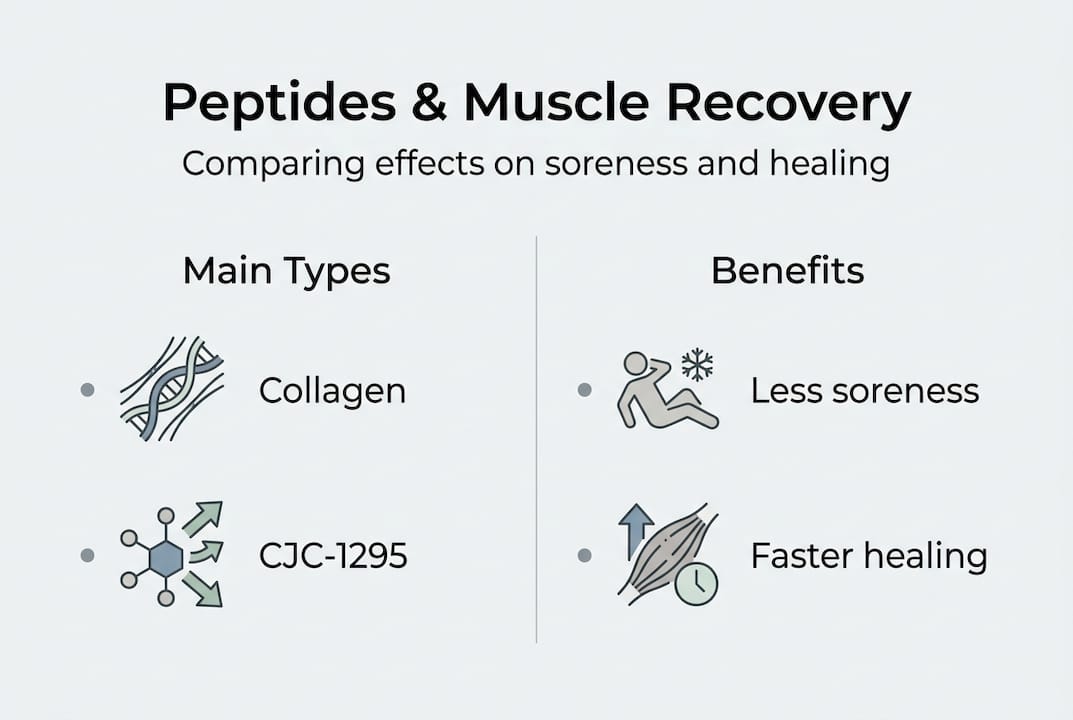
The practical implication: collagen peptides may genuinely reduce the discomfort and performance drag of post-exercise soreness, which matters if you’re training on consecutive days. But they are not building more contractile muscle tissue. That’s a critical distinction for anyone trying to maximize hypertrophy.
Here are the practical situations where peptide use may realistically support recovery:
- High-frequency training blocks where cumulative soreness impairs performance quality across the week, and collagen peptides may blunt that effect.
- Joint and tendon stress periods where collagen supplementation combined with vitamin C may support connective tissue remodeling around loaded joints.
- Caloric restriction phases where overall protein and amino acid availability is lower, and collagen peptides can provide additional glycine, proline, and hydroxyproline.
- Post-injury rehabilitation where some peptide compounds are being explored clinically, though most evidence still centers on animal models for non-collagen compounds.
For a deeper comparison of the structural differences between collagen and other peptide types, this breakdown of peptide vs protein differences in fitness contexts is worth reading.
The honest science consensus is this: most research peptides beyond collagen do not add measurable anabolic benefit in healthy, well-nourished individuals who are training consistently and eating adequate protein. Hormonal signals matter, but they are one variable in a complex system. Healthy lifters already produce sufficient GH and IGF-1 to drive hypertrophy when training and nutrition are dialed in.
Risks, regulatory status, and safety: What athletes must know
Practical benefits are only half the story. Smart athletes need to look critically at the other side: what health and rulebook risks are really involved?
The regulatory landscape for research peptides is genuinely complicated. Most of the compounds discussed in fitness contexts, including CJC-1295, Ipamorelin, BPC-157, and TB-500, are not FDA-approved for human use in muscle growth, recovery, or performance enhancement. They exist in a space designed for research purposes, which means quality control, purity verification, and dosing consistency are not subject to the same oversight as pharmaceutical-grade drugs or even regulated dietary supplements.
Sports authorities have taken a firm position. Peptide promoters cite mechanisms and anecdotes, but organizations including AOSSM, NCBI-linked researchers, and WADA stress that no human RCTs support performance claims, that risks outweigh unproven benefits, and that precautionary bans are in place. WADA’s prohibited list includes several peptide hormones and related substances, which means tested athletes face disqualification, not just health risk.
The practical risk profile includes:
- Unknown long-term effects: Even for compounds that appear benign in short-term rodent studies, multi-year human safety data simply does not exist.
- Product quality and purity: Research-grade peptides sourced outside pharmaceutical channels carry serious impurity risk, including bacterial endotoxins, incorrect concentration labeling, and cross-contamination.
- WADA and sport governing body bans: CJC-1295, Ipamorelin, and GH-releasing peptides as a class are explicitly prohibited in competitive sport. Testing positive carries career consequences.
- Unknown drug interactions: Combining peptides with other performance compounds creates interaction profiles that have essentially never been studied in humans.
- Subcutaneous injection risks: Many peptides require injection, which introduces infection risk, injection site reactions, and skill-dependent dosing accuracy.
Pro Tip: Your first filter for any peptide compound should be documented safety exposure in peer-reviewed research and transparent purity verification. The more information about peptide safety tips you can access before considering anything, the better. Unverified products from unregulated suppliers carry the highest risk profile of anything in this space.
Keep up with the evolving legal picture by reviewing peptide regulations in 2026, which has seen meaningful shifts in how research peptides are classified and enforced in several jurisdictions.
The responsible position is straightforward: if you are a competitive athlete subject to drug testing, most research peptides are off the table entirely. If you are researching these compounds purely for investigational purposes, the absence of human clinical evidence for performance benefits combined with real and poorly quantified risk is a combination that demands caution rather than enthusiasm.
Why most peptide research leaves athletes disappointed
Here’s the uncomfortable reality that most peptide content avoids saying directly: the gap between “this spike growth hormone 10x in a clinical setting” and “this will help you build more muscle or recover faster” is enormous, and that gap is where most athlete expectations collapse.
The fitness world has a deep structural bias toward mechanism over outcome. When someone reads that CJC-1295 elevates IGF-1 by 300%, the brain immediately connects that to more muscle, because IGF-1 is anabolic. But healthy athletes aren’t deficient in IGF-1 signaling. Their muscle-building limitation is training stimulus, caloric sufficiency, sleep quality, and accumulated progressive overload over years. Adding more hormonal signal to a system that is already operating in a healthy range doesn’t move the needle the way it does in clinical populations with genuine hormonal deficiencies.
BPC-157 is a perfect example of this gap. The rodent data is genuinely fascinating: accelerated tendon healing, gut protection, even neurological effects. But rodent studies translate to human benefit far less often than people assume, and no human RCT has confirmed these effects in athletes. The mechanism is real. The jump to “therefore I’ll heal my elbow faster” is speculative.
The path to improving real results in the gym still runs through the fundamentals: progressive overload, high protein intake, quality sleep, and intelligent periodization. These aren’t exciting claims, but they’re built on decades of reproducible human data.
Peptides worth monitoring? Absolutely. Worth gambling your health, career, and wallet on pre-clinical hype? No. Demand the same quality of evidence from performance compounds that you’d demand from any other health decision. The research will eventually catch up, and when it does, we’ll have real answers.
Discover safe and effective peptide resources
With a balanced view on peptides, the next logical step is making smart, safe, and evidence-based choices.

At Primegen Labs, we’re committed to giving fitness and bodybuilding communities access to science-backed information, not marketing hype. Whether you’re exploring the fundamentals through our muscle growth peptide guide or reviewing the full spectrum of peptide performance evidence including benefits and documented cautions, our resources are built to help you cut through noise. For those actively working with peptides, our peptide optimization strategies offer structured, evidence-informed frameworks for getting the most out of your research while prioritizing your safety.
Frequently asked questions
Do research peptides work for muscle growth in healthy lifters?
Clinical data shows dramatic hormone boosts with stacks like CJC-1295/Ipamorelin, but little to no measurable extra muscle gain has been documented in healthy, trained individuals whose baseline hormonal function is already normal.
Are peptides like BPC-157 or TB-500 proven for recovery?
No human clinical evidence exists for BPC-157 or TB-500 in athlete recovery contexts; as current research confirms, testing for these healing peptides has been conducted almost entirely in animal models with no confirmed translation to human outcomes.
Is collagen peptide different from other research peptides for fitness?
Yes, collagen peptides are far better studied than other fitness peptides; RCT evidence shows they reduce post-exercise soreness and fatigue, but they don’t outperform free amino acids for actual muscle protein synthesis.
Are research peptides legal or safe for athletes to use?
Most research peptides are unsanctioned and potentially banned under WADA rules for competitive athletes, and they lack the long-term human safety data needed to confirm that benefits outweigh the risks for healthy individuals.