
How to select peptide types for muscle growth and recovery


TL;DR:
- Selecting peptides based on a clear goal—either muscle growth or recovery—is essential for effective results. Prioritizing compounds with strong clinical evidence and verifying supplier quality ensures safety and efficacy. Avoid unregulated sources and WADA-prohibited peptides to prevent health risks and potential sanctions.
Walk into any bodybuilding forum today and you’ll find hundreds of threads debating peptides, yet most of the advice skips the one question that actually matters: what is your specific goal? Knowing how to select peptide types is the difference between targeted, measurable results and wasted money on compounds that don’t match your physiology or training phase. The goal-first approach is the most practical framework available, and this guide applies it step-by-step so you can make a confident, safe, evidence-backed decision for muscle growth and recovery.
Table of Contents
- How to select peptide types: start with your primary goal
- Map fitness goals to peptide classes and types
- Evaluate peptide safety, regulatory status, and quality
- Consider anti-doping rules and athlete eligibility
- Practical checklist: selection criteria and sourcing peptides safely
- Our perspective: the hype cycle is costing you real results
- Explore our peptide resources to support your next phase
- Frequently asked questions
Key Takeaways
| Point | Details |
|---|---|
| Start with goals | Define your primary fitness goal to guide peptide type selection focusing on muscle growth or recovery. |
| Prioritize evidence | Choose peptides with strong clinical evidence and FDA approval when possible for safety and efficacy. |
| Verify quality | Only use peptides from regulated pharmacies that provide lot-specific testing and certifications. |
| Check regulations | Athletes must confirm peptides are not banned substances under anti-doping rules like WADA. |
| Simple administration | Begin with beginner-friendly peptide forms like topical or pre-filled injections to ease use. |
How to select peptide types: start with your primary goal
Before you look at a single compound name, you need to answer one question clearly: are you primarily trying to build muscle or recover faster? These two objectives map to entirely different peptide categories, and mixing them up from the start is the most common mistake beginners make.
Muscle growth typically requires optimizing growth hormone (GH) and insulin-like growth factor 1 (IGF-1) levels. Peptides in this lane stimulate your pituitary gland to release more GH naturally, supporting body recomposition, lean muscle accumulation, and fat metabolism. Recovery, on the other hand, focuses on repairing damaged tissue at the cellular level, including tendons, ligaments, and muscle fibers stressed by training.
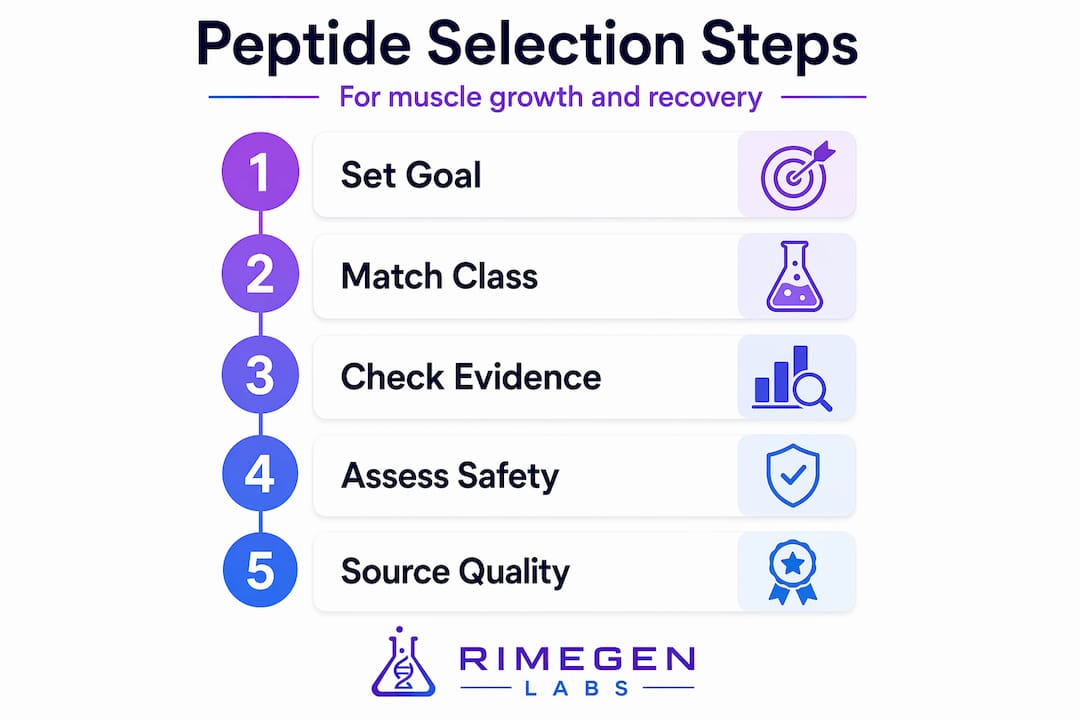
According to the peptide goal framework, peptides map into categories like Growth Hormone Optimization for recovery and Muscle Building and Recovery focusing on protein synthesis and myostatin inhibition. Understanding this split before anything else reduces your options dramatically.
Here is what defining your goal does for your selection process:
- Narrows your peptide category from dozens of compounds to a shortlist of 3 to 5 relevant options
- Helps you set realistic timelines, since GH optimization takes weeks to months while some recovery peptides show effects faster
- Prevents you from stacking compounds prematurely, which increases both cost and risk without proportional benefit
- Makes it easier to track progress, because you know exactly what outcome you are measuring
For more on the key criteria for choosing peptides, including how training frequency and injury history influence selection, that resource breaks it down with real-world context.
Map fitness goals to peptide classes and types
Once your goal is locked in, the next step is understanding which peptide classes belong in each category and what the evidence actually looks like for each one.
Growth hormone secretagogues for muscle building
These are the most studied peptides for fitness applications. They work by triggering the pituitary to release GH in pulses that mimic natural rhythms. Common muscle growth peptides in this class include CJC-1295, ipamorelin, sermorelin, and tesamorelin, while recovery peptides include BPC-157 and TB-500, often used together for synergy.

| Peptide | Primary goal | Evidence level | Administration |
|---|---|---|---|
| Sermorelin | GH stimulation, body recomposition | Clinical (FDA-approved history) | Subcutaneous injection |
| Ipamorelin | GH pulse amplification, lean mass | Moderate clinical | Subcutaneous injection |
| CJC-1295 | Sustained GH release | Moderate clinical | Subcutaneous injection |
| Tesamorelin | Visceral fat reduction, GH increase | Strong clinical (FDA-approved) | Subcutaneous injection |
| BPC-157 | Tendon and muscle repair | Preclinical (animal studies) | Injection or oral |
| TB-500 | Tissue regeneration, flexibility | Preclinical | Subcutaneous injection |
A few things stand out from this table that most guides skip. Tesamorelin and sermorelin carry the strongest evidence precisely because they have gone through formal FDA review processes. That matters when you are making safety decisions. BPC-157 and TB-500, despite enormous community enthusiasm, are still largely based on animal studies.
For muscle growth and recovery peptides with a deeper breakdown of mechanisms and dosing protocols, that resource fills in the gaps the table cannot.
Key points when evaluating peptide classes:
- Prioritize peptides with human clinical data over those with only animal or preclinical evidence
- GH secretagogues work best with consistent sleep, adequate protein intake, and progressive overload training
- Recovery peptides like BPC-157 are often used post-injury or during deload phases rather than as primary mass-building tools
- Combining GH secretagogues with recovery peptides is done by experienced users, not beginners
Pro Tip: If you are new to peptides, start with a single compound for a minimum of 8 to 12 weeks before adding anything else. This gives you a clean baseline to assess what is actually working and what is not. For research peptides for muscle recovery specifically, understanding their preclinical status helps set appropriate expectations.
Evaluate peptide safety, regulatory status, and quality
This is where most guides go soft, and where you cannot afford to. Peptide safety is not a minor footnote; it is a central part of the selection process.
“Wellness peptides often lack reliable safety or efficacy data. ECRI and ISMP recommend FDA-approved products from regulated pharmacies to reduce risk and ensure quality.”
That warning exists for a reason. The unregulated peptide market is full of products with inconsistent potency, contamination risks, and zero batch-level verification. Here is how to evaluate safety before you purchase:
- Check FDA approval status. Tesamorelin and sermorelin have approved applications; compounds like BPC-157 do not. Approval signals a compound has cleared formal safety review.
- Request a Certificate of Analysis (COA). Any legitimate supplier provides lot-specific documentation covering identity, potency, sterility, endotoxin levels, and pH. No COA means no purchase.
- Verify accreditation. The pharmacy or supplier should be licensed, ideally with 503A or 503B pharmacy accreditation for compounded products.
- Check cold chain integrity. Many peptides degrade without proper refrigeration. Confirm the supplier ships with cold packs and temperature monitoring.
The Peptide Association outlines critical testing including identity verification, potency assays, sterility testing, endotoxin screening, particulate checks, and pH measurement as the baseline quality control standard for compounded peptides.
Red flags to avoid:
- No COA available or COA is from a non-independent lab
- Pricing significantly below market rates (often signals underdosed or contaminated product)
- No licensed pharmacist or physician oversight
- Vague ingredient sourcing or country of origin
For detailed peptide safety tips and how peptide regulations 2026 affect your purchasing options, both resources are worth reading before you place any order.
Pro Tip: Always ask your supplier for the independent third-party lab that performed the COA testing. In-house testing has an obvious conflict of interest and should not be the only verification you rely on.
Consider anti-doping rules and athlete eligibility
If you compete in any tested sport, this section is not optional reading. It is the section that could end your career if you skip it.
“BPC-157 and TB-500 are prohibited by WADA under S0 and S2 categories respectively, banned at all times without Therapeutic Use Exemptions; athletes risk sanctions if detected.”
This surprises many athletes who assume that because a peptide is not a steroid, it falls outside testing scope. It does not.
| Peptide | WADA category | Ban status | TUE available |
|---|---|---|---|
| BPC-157 | S0 (non-approved substances) | Banned at all times | No |
| TB-500 | S2 (peptide hormones, growth factors) | Banned at all times | No |
| Ipamorelin | S2 (growth hormone releasing peptides) | Banned at all times | No |
| CJC-1295 | S2 (GHRPs/GHRHs) | Banned at all times | No |
| Tesamorelin | S2 | Banned at all times | Possibly with documented need |
Key points for competitive athletes when selecting peptide types:
- WADA bans apply both in-competition and out-of-competition, meaning off-season use still risks sanctions
- Modern mass spectrometry can detect peptide metabolites with high sensitivity, making microdosing strategies unreliable as a workaround
- Always cross-reference your research peptides muscle recovery choices against the current WADA prohibited list, which updates annually
- Natural athletes governed by organizations like USADA, INBA, or WADA-affiliated bodies should treat the entire S2 category as off-limits
Pro Tip: Download the updated WADA prohibited list each January and cross-check every supplement, not just peptides, before your competitive season begins.
Practical checklist: selection criteria and sourcing peptides safely
You now have the framework. Here is how it translates into an actual decision process you can use today.
The most practical selection strategy maps goal first, then filters by evidence strength, safety, and beginner accessibility, with a strong emphasis on obtaining peptides from regulated, transparent sources.
Step-by-step selection checklist:
- Write down your primary goal: muscle growth, body recomposition, or injury recovery
- Match that goal to the correct peptide category using the tables above
- Within that category, prioritize compounds with the highest level of human clinical evidence
- Confirm your competition status and check WADA lists if you are a tested athlete
- Identify licensed, accredited suppliers or compounding pharmacies
- Request and review a full COA before purchasing
- Choose the simplest effective administration method for your experience level
- Use one peptide for a full cycle before adding anything else
Beginner-friendly administration options:
- Topical creams or gels (lowest complexity, no injection required)
- Oral capsules (convenient, though bioavailability is lower for some compounds)
- Pre-filled injection pens (more bioavailable than topical, simpler than reconstituted powders)
- Reconstituted subcutaneous injections (most precise dosing, highest learning curve)
For a complete choosing peptides fitness and recovery breakdown, or if you want a structured peptide recovery checklist to work through before your next training block, those resources give you the specifics this checklist points toward. When you are ready to refine your protocol, the guidance on how to improve peptide outcomes covers the variables most people overlook.
Our perspective: the hype cycle is costing you real results
Here is something most peptide content will not say directly: the bodybuilding community has collectively overestimated what unregulated, preclinical compounds will do, and underestimated how much the quality of the source matters.
Athletes spend significant time and money on BPC-157 and TB-500, two compounds with genuinely exciting preclinical data, while buying them from research chemical suppliers with no quality verification. The result? They cannot tell if the compound failed or if the product they received was underdosed or contaminated. That is not a peptide problem. That is a sourcing and expectation problem.
Meanwhile, FDA-approved secretagogues like tesamorelin sit underused because they are less discussed in community forums, despite having the strongest evidence base of any peptide class available. The compounds with the most Instagram mentions are rarely the compounds with the most clinical data.
The real best peptide selection process looks nothing like the lists you see posted in gym communities. It starts with humility about what the evidence actually supports, moves through a rigorous sourcing verification process, and holds off on stacking until a single compound has been evaluated properly. That approach is slower. It is also the one that produces consistent, trackable results rather than anecdotes.
Explore our peptide resources to support your next phase
If this guide helped you think more clearly about selecting peptides, the resources on our site take each step further with detailed protocols, dosing guides, and sourcing frameworks built for serious fitness athletes.
At Primegen Labs, we have put together educational content covering everything from the science behind growth hormone secretagogues to practical recovery optimization for competitive athletes. Whether you are choosing peptides for the first time or refining an existing protocol, the guides are built to give you the specifics you actually need. Browse our full peptide resource library and take the next step in building a protocol that fits your goals, your body, and your competition requirements.
Frequently asked questions
What is the best way to choose a peptide type for muscle growth?
Start by identifying your primary goal, then select peptides in the relevant category with strong evidence and safety profiles. Growth hormone secretagogues like ipamorelin have more human clinical data than most alternatives and are a logical starting point for muscle-focused protocols.
Are peptides like BPC-157 safe and approved for human use?
BPC-157 is not FDA-approved and carries significant uncertainty. 35 of 36 published studies on BPC-157 were conducted in animals, with no published Phase 1 human safety data and no controlled human efficacy trials available.
Can competitive athletes use peptides like TB-500 without risking bans?
No. TB-500 is prohibited under WADA section S2 since 2018, banned at all times with no Therapeutic Use Exemptions available, meaning any detected use carries full sanction risk regardless of how it was used.
How can I ensure the quality of compounded peptides I purchase?
Always request lot-specific Certificates of Analysis covering identity, potency, sterility, endotoxin, particulate, and pH. The Peptide Association advises verifying that testing includes HPLC and mass spectrometry from an independent third-party laboratory.
What administration methods are easiest for peptide beginners?
Topical applications and oral capsules require no injection skills and are the simplest entry points. Pre-filled injection pens come next, offering better bioavailability with lower complexity than reconstituted powder injection protocols.