
Peptide stability: key factors for research success

TL;DR:
- Peptide stability depends on resisting chemical and physical degradation, which varies with experimental conditions beyond storage. Degradation pathways like hydrolysis, oxidation, deamidation, and aggregation are driven by factors such as pH, temperature, and handling, requiring comprehensive, orthogonal assay profiling. Managing solution-phase handling and optimizing protocols are essential to ensure accurate, reproducible peptide research results.
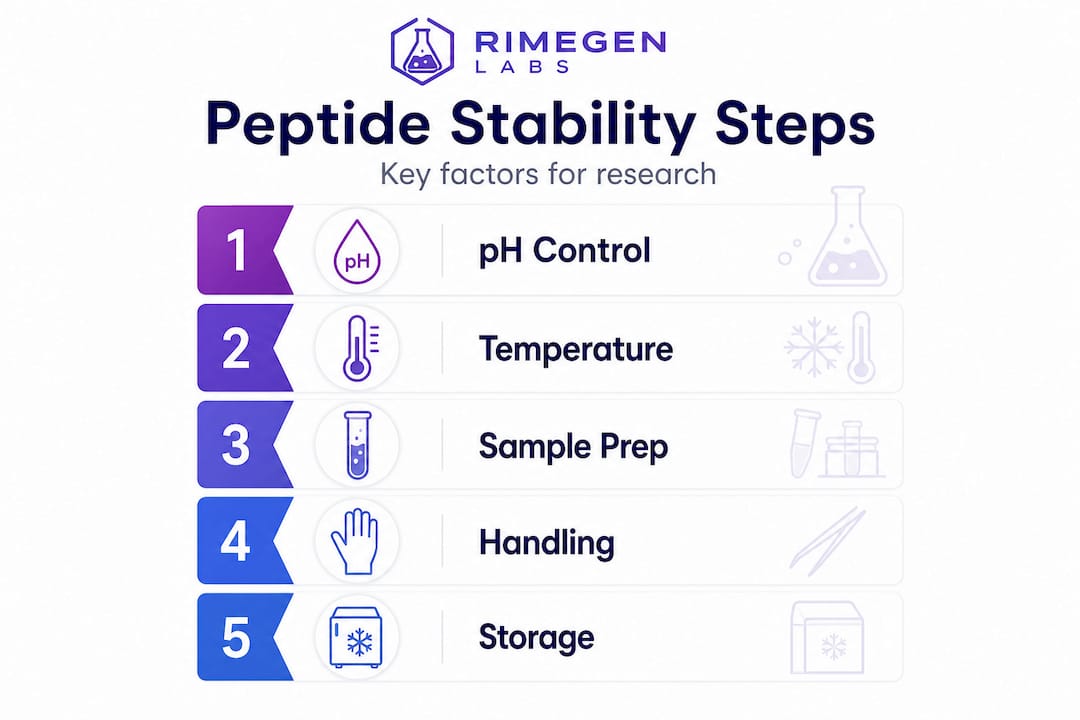
Peptide research failures rarely announce themselves loudly. More often, they accumulate quietly, buried in assay variability, inconsistent dose-response curves, or batch-to-batch discrepancies that get blamed on everything except the actual culprit: overlooked stability factors. Most researchers tighten storage protocols and call it solved, but the real problem frequently begins the moment the vial is opened. Solution-phase degradation, handling-induced aggregation, and matrix-specific losses during sample preparation collectively undermine data quality in ways that careful storage alone cannot prevent. This guide maps the full stability picture, from chemical mechanisms to practical assay design, so your research produces results you can actually trust.
Table of Contents
- Defining peptide stability: what are we really measuring?
- Major degradation pathways and influencing factors
- Practical experimental nuances researchers must consider
- Best practices for preserving and optimizing peptide stability
- What most researchers miss about peptide stability
- Resources to support your peptide research
- Frequently asked questions
Key Takeaways
| Point | Details |
|---|---|
| Multi-factor stability | Peptide stability is influenced by chemical and physical factors like pH, temperature, and handling conditions. |
| Handling matters | Laboratory practices, not just storage, play a major role in degradation rates and reproducibility. |
| Assay validation | Sample preparation and validation are critical to reliable peptide stability measurements. |
| Practical improvements | Applying best practice strategies dramatically improves peptide lifespan and experimental success. |
Defining peptide stability: what are we really measuring?
Now that we’ve highlighted why inconsistent results occur, it’s vital to define exactly what scientists mean by “peptide stability” in both research and practical terms. The phrase gets used loosely, but operationally it means something specific: the ability of a peptide to resist chemical and physical degradation under defined experimental conditions over a defined time period.
“Stable” in one context, say a lyophilized powder stored at minus 80°C, means something entirely different from “stable” in a 37°C incubation buffer at physiological pH. Researchers who conflate these conditions set themselves up for unreproducible data.
The four primary degradation modes you need to know:
- Hydrolysis: Cleavage of the peptide backbone or side-chain bonds by water, often accelerated at acidic or alkaline pH and elevated temperature. Asp-Pro bonds are notoriously labile.
- Oxidation: Attack on methionine, cysteine, tryptophan, or histidine residues by reactive oxygen species; even trace oxygen dissolved in buffer can drive this.
- Deamidation: Conversion of asparagine or glutamine residues to aspartate or glutamate, producing charge heterogeneity and altered bioactivity; often pH- and temperature-dependent.
- Aggregation: Non-covalent or covalent association of peptide monomers into oligomers or higher-order assemblies, reducing bioavailability and potentially triggering immunogenic responses in vivo.
As documented in peptide degradation research, common chemical and physical degradation pathways include hydrolysis, oxidation, deamidation, and aggregation, and these are strongly influenced by pH and temperature.
Why does the definition matter beyond semantics? Because how you define stability determines what you measure, which assay you choose (HPLC purity, SEC for aggregation, mass spectrometry for deamidation), and how you compare your results to the published literature. Misaligned definitions mean studies conducted under different operational assumptions cannot be meaningfully compared. For researchers reviewing peptide performance evidence, this conceptual clarity is the starting point for honest data interpretation.
“Stability is not a single property but a matrix of condition-dependent resistances. Measuring only purity by HPLC tells you nothing about aggregation state, and measuring only aggregation tells you nothing about deamidation. Full stability profiling requires multiple orthogonal assays.”
Major degradation pathways and influencing factors
A clear definition sets the stage for dissecting the main forces undermining peptide stability and what conditions accelerate them.
Each degradation pathway has a specific set of environmental triggers. Understanding which variables matter most for your peptide class allows you to design experiments that control the right parameters from the start.
Environmental factors that drive degradation
| Factor | Effect on stability | Critical threshold |
|---|---|---|
| pH | Acidic/alkaline pH accelerates hydrolysis and deamidation | Optimal range typically 4.5 to 7.0 |
| Temperature | Elevates reaction rate for nearly all pathways | Every 10°C rise roughly doubles degradation rate |
| Oxygen | Drives methionine/cysteine oxidation rapidly | Even trace dissolved O2 is problematic |
| Light | Tryptophan and other aromatic residues are photosensitive | UV exposure causes irreversible oxidation |
| Concentration | Higher concentration increases aggregation propensity | Sequence-dependent; no universal threshold |
| Agitation | Shear forces promote aggregation at air-liquid interfaces | Relevant during reconstitution and transport |
Research confirms that temperature and pH accelerate hydrolysis and deamidation, while aggregation is promoted by high concentration, aqueous conditions, and temperature. Small deviations in these parameters have outsized consequences. A shift from pH 6 to pH 8 during buffer preparation, or leaving a reconstituted peptide on the bench for an extra 30 minutes while you set up your assay, can meaningfully change what you inject.
Common lab mistakes that accelerate degradation
- Reconstituting in water and leaving at room temperature for extended periods before aliquoting
- Using buffers prepared days earlier without pH re-verification
- Storing reconstituted peptides in non-siliconized plastics that cause adsorption losses
- Neglecting to purge headspace oxygen from storage vials
- Freeze-thaw cycling more than twice without evaluating impact on aggregation
- Handling peptide solutions in full ambient light without light-sensitive precautions
Critically, stability problems are not confined to the freezer. As confirmed across the field, stability is not only a storage problem: reconstitution, incubation, solution conditions, and handling all accelerate degradation or aggregation. Reviewing safe peptide handling protocols and peptide reconstitution steps should be mandatory before running stability-sensitive experiments, not optional reading for new lab members.
A key statistic worth internalizing: Even modest shifts in pH or temperature during solution-phase handling can double or triple the rate of hydrolysis and deamidation, meaning two researchers running the same protocol but at slightly different bench conditions may be working with chemically different samples by the time they run their assays.
Practical experimental nuances researchers must consider
Delving deeper, it’s not just degradation chemistry but also how we handle and measure peptides that impacts results, especially in complex biological matrices.

Complex matrices like plasma, cell culture supernatant, or tissue homogenate introduce additional variables that amplify or mask true stability. Proteolytic enzymes are the obvious concern, but they are not the only one.
Sample preparation as a hidden variable
Protein precipitation steps (commonly using acetonitrile or methanol) can selectively co-precipitate peptides depending on hydrophobicity, charge, and matrix composition. The result is a biased recovery that looks like stability when it is actually an artifact of differential loss. Published research highlights that preparation steps like precipitation can bias stability results by selectively losing peptide analyte, and that assay design should be validated for specific matrices.
Filtration steps introduce similar risks. Centrifugal filtration membranes made from materials like polyethersulfone (PES) bind hydrophobic peptides at a rate that varies with concentration and organic solvent content. Pipetting losses at low concentrations, particularly sub-nanomolar, can easily exceed 20% before any chemical degradation occurs.
Steps for rigorous assay validation
- Define your stability endpoint clearly: Choose the specific degradation mode (chemical purity, aggregation, bioactivity) before designing the assay.
- Validate recovery in your specific matrix: Spike a known concentration of your peptide into the exact biological matrix you will use and measure recovery through the full sample preparation workflow.
- Include multiple time-point controls: Do not measure stability only at the final endpoint. Sampling at intermediate time points reveals whether degradation is linear, exponential, or delayed onset.
- Run matched blanks without biological matrix: This separates chemical degradation from matrix-driven losses.
- Test your assay with and without each preparation step: Precipitation, centrifugation, filtration, all should be evaluated individually to identify which step contributes most to variability.
- Document buffer lot and pH at time of use: pH drift in phosphate and carbonate buffers is well documented and often overlooked.
“The reproducibility crisis in peptide biology is partly a crisis of method validation. Studies often report stability data without specifying the preparation conditions, making inter-laboratory comparison unreliable at best and misleading at worst.” (Methodological nuance perspective, ACS Publications)
Pro Tip: Always benchmark stability with and without each preparation intervention by running a side-by-side comparison using the same peptide lot. If results diverge by more than 10%, the preparation step is contributing significant variability that must be controlled or reported as a limitation. Detailed guidance on designing safer, more reliable experiments is available in our peptide safety tips resource.
Best practices for preserving and optimizing peptide stability
Understanding experimental pitfalls leads naturally to implementing effective, evidence-based best practices that hold across research and pharmaceutical development contexts.
Preservation strategy comparison
| Strategy | Pros | Cons |
|---|---|---|
| Lyophilized storage at minus 80°C | Maximum long-term stability; slows all degradation modes | Requires controlled reconstitution; freeze-thaw risk on retrieval |
| Single-use aliquots in solution | Eliminates repeated freeze-thaw cycles | Increases plastic adsorption surface area; requires more vials |
| Addition of stabilizing excipients (e.g., trehalose, mannitol) | Protects structure during lyophilization and storage | May interfere with downstream assays at high concentrations |
| Argon or nitrogen headspace purging | Reduces oxidative degradation significantly | Requires appropriate equipment; not standard in all labs |
| pH-adjusted lyophilization buffer | Optimizes reconstitution pH automatically | Buffer choice affects excipient compatibility |
| Peptide PEGylation or modification | Dramatically extends plasma half-life | Alters pharmacokinetics and may reduce receptor affinity |
Lab dos and don’ts for maximizing peptide life
Do:
- Store lyophilized peptides with desiccant in sealed containers to prevent moisture uptake
- Reconstitute in a solvent that immediately produces a clear solution before diluting to aqueous buffers
- Use low-binding plasticware (polypropylene, siliconized glass) for all solution-phase handling
- Aliquot immediately after reconstitution and flash-freeze aliquots in liquid nitrogen
- Use HPLC or mass spectrometry periodically to confirm purity throughout your experimental timeline
Don’t:
- Reconstitute directly into phosphate-buffered saline (PBS) at neutral pH if your peptide contains Asp-Pro bonds
- Assume that a peptide stable at one concentration is equally stable when diluted tenfold in buffer
- Vortex peptide solutions vigorously; gentle inversion is sufficient and avoids air-liquid interface aggregation
- Skip stability checks when moving to a new matrix or changing buffer compositions mid-project
Research supports considering stability across the entire experimental timeline, from reconstitution through incubation and handling, as all these stages contribute to final peptide integrity. For a structured approach to this, our guide on peptide optimization strategies covers sequence-level and formulation-level strategies relevant to both research and therapeutic development.
Pro Tip: Integrate real-time stability checkpoints into your experimental workflow by running a freshly reconstituted sample alongside your experimental samples during every assay. This internal reference reveals drift caused by the assay conditions themselves rather than storage.
What most researchers miss about peptide stability
With a practical roadmap established, it is worth pausing to reconsider some common assumptions baked into how the field approaches stability.
The dominant narrative frames stability as primarily a storage problem. Get the right temperature, minimize freeze-thaw cycles, add appropriate excipients, and you have done your job. This framing is not wrong, it is just radically incomplete. In our experience reviewing published experimental designs and reproducibility data across peptide biology, the storage phase is often the least problematic part of the stability equation. The real bottleneck happens after the vial is opened.
Solution-phase events during reconstitution and incubation represent the majority of uncontrolled variability in peptide research. A peptide that survives two years at minus 80°C can degrade meaningfully within four hours in assay buffer at 37°C. Researchers sometimes interpret diminishing biological activity over an experiment as target desensitization or receptor downregulation when it is actually a steadily degrading peptide concentration.
The disconnect is partly cultural. Stability is treated as a logistics problem solved by the storage department or the reagent supplier, not as an ongoing experimental variable that must be actively managed. But every day-to-day decision matters. Bench temperature on a warm afternoon, the age of your buffer stock, how long your centrifuge run took, which plastic tube you grabbed, all of these can shift your effective peptide concentration and chemical identity.
There is also a tendency to benchmark new peptides against their own baseline without considering whether the baseline itself was captured under conditions that preserve integrity. If your “time zero” sample was handled at room temperature while you optimized the HPLC run, your stability curve starts from a compromised reference point.
Keeping pace with current peptide research trends means more than following new therapeutic targets. It means updating stability protocols in line with methodological advances in bioanalytical chemistry, which are moving faster than most lab SOPs (standard operating procedures) are updated.
Pro Tip: Periodically audit your stability protocols by pulling your current procedure and comparing it systematically against literature published within the last two years. Degradation science for peptides is an active field, and even small protocol refinements can substantially improve data reproducibility.
Resources to support your peptide research
For biochemists and research teams who want to go deeper or need practical lab solutions, the following resources offer immediate ways to put this knowledge into action.

At Primegen Labs, we design our resources to match the actual complexity researchers face in the lab rather than offering simplified overviews. Whether you need a detailed peptide synthesis guide to understand how manufacturing choices influence downstream stability, a step-by-step reconstitution safety guide built around minimizing degradation risk from the first moment of handling, or context-specific guidance like our muscle growth and recovery guide for application-oriented research, our library is built for working scientists who need actionable, evidence-grounded content. Pair these resources with a rigorous stability protocol and you have a foundation for reproducible, publication-quality data.
Frequently asked questions
What are the main causes of peptide instability in research applications?
The main causes are hydrolysis, oxidation, deamidation, and aggregation, triggered primarily by pH, temperature, and handling conditions that researchers often do not control consistently across experimental sessions.
How does sample preparation affect measured peptide stability?
Preparation steps like precipitation can selectively lose peptide analyte, producing stability data that reflects differential recovery rather than true chemical degradation, which is why workflow validation in your specific matrix is essential.
Are peptide storage conditions as important as assay conditions?
Storage matters, but stability extends beyond storage to encompass reconstitution, incubation, and solution handling, all of which can drive rapid degradation even when pre-storage conditions were optimal.
How can peptide stability be optimized during experiments?
Validated reconstitution procedures, precise pH and temperature control, use of low-binding plasticware, and integrating real-time stability checks at multiple experimental time points together represent the most effective strategy for maintaining peptide integrity from reconstitution through final measurement.