

Peptide guide: muscle growth, recovery & real science

TL;DR:
- Peptides act as biological messengers influencing growth, healing, and fat loss, but research is limited.
- Most human studies show peptides improve recovery and connective tissue health rather than significant muscle gains.
- Responsible use requires proper cycling, monitoring biomarkers, high-quality sourcing, and realistic expectations.
Peptides have become one of the most talked-about tools in fitness circles, yet most conversations skip straight to dosing without addressing what the science actually supports. Not every peptide works the same way, and the gap between animal research and human clinical data is wider than most people realize. Whether you’re chasing faster recovery, more muscle, or better performance, understanding which peptides do what, and under what conditions, changes everything. This guide cuts through the noise with evidence-based clarity, practical application advice, and an honest look at where the research still falls short.
Table of Contents
- What are peptides and how do they work?
- Popular peptides for muscle growth and recovery
- Risks, evidence gaps, and regulatory controversies
- How to use peptides safely and maximize benefits
- Why muscle quality matters more than just peptide mass gains
- Explore trusted peptide solutions and further learning
- Frequently asked questions
Key Takeaways
| Point | Details |
|---|---|
| Mechanisms matter | Not all peptides work the same; knowing their mechanism helps maximize fitness benefits. |
| Evidence is mixed | Animal studies are promising, but human trials rarely confirm muscle growth or strength gains. |
| Prioritize safety | Responsible use—through supervised cycles, adequate nutrition, and regulated sources—reduces risks. |
| Recovery vs mass | Peptides often improve recovery metrics rather than truly increasing muscle size or functional strength. |
What are peptides and how do they work?
Peptides are short chains of amino acids, typically between 2 and 50 amino acids long, that act as biological messengers in the body. Unlike full proteins, they’re small enough to interact directly with specific cell receptors, triggering targeted physiological responses. If you want to understand the peptide vs protein differences in the context of fitness and recovery, that distinction matters more than most people think.
For athletes and bodybuilders, four main peptide categories are relevant:
- Growth hormone releasing peptides (GHRPs): Stimulate the pituitary gland to secrete more growth hormone (GH)
- Healing peptides: Promote tissue repair in muscles, tendons, and ligaments
- Fat loss peptides: Influence lipid metabolism and energy partitioning
- Collagen peptides: Support connective tissue integrity and joint recovery
The mechanism that makes GHRPs particularly interesting is their downstream effect. GHRPs stimulate GH secretion, which in turn raises insulin-like growth factor 1 (IGF-1). IGF-1 is the key driver of muscle protein synthesis, meaning more IGF-1 signals your muscle cells to build and repair faster. This is why GHRPs like Ipamorelin and GHRP-2 have attracted serious attention in the fitness community.
Peptides also vary widely in how they’re administered. Most research-grade peptides are injected subcutaneously because oral bioavailability is poor. The stomach breaks down peptide bonds before they can reach the bloodstream intact. This is a critical practical point that many supplement marketing campaigns conveniently ignore.
Cycle length also matters. Running peptides indefinitely can cause receptor desensitization, where your body stops responding to the signal. Most protocols recommend structured cycles of 8 to 12 weeks with breaks in between to preserve sensitivity.
Pro Tip: Before adding any peptide to your protocol, get baseline bloodwork including IGF-1 and GH levels. Without a baseline, you have no way to measure whether the peptide is actually working for your biology.
With this foundation, let’s focus on popular peptides for muscle growth and their scientific backing.
Popular peptides for muscle growth and recovery
Not all peptides are created equal, and the evidence behind each one varies dramatically. Here’s what the research actually says about the most commonly used options.
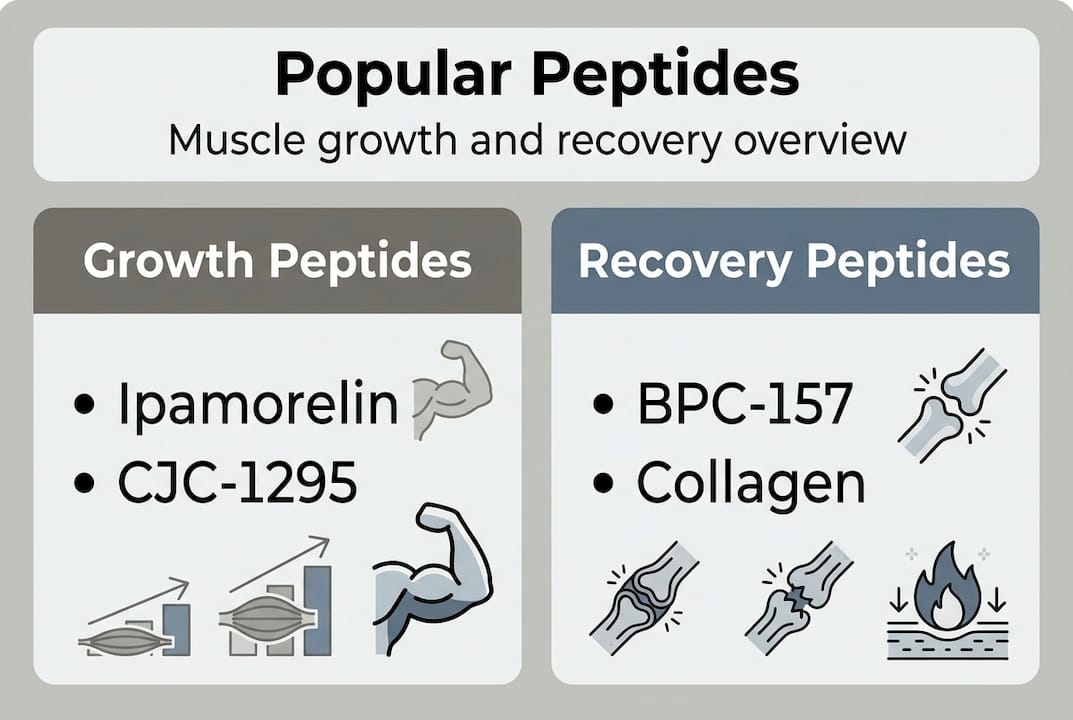
GHRPs: Ipamorelin, CJC-1295, GHRP-2, and GHRP-6
These peptides work by stimulating the pituitary to release GH in pulses that mimic natural secretion. Ipamorelin is considered the cleanest option because it selectively stimulates GH without significantly raising cortisol or prolactin. CJC-1295 extends the half-life of GH release, making it a popular pairing with Ipamorelin. GHRP-2 and GHRP-6 are more potent but come with stronger hunger side effects, particularly GHRP-6.
BPC-157: The healing peptide
Body Protection Compound 157 (BPC-157) is a synthetic peptide derived from a protein found in gastric juice. It’s become a go-to for athletes dealing with nagging injuries. BPC-157 promotes healing and recovery, with 35 preclinical studies supporting its efficacy across muscle, tendon, and ligament repair. It also promotes angiogenesis, which means it helps grow new blood vessels into damaged tissue, accelerating the delivery of nutrients and oxygen to injury sites. You can explore the BPC-157 peptide for research purposes if injury recovery is your primary goal.

Collagen peptides: Connective tissue support
Collagen peptides are the most accessible option and the only one with meaningful oral bioavailability. Collagen peptides improve recovery markers like force output and jump height in 12-week randomized controlled trials, though they don’t significantly change body composition.
| Peptide | Primary mechanism | Evidence level | Best use case |
|---|---|---|---|
| Ipamorelin/CJC-1295 | GH and IGF-1 elevation | Preclinical, limited human | Muscle growth, fat loss |
| GHRP-2/GHRP-6 | Strong GH pulse stimulation | Preclinical | Aggressive GH protocols |
| BPC-157 | Tissue repair, angiogenesis | 35+ preclinical studies | Injury recovery |
| Collagen peptides | Connective tissue synthesis | RCT human data | Joint and tendon health |
Key takeaways from the current research landscape:
- GHRPs show strong preclinical data but limited human RCT evidence for muscle mass
- BPC-157 has the broadest injury recovery support in animal models
- Collagen peptides are the most evidence-backed for human use in recovery metrics
- No peptide currently replaces progressive overload and adequate protein intake
Now that you know the science and key peptide types, it’s vital to address evidence gaps, risks, and functional gains.
Risks, evidence gaps, and regulatory controversies
This is where most peptide content goes quiet, and that silence is a problem. The honest reality is that the human research on most performance peptides is thin.
“Risks outweigh unproven benefits in many cases, with functional gains rarely demonstrated in human trials despite promising animal data.”
Here are the most important risks and limitations to understand before using any peptide:
- Limited human trials. Most peptide research is Phase I or small pilot studies. Animal models don’t always translate to human physiology, and the dosing used in preclinical research often doesn’t map cleanly to human protocols.
- WADA bans. The World Anti-Doping Agency prohibits most GHRPs and related peptides for competitive athletes. WADA bans most peptide supplementation, and testing positive can end a competitive career.
- Cancer risk concerns. GH and IGF-1 elevation can theoretically accelerate the growth of existing cancer cells. This is not a proven causal link in healthy people, but it’s a real concern for anyone with a personal or family history of cancer.
- Compartment syndrome. Some peptide users have reported compartment syndrome, a dangerous condition where pressure builds in muscle compartments, cutting off blood flow.
- Contamination from unregulated sources. Peptides purchased from gray market sources often contain incorrect concentrations, bacterial contamination, or entirely different compounds. This is not a minor risk. It’s a serious one.
The responsible path is to use a peptide safety guide that covers proper handling, reconstitution, and sourcing standards. Most experts in sports medicine recommend prioritizing nutrition and training optimization before considering peptides, and only doing so under medical supervision when you do.
Understanding the risks and gaps provides context for how to use peptides responsibly and maximize safe results.
How to use peptides safely and maximize benefits
If you’ve done your research, consulted a physician, and decided to proceed, here’s how to approach peptide use with the highest probability of positive outcomes and the lowest risk profile.
- Follow structured cycles. Cycle for 8 to 12 weeks for most peptides, then take a break of equal length. This prevents receptor desensitization and gives your endocrine system time to recalibrate.
- Optimize your protein intake. Peptides work best when paired with adequate dietary protein. Aim for 1.6 to 2.2 grams per kilogram of bodyweight daily. Without sufficient amino acid availability, even elevated IGF-1 can’t drive meaningful muscle protein synthesis.
- Prioritize progressive strength training. The anabolic signal from peptides amplifies the signal from resistance training. Without the training stimulus, there’s little for the peptide to amplify.
- Monitor your biomarkers. Get IGF-1 and GH levels checked before, during, and after a cycle. This is the only way to know if the peptide is working and if levels are moving into a safe range.
- Source responsibly. Only use peptides from suppliers with third-party testing and transparent certificates of analysis. Explore the full peptide archive for research-grade options.
| Peptide | Recommended cycle | Key monitoring actions |
|---|---|---|
| Ipamorelin/CJC-1295 | 8 to 12 weeks | IGF-1, fasting glucose |
| BPC-157 | 4 to 8 weeks | Injury markers, imaging if needed |
| Collagen peptides | Ongoing | Joint pain scores, recovery metrics |
| GHRP-2/GHRP-6 | 8 weeks max | GH, cortisol, prolactin |
Pro Tip: Nutrition and training will always outperform peptides as standalone tools. Think of peptides as a multiplier on an already solid foundation, not a shortcut around one.
Having covered safe, practical use, let’s look at a fresh perspective shaping peptide use today.
Why muscle quality matters more than just peptide mass gains
Here’s something most peptide content won’t tell you: gaining mass and gaining functional strength are not the same thing. The fitness industry has a mass obsession, and peptide marketing feeds directly into it. But the research tells a more complicated story.
Functional gains are rarely seen in human trials, even when peptides produce measurable increases in lean mass. What does that mean in practice? It means you might look bigger on paper without actually being stronger, faster, or more resilient. That’s a bad trade.
The athletes who get the most out of peptide protocols are the ones who are already training hard, eating right, and sleeping well. Peptides in that context can sharpen recovery and reduce downtime between sessions. But chasing peptide-driven mass gains as a primary goal, while neglecting training quality or nutrition, consistently underdelivers.
We’ve seen this pattern repeatedly in the peptide research trends emerging in 2026. The conversation is shifting from “how much mass can I add” to “how do I perform better and stay healthy longer.” That’s the right question. Prioritize performance metrics, recovery speed, and strength output over scale weight. Those are the numbers that actually tell you something meaningful.
Explore trusted peptide solutions and further learning
You now have a clearer picture of what peptides can and can’t do, where the science is solid, and where it’s still catching up. The next step is finding trusted resources and research-grade products that match your goals.

At PrimeGen Labs, we’re committed to evidence-backed peptide education and transparent sourcing. Whether you’re exploring the S-10 peptide product for your next research cycle, comparing options through our peptide vs protein guide, or staying current with the latest peptide research, we’ve built the resources to support informed decisions. Responsible use starts with reliable information and quality sourcing. We’re here to provide both.
Frequently asked questions
Are peptides legal for use in sports or bodybuilding?
Many peptides are banned by WADA and major sports leagues, and using them can risk disqualification. Always check the banned substance list for your specific sport before using any peptide.
Do peptides actually build muscle or just help recovery?
Preclinical evidence shows IGF-1 increases satellite cell proliferation by 65%, but human trials rarely demonstrate significant strength or mass gains. Collagen peptides improve recovery markers without meaningfully changing body composition.
How can I use peptides safely?
Cycle for 8 to 12 weeks, combine with adequate protein and strength training, monitor bloodwork regularly, and only source from suppliers with verified third-party testing.
What peptide is best for injury recovery?
BPC-157 promotes muscle, tendon, and ligament healing with 35 preclinical studies supporting its efficacy, though human clinical trials remain limited and more data is needed.
10 thoughts on “Peptide guide: muscle growth, recovery & real science”