

Peptide vs protein: key differences for fitness and recovery


Plenty of athletes and gym-goers take both peptides and proteins every single day without being able to explain what actually separates them. Marketing labels blur the line constantly, and even some research papers use the terms loosely. That confusion is not just academic. It shapes which supplements you buy, how you time them, and whether you are getting the results you expect. Understanding the real difference between peptides and proteins gives you a sharper lens for evaluating every product on the shelf and every claim in your feed.
Table of Contents
- What are peptides and proteins?
- Structural differences between peptides and proteins
- Where the line blurs: the peptide-protein gray area
- Peptides and proteins in fitness and recovery
- Are peptides or proteins better for athletes?
- Discover peptide and protein solutions for your fitness goals
- Frequently asked questions
Key Takeaways
| Point | Details |
|---|---|
| Peptides vs proteins | Peptides are shorter amino acid chains, while proteins are longer and more complex. |
| Absorption and effect | Peptides generally absorb faster, but proteins offer broader functions and nutrients. |
| Fitness impact | Collagen peptides and free amino acids show similar results for muscle recovery. |
| Label confusion | The difference between peptides and proteins can be unclear and varies by context. |
| Supplement wisely | Always consider scientific evidence and consult experts before starting new peptides or proteins. |
What are peptides and proteins?
Every peptide and every protein starts with the same raw material: amino acids. Think of amino acids as individual Lego bricks. String a few together and you get a peptide. Keep building and eventually you have a protein. The distinction comes down to chain length and, in some contexts, molecular weight.
Peptides are short chains of 2 to 50 amino acids, while proteins consist of 50 or more amino acids. That is the most widely accepted definition, though the exact cutoff shifts depending on who you ask. Some researchers and regulatory bodies use molecular weight above 10 kDa (kilodaltons) as the threshold for calling something a protein.
You will also see the term polypeptide used in research. A polypeptide is simply a long, unbranched chain of amino acids that may or may not have folded into a functional shape yet. It sits in the gray zone between a large peptide and a small protein.
Why does this matter for supplement labels? Because manufacturers sometimes call a product a “peptide formula” when it contains partially broken-down proteins, and vice versa. Browsing peptide supplements with a clear definition in mind helps you cut through that noise immediately.
- Amino acids: the individual building blocks
- Peptides: 2 to 50 amino acids linked together
- Polypeptides: longer chains, often used interchangeably with small proteins
- Proteins: 50 or more amino acids, typically folded into complex shapes
- Molecular weight above 10 kDa: an alternative threshold used in some scientific contexts
Structural differences between peptides and proteins
Size is just the beginning. The real functional gap between peptides and proteins comes from how they fold and what that folding allows them to do.

| Feature | Peptides | Proteins |
|---|---|---|
| Chain length | 2 to 50 amino acids | 50 or more amino acids |
| Structural complexity | Primary or secondary | Up to quaternary (4 levels) |
| Stability | Less stable | More stable |
| Primary role | Signaling, hormones | Enzymes, structural machinery |
| Absorption speed | Faster | Slower |
Peptides have simpler structure (primary or secondary), are less stable, and act mainly as signaling molecules or hormones. Proteins have complex four-level structure, are more stable, and function as enzymes or structural machinery. That structural complexity is what lets a protein like myosin power your muscle contractions or hemoglobin carry oxygen through your blood.
“The structural hierarchy of proteins is what gives them their extraordinary functional range. Peptides, by contrast, are precision signals, not heavy machinery.”
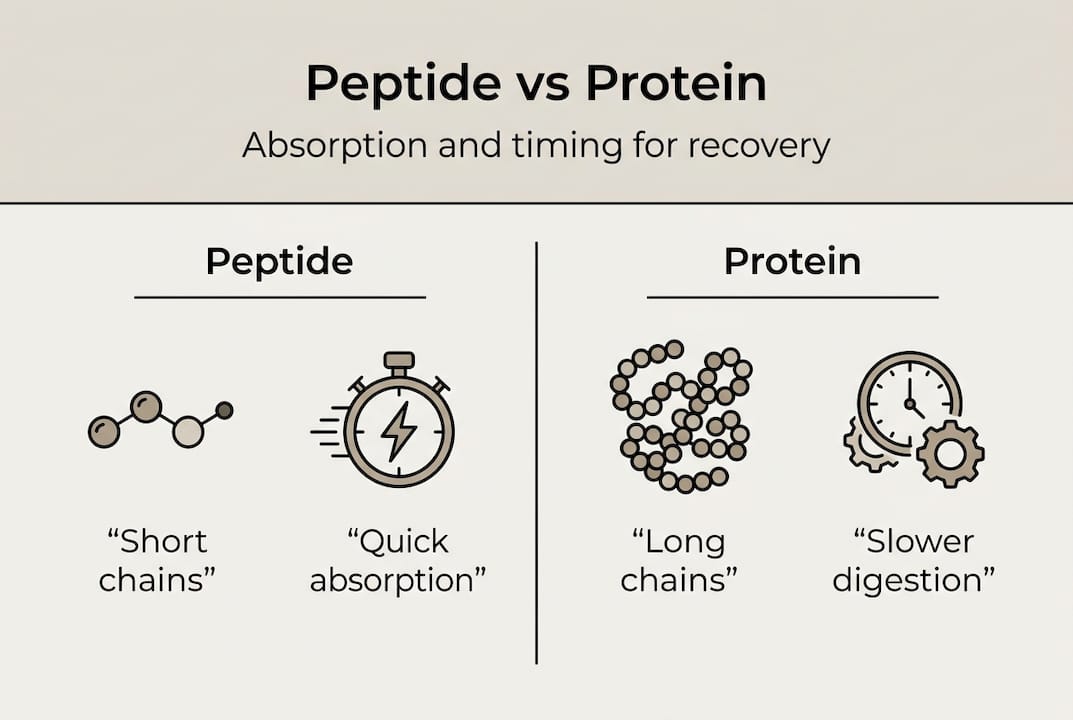
For supplementation timing, structure matters a lot. Peptides absorb faster due to their smaller size, which is why some athletes prefer them around training windows. Whole proteins take longer to digest and release amino acids more gradually.
Insulin is a fascinating edge case. It contains 51 amino acids, which technically puts it at the protein boundary, yet it is universally called a peptide hormone because of how it functions as a signaling molecule. If you want to explore how stacking different compounds can work together, stacked supplement options are worth reviewing once you understand the structural logic behind each ingredient.
Where the line blurs: the peptide-protein gray area
Here is something most supplement brands will not tell you: there is no single, universally agreed-upon number that separates a peptide from a protein. The boundary between peptides and proteins is fuzzy and varies by context, with the FDA and academic researchers using thresholds anywhere from 40 to 100 amino acids.
That ambiguity has real consequences when you are reading a supplement label or a research abstract. A product marketed as a “bioactive peptide blend” might contain molecules that most biochemists would classify as small proteins. Neither label is necessarily wrong. They are just using different conventions.
Insulin (51 amino acids) is the most cited edge case. By chain length, it sits right at the boundary. By function, it behaves like a peptide hormone. Scientists call it a peptide because of what it does, not just what it is made of.
Pro Tip: When reading supplement labels, look past the “peptide” or “protein” marketing language. Check the source ingredient (e.g., hydrolyzed collagen, whey isolate), the amino acid profile, and third-party testing certificates. Those details tell you far more than the category name.
- Check whether the product lists molecular weight or chain length
- Look for hydrolyzed or enzymatically processed ingredients, which indicate shorter chains
- Verify third-party testing for purity and potency
- Cross-reference any research cited on the label with actual human studies
- Ask whether the compound is approved for human use or still experimental
For a concrete example of how a specific peptide is characterized and dosed, the S-10 peptide details page breaks down exactly what you are getting.
Peptides and proteins in fitness and recovery
This is where the science gets both exciting and sobering. The fitness industry has built enormous hype around peptide supplements, but the research tells a more nuanced story.
Start with collagen. Hydrolyzed collagen is one of the most popular peptide supplements on the market, sold for joint support and muscle recovery. A 2024 study found that collagen peptides do not increase myofibrillar or muscle connective protein synthesis beyond free amino acids post-exercise. In other words, the peptide form of collagen did not outperform its individual amino acid components when it came to building or repairing muscle tissue.
That does not mean collagen peptides are useless. It means their benefits likely come from precursors they supply, particularly glycine and proline, rather than from any unique anabolic signaling that peptides provide over free amino acids.
Then there are experimental peptides like BPC-157, which have generated significant buzz in recovery circles. The honest picture is that these compounds lack human RCTs and FDA approval. Most of the data comes from animal models. That does not make them worthless, but it does mean you should approach them with clear eyes and realistic expectations.
Pro Tip: For post-workout recovery, prioritize total protein intake and amino acid completeness first. Peptide supplements can complement that foundation, but they should not replace it.
Here is a practical supplementation sequence for recovery:
- Consume a complete protein source (whey, casein, or plant-based blend) within 30 to 60 minutes post-training
- Add collagen peptides if joint or connective tissue support is a priority, ideally with vitamin C to support collagen synthesis
- Consider targeted peptide supplements only after your foundational protein intake is consistent and adequate
- Track your recovery markers (sleep quality, soreness, performance) to assess what is actually working
- Consult a sports nutritionist before adding experimental or unapproved peptide compounds
If you want to browse peptide options that are clearly labeled and sourced, that is a smart starting point for building your stack.
Are peptides or proteins better for athletes?
The honest answer is: it depends on what you are trying to accomplish. Neither category is universally superior. They serve different roles, and the best athletes use both strategically.
For muscle growth, whole proteins and free amino acids remain the gold standard. The research is deep, the mechanisms are well understood, and the practical results are consistent. Collagen hydrolysates provide amino acids but no unique anabolic signaling over free amino acids, so they are best viewed as a complement rather than a replacement.
For signaling and targeted recovery, peptides have a compelling theoretical case. Their faster absorption and receptor-specific activity make them interesting tools. The gap is in the human clinical data, which is still catching up to the enthusiasm.
- Prioritize complete protein intake before adding peptide supplements
- Use peptides for specific goals (joint support, signaling) rather than as a primary protein source
- Choose products from brands that publish third-party testing results
- Avoid making decisions based solely on animal study data for experimental compounds
- Always loop in a healthcare provider or sports nutritionist when adding new compounds
Pro Tip: If you are new to peptide supplementation, start with well-researched options like collagen hydrolysates before moving to experimental compounds. Build your knowledge base alongside your supplement stack.
The bottom line is that exploring peptide supplements with a clear understanding of the science puts you in a far stronger position than following trends blindly.
Discover peptide and protein solutions for your fitness goals
Now that you understand the real differences between peptides and proteins, and how the research actually applies to performance and recovery, the next step is finding products that match that standard. PrimeGen Labs offers a curated selection of high-quality peptides formulated for athletes who want transparency, purity, and science-backed sourcing. Every product is selected with quality and third-party testing in mind, so you are not guessing about what you are putting in your body.

Whether you are building a foundational recovery stack or exploring targeted peptide compounds, the full supplement shop gives you a clear view of what is available and how each product fits your goals. Start with what the science supports, and build from there.
Frequently asked questions
What is the main structural difference between peptides and proteins?
Peptides are short chains of 2 to 50 amino acids with simpler folding, while proteins have 50 or more amino acids and can fold into up to four levels of complex structure.
Are peptides more effective than proteins for muscle growth?
Not according to current research. Collagen peptides do not increase muscle protein synthesis beyond free amino acids post-exercise, making whole proteins the stronger choice for muscle building.
How do peptides and proteins absorb differently in the body?
Peptides absorb faster because of their smaller molecular size, but the overall impact on recovery and performance depends on total intake and your specific goals.
Is there a clear number of amino acids that separates peptides from proteins?
No. The boundary varies by context, with different organizations and researchers using cutoffs anywhere from 40 to 100 amino acids depending on the application.
Are experimental peptides like BPC-157 safe and legal for athletes?
BPC-157 and similar compounds lack human RCTs and FDA approval, so they should be approached with caution and discussed with a qualified healthcare provider before use.
9 thoughts on “Peptide vs protein: key differences for fitness and recovery”