

Fast shipping peptides in the USA: What you need to know


TL;DR:
- Waiting two weeks for a peptide order during a cycle can hinder recovery and lead to rushed, risky buying decisions.
- Fast shipping often masks the risk of low-quality, misbranded, or contaminated products due to the gray-market’s regulatory gray area.
- Choosing reputable suppliers with transparent testing, clear policies, and U.S. warehousing ensures safer, more reliable peptide procurement.
Waiting two weeks for a peptide order when you’re mid-cycle and your recovery is suffering isn’t just frustrating. It’s the kind of delay that pushes serious athletes into making rushed decisions, often from suppliers they know nothing about. Fast shipping has become one of the top purchase drivers in the U.S. peptide market, but most buyers focus so hard on the delivery window that they skip the questions that actually matter: Is this product what it claims to be? Is the supplier operating within legal boundaries? This guide breaks down exactly what you need to know before clicking “buy.”
Table of Contents
- Understanding the peptide shipping landscape in the USA
- How to identify reputable fast-shipping peptide suppliers
- Balancing speed with safety: Regulatory risks and health implications
- Smart purchasing practices for U.S. buyers
- The overlooked reality: Why fast shipping isn’t the only priority
- Ready to choose peptides with confidence?
- Frequently asked questions
Key Takeaways
| Point | Details |
|---|---|
| Shipping speed varies | Fast peptide shipping within the U.S. depends on both supplier practices and federal regulations. |
| Safety over speed | Always verify product quality and supplier transparency before prioritizing fast delivery. |
| Research supplier legitimacy | Look for COAs, clear U.S.-based operations, and customer support when choosing peptide sources. |
| Understand legal nuances | Many peptides are sold for research use only, and FDA import alerts can affect availability. |
| Smart practices reduce risk | Following step-by-step best practices helps protect your health and investment when buying peptides. |
Understanding the peptide shipping landscape in the USA
The U.S. peptide market has grown dramatically over the last several years. Bodybuilders, competitive athletes, and fitness-focused individuals are turning to peptides like BPC-157, TB-500, CJC-1295, and Ipamorelin to accelerate muscle recovery, improve sleep quality, and push past performance plateaus. Demand is real, and it’s rising fast.
Here’s where it gets complicated. Most peptides sold in the U.S. are labeled and marketed as “research use only” compounds. This labeling distinction matters enormously because it affects how products are legally shipped, stored, and sold. It also creates a gray area that both legitimate suppliers and bad actors operate within simultaneously.
“Grey-market procurement of peptides poses safety risks including mislabeling, improper dosing, or contamination,” according to a 2026 peptide regulation analysis, which also notes that FDA import alerts and warning letters for specific substances remain active.
Understanding the 2026 peptide regulations is not optional if you’re buying in the U.S. this year. The regulatory environment has shifted, and enforcement actions have increased. Some of the most popular peptides among bodybuilders are now explicitly named in FDA import alerts, which means shipments can be intercepted, delayed, or seized at the border.
Key regulatory factors shaping U.S. peptide shipping right now:
- FDA import alerts: Active alerts for specific compounds restrict importation and can delay or stop domestic delivery of foreign-sourced products
- Gray-market risks: Products without proper documentation can be mislabeled, underdosed, or contaminated
- Labeling requirements: “Research use only” labeling is a legal buffer, but it doesn’t guarantee product quality or purity
- Enforcement variability: The FDA’s enforcement is not uniform, which creates inconsistency in what gets through and what doesn’t
The takeaway here is simple. Fast shipping from a domestic U.S. warehouse sounds appealing, but if that warehouse is stocked with gray-market imports relabeled for domestic sale, you haven’t actually solved the problem. You’ve just moved the risk closer to your front door.
How to identify reputable fast-shipping peptide suppliers
Speed without legitimacy is worthless. A supplier who ships same-day but sells contaminated or mislabeled products is worse than a supplier who takes five days but delivers exactly what you ordered. The challenge is that the peptide market is full of companies that look credible on the surface but fall apart the moment you ask hard questions.
The grey-market procurement risks are well documented, including mislabeling, improper dosing, and contamination, with FDA import alerts and warning letters for substances like BPC-157 and TB-500 still in force. Knowing this, here’s how to evaluate suppliers before you commit.
What reputable suppliers provide:
- Certificates of Analysis (COAs): Every legitimate supplier should offer batch-specific COAs from third-party labs. If they can’t produce one, walk away.
- Clear company information: A real U.S. address, verifiable contact details, and a named team or organization. Anonymous storefronts are a red flag.
- Transparent shipping policies: Exact fulfillment windows, carrier options, and handling procedures for temperature-sensitive compounds.
- Responsive customer support: A team that answers questions about sourcing, testing, and compliance. Slow or evasive responses are warning signs.
- Consistent product documentation: Lot numbers, expiration dates, and storage instructions should accompany every order.
Supplier comparison at a glance:
| Feature | Reputable supplier | Red-flag supplier |
|---|---|---|
| COA availability | Yes, third-party verified | Missing or vague |
| Company transparency | Named team, real address | Anonymous, no physical address |
| Shipping policy | Clear timelines, carrier info | Vague or no policy listed |
| Customer service | Responsive, knowledgeable | Slow, evasive, or scripted |
| Product labeling | Accurate, compliant | Inconsistent or misleading |
| Regulatory awareness | Acknowledges gray-area status | Ignores or dismisses regulations |
Pro Tip: Before placing your first order with any supplier, send a direct message to their customer service team asking for the COA for a specific product. How fast they respond and how detailed their answer is will tell you almost everything you need to know about their operational standards.
Reviewing peptide safety tips before purchasing can also sharpen your instincts. And if you’re new to peptides or scaling up your protocol, it’s worth taking the time to consult a peptide specialist who can guide your choices based on your specific goals and health profile.
Balancing speed with safety: Regulatory risks and health implications
Once you know what to look for in a fast-shipping supplier, it’s time to weigh the potential health and legal tradeoffs that come with urgency-driven purchases.

The FDA’s enforcement posture in 2026 is more active than it was three years ago. Specific peptides have been flagged, and the ongoing FDA alerts for compounds like BPC-157 and TB-500 are not symbolic. They represent real enforcement risk for both suppliers and buyers who aren’t paying attention.
Health risks associated with gray-market peptide products:
- Contamination: Products sourced from unverified manufacturers may contain bacterial endotoxins, heavy metals, or chemical byproducts from poor synthesis
- Incorrect dosing: Mislabeled concentrations mean you could be injecting far more or far less than you intend, with unpredictable physiological effects
- Sterility failures: Peptides that require reconstitution and injection must be manufactured under sterile conditions. Gray-market products frequently skip this
- Degraded compounds: Improper storage or shipping without temperature control can degrade peptide chains, rendering them ineffective or potentially harmful
- Unknown fillers: Some products contain undisclosed excipients or binders that can trigger adverse reactions
Risk comparison by sourcing type:
| Sourcing type | Contamination risk | Dosing accuracy | Regulatory exposure |
|---|---|---|---|
| Verified U.S. supplier with COAs | Low | High | Minimal |
| Unverified domestic supplier | Moderate | Variable | Moderate |
| Gray-market import | High | Low | High |
| Anonymous online vendor | Very high | Very low | Very high |
The evidence on peptides makes it clear that when these compounds are used correctly with verified products, the performance and recovery benefits are real. But those benefits disappear entirely when the product itself is compromised.
Pro Tip: Always request the batch lot number for any peptide you purchase and cross-reference it with the supplier’s COA database. If no database exists or the lot number doesn’t match, that’s a serious red flag. Responsible peptide purchasing safety starts with this one simple verification step.
Smart purchasing practices for U.S. buyers
Balanced decision-making means knowing not only the risks, but also the most responsible way to purchase. Here’s how you can do it.
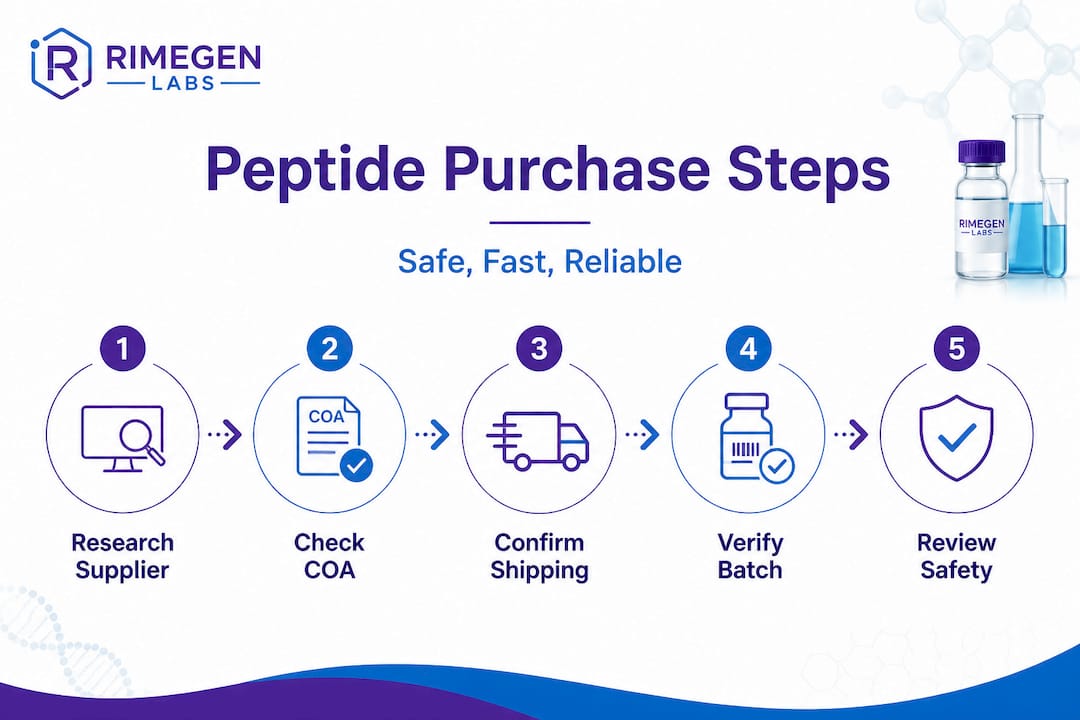
The foundation of smart peptide buying in the U.S. is research. Not a quick Google search, but genuine due diligence that covers the supplier’s background, their testing practices, and their legal compliance posture. The research use only landscape is complex, and buyers who treat it casually expose themselves to both health and legal risk.
Step-by-step purchasing checklist:
- Search for third-party reviews: Look beyond the supplier’s own website. Check independent forums, bodybuilding communities, and verified review platforms for consistent feedback over time.
- Confirm lab certifications: Ask whether the manufacturer holds ISO or GMP certifications (Good Manufacturing Practice). These indicate standardized production quality.
- Verify U.S.-based distribution: Domestic warehousing means faster shipping and fewer regulatory complications at the border. Confirm this directly, not just from marketing copy.
- Read the shipping policy in full: Look for specific transit windows, carrier names, and cold-chain handling procedures if applicable. Vague policies are a warning sign.
- Use purchase protection: Pay with a credit card or through a reputable payment gateway that offers dispute resolution. Avoid wire transfers or crypto payments with unverified vendors.
- Understand the legal framing: Knowing what “research use only” means practically helps you make informed decisions. It does not mean the product is approved for human use, and it does not protect you from enforcement if a product is explicitly banned.
What to look for in a U.S.-based supplier:
- Physical warehouse address that can be independently verified
- Documented cold-chain shipping for temperature-sensitive peptides
- Published return and refund policies
- Active social presence with real community engagement
- No claims of FDA approval or therapeutic use on the product pages
When researching peptides for performance, the quality of your information source matters as much as the quality of the product itself. Suppliers who invest in education and transparency are almost always more reliable than those who just push fast checkout.
One more thing worth emphasizing: don’t let urgency override judgment. If you’re in the middle of a training block and running low on a peptide, the pressure to reorder fast is real. But a two-day shipping upgrade from a questionable source is not worth the risk of receiving a contaminated or mislabeled product. Plan ahead, keep a buffer supply, and build a relationship with a supplier you’ve already vetted.
The overlooked reality: Why fast shipping isn’t the only priority
Most U.S. buyers spend their time comparing shipping speeds and checkout prices. Very few spend that same energy verifying the science behind the products or the integrity of the sourcing chain. That’s a mistake with real consequences.
Here’s the uncomfortable truth: fast shipping is a logistics feature, not a quality indicator. A supplier can have same-day fulfillment and still be selling you a product that’s 40% underdosed or contaminated with endotoxins. The two things have almost no relationship to each other. Fulfillment speed is about warehouse efficiency. Product quality is about manufacturing standards, third-party testing, and regulatory compliance. These are completely different operations.
The real return on investment in peptide use comes from traceable, science-backed sourcing. When you know exactly what’s in your peptide, where it was synthesized, how it was tested, and how it was stored, you can actually trust the results you’re getting. When you don’t know those things, you’re essentially running an uncontrolled experiment on your own body.
Think about it from a training perspective. You spend months dialing in your programming, your nutrition, your sleep, and your recovery protocols. Then you introduce a compound from a supplier you vetted for nothing more than their shipping speed. That’s a variable you can’t control, and it can corrupt everything else you’ve built.
The fitness results that last are the ones built on consistent, verified inputs. A legitimate peptide from a transparent supplier, even if it arrives two days later, will always outperform a fast-shipped product of unknown quality. Choose the supplier you’d trust with your long-term health, not just your current training block.
Ready to choose peptides with confidence?
You’ve done the hard work of understanding what separates a trustworthy supplier from a risky one. Now the question is where to find products that actually meet those standards.
PrimeGen Labs provides detailed performance and safety evidence alongside a curated selection of peptides backed by transparent sourcing and third-party testing. Whether you’re looking for recovery support, muscle growth optimization, or a better understanding of what each compound actually does, the muscle growth peptide guide is a strong starting point. Clear shipping policies, science-grounded product information, and responsive support make PrimeGen Labs a resource worth bookmarking before your next order.
Frequently asked questions
Are peptides legal to ship and buy in the USA?
Peptides are generally legal when labeled for research use only, but the regulatory landscape is complex and specific compounds may face restrictions depending on current enforcement actions. Always verify the status of individual compounds before purchasing.
Which popular peptides face FDA warnings or import restrictions in 2026?
BPC-157 and TB-500 are subject to active FDA import alerts and warning letters in 2026, making sourcing and shipping these compounds more legally complicated than others.
How can I verify if a peptide supplier is reputable and ships quickly?
Look for transparent company information, batch-specific Certificates of Analysis from third-party labs, documented U.S.-based shipping policies, and a customer service team that responds promptly and knowledgeably to direct questions.
Do all peptides shipped within the U.S. arrive faster than imported ones?
Domestically warehoused peptides typically arrive faster because they bypass customs and import processing, but individual supplier fulfillment speeds vary widely and should be confirmed before ordering.
Are there health risks if I choose the fastest shipping peptide option available?
Yes. Grey-market fast-shipping sources carry documented risks of mislabeling, improper dosing, and contamination, all of which can lead to ineffective results or serious health incidents regardless of how quickly the package arrives.