
Why consult a peptide specialist: results and safety


TL;DR:
- Peptides are complex compounds requiring expert oversight for safe and effective use.
- Working with a peptide specialist ensures personalized protocols, proper dosing, and lab monitoring.
- Unsupervised use poses health, legal, and efficacy risks due to unregulated sources and lack of guidance.
Peptides are not the same as protein shakes or over-the-counter supplements. They are biologically active compounds that interact with your hormones, immune response, and cellular signaling in ways that can go sideways fast when used without proper oversight. A growing number of athletes and fitness enthusiasts are sourcing peptides online and self-administering based on forum protocols, assuming that because peptides are “natural,” the risks are low. That assumption is wrong. This guide breaks down exactly what a peptide specialist provides, why the risks of going alone are real, and how to know when expert input is not optional.
Table of Contents
- What makes a peptide specialist different?
- Risks of unsupervised peptide use
- How a peptide specialist ensures your safety and results
- When should you consult a peptide specialist?
- Why most athletes underestimate the value of true peptide expertise
- Next steps: Connect with peptide expertise you can trust
- Frequently asked questions
Key Takeaways
| Point | Details |
|---|---|
| Specialist advantage | Peptide specialists provide expertise and safety far beyond general doctors, giving you personalized protocols that work. |
| Risk reduction | Unsupervised peptide use risks side effects, ineffective results, and contaminated products. |
| Whole-person optimization | The best outcomes happen when specialists tailor peptide regimens with nutrition, training, and recovery plans. |
| Evidence matters | Most peptides have limited human data; professional oversight ensures your regimen follows the best available evidence. |
What makes a peptide specialist different?
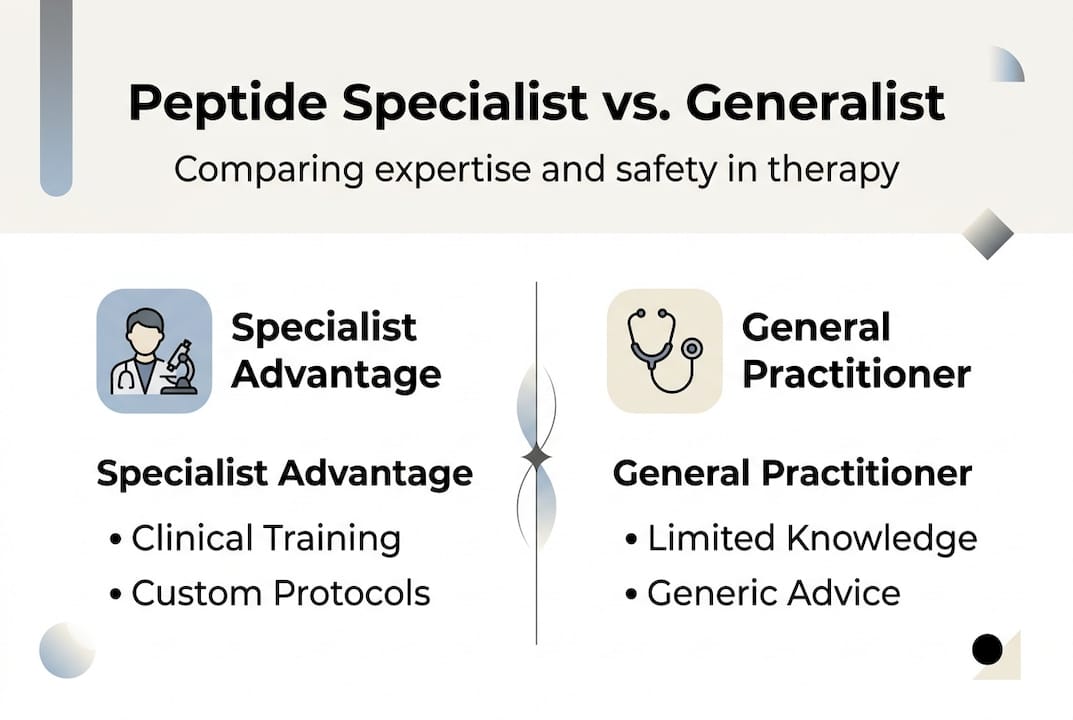
Most physicians never encounter peptide therapy during medical school or residency. It simply is not part of standard training. A peptide specialist, by contrast, has built deep, focused knowledge in peptide pharmacology, dosing strategies, biomarker monitoring, and patient safety protocols specific to these compounds. That gap in knowledge matters enormously when you are deciding who should guide your protocol.
Specialists understand how peptides behave differently depending on your health history, training load, and goals. They know peptide evidence and cautions inside out, including which compounds have solid data behind them and which are still largely experimental. General practitioners, even excellent ones, often lack this level of fluency. As noted by telehealth peptide providers, specialists possess pharmacology knowledge and dosing protocols required for safe and effective use that most GPs simply do not have.
For athletes and fitness enthusiasts specifically, a specialist adds another layer: they can individualize your protocol around your sport, your recovery cycles, your hormonal baseline, and your training phase. A bodybuilder prepping for a competition has different needs than a recreational runner recovering from a hamstring tear. A generalist cannot make those distinctions with confidence.
Here is a quick comparison of what you typically get:
| Feature | Peptide specialist | General practitioner |
|---|---|---|
| Peptide pharmacology knowledge | Deep and current | Limited or absent |
| Custom dosing protocols | Yes, based on labs and goals | Rarely available |
| Biomarker monitoring | Routine and ongoing | Not standard |
| Compounding pharmacy access | Yes, licensed sources | Uncommon |
| Sports performance integration | Core competency | Outside scope |
Key advantages of working with a true specialist include:
- Ability to stack compounds safely with an understanding of interactions
- Protocols adjusted in real time based on lab results and your feedback
- Recognition of early warning signs of adverse effects
- Guidance on safe peptide dosing that prevents the most common mistakes
- Access to pharmaceutical-grade compounds through legitimate channels
Pro Tip: The fact that someone holds an MD does not mean they are qualified to manage your peptide protocol. Ask specifically about their experience with peptide pharmacology and how many patients they have managed on these compounds before trusting their guidance.
Risks of unsupervised peptide use
Let’s be direct. The peptide market is largely unregulated in the United States, and the majority of compounds sold online as “research chemicals” are not tested for human use the way pharmaceutical drugs are. That creates serious exposure for anyone self-administering without professional oversight.

Take BPC-157 as a real-world example. Animal studies on this peptide are genuinely impressive, showing accelerated wound healing, gut repair, and anti-inflammatory effects. But quality human randomized controlled trials are almost entirely absent. Many peptides lack human RCTs, with evidence strong in animal models but limited in humans, and unregulated sources carry contamination risks that most users never consider.
Here is what you are actually risking when you go unsupervised:
- Health risks: Contamination from bacterial endotoxins, incorrect peptide sequences, improper lyophilization, and allergic reactions to fillers or preservatives
- Dosing risks: Underdosing produces no benefit while overdosing can suppress natural hormone production or trigger unwanted systemic effects
- Legal risks: Several peptides are banned substances under WADA and similar organizations, putting competitive athletes at real risk of sanctions
- Efficacy risks: Without lab monitoring, you have no way of knowing whether the compound is working, whether your body is responding appropriately, or whether you should adjust or stop
“Even compounds with strong animal data carry unknown risks in humans, especially when sourced outside clinical supply chains. The gap between animal models and human application is where most unsupervised users get hurt.”
A useful reference table for context:
| Peptide | Evidence quality | Specialist supervision required |
|---|---|---|
| CJC-1295 | Moderate (human) | Yes |
| BPC-157 | Strong (animal) | Strongly recommended |
| TB-500 | Moderate (animal) | Yes |
| Ipamorelin | Moderate (human) | Yes |
| Sermorelin | Good (human) | Yes |
A specialist mitigates every one of these risks. They verify peptide safety tips and source compounds from licensed compounding pharmacies, monitor your biomarkers to confirm the protocol is working, and can identify problems before they become serious.
How a peptide specialist ensures your safety and results
Working with a specialist is not just about getting a prescription. It is a clinical process that starts before your first dose and continues throughout your protocol. The goal is to maximize the benefit you get from these compounds while keeping every risk as low as possible.
Specialists rely on licensed 503A and 503B compounding pharmacies, which are regulated by the FDA and subject to strict quality standards. This alone eliminates most of the contamination and purity risks that plague the research chemical market. Specialist supervision mitigates risks from improper dosing, interactions, and purity issues through licensed compounding and evidence-based protocols.
Here is what the process typically looks like from first contact to ongoing care:
- Initial consultation: Full health history, current medications, training goals, and baseline labs including hormones, metabolic panels, and any relevant biomarkers
- Protocol design: Selection of peptides, dosing frequency, timing around training and sleep, and delivery method based on your specific profile
- Sourcing: Compounds ordered through a licensed compounding pharmacy with certificates of analysis
- Follow-up at 4 to 6 weeks: Labs re-checked, subjective response assessed, dosing adjusted if needed
- Ongoing monitoring: Regular check-ins tied to your training cycles and health status, not a set-and-forget approach
- Integration: Coordination with your nutrition, sleep, and improving peptide outcomes strategy for maximum effect
One thing that surprises a lot of athletes is how much bioactive peptide benefits depend on context. Timing relative to meals and workouts, the interaction between different compounds, and your hormonal environment at the time of dosing all affect outcomes significantly.
Pro Tip: If a provider offers you a peptide protocol without ordering baseline labs first, that is a red flag. A serious specialist never doses blind. Labs give them the data they need to build a protocol that is actually calibrated to your physiology.
When should you consult a peptide specialist?
Some athletes assume specialist consultation is only for beginners or people with health problems. That thinking is backwards. The more seriously you take performance and recovery, the more important expert oversight becomes.
Here are the scenarios where consulting a specialist is not just helpful but essential:
- You are new to peptides and have no established baseline or protocol
- You have a complex health history including metabolic disorders, hormonal imbalances, or prior medication interactions
- You are considering stacking multiple peptides or combining them with other performance interventions
- You have experienced side effects or unexpected results from a previous peptide cycle
- You are a competitive athlete and need to ensure compliance with anti-doping regulations
- You want to use peptides as part of a broader rehab, sleep optimization, or nutrition protocol
For athletes focused on performance and recovery, specialists provide personalized risk assessment and training-nutrition integration that no generic protocol can replicate.
There is also a perspective that applies to everyone:
“Peptides are not first-line interventions. Proven rehab strategies, quality sleep, and optimized nutrition should come first. Peptides work best as a supervised layer on top of an already solid foundation, not as a shortcut to avoid building that foundation.”
This reflects what the evidence actually supports. As research on muscle injury recovery confirms, peptides are not a replacement for established recovery methods. They are a complement to them, and only under supervision.
If you are serious about a muscle growth peptide guide approach to your training, that means building the right team around your protocol, not just reading forum posts.
Why most athletes underestimate the value of true peptide expertise
Here is an uncomfortable truth: being well-informed and being well-guided are not the same thing. Many athletes who come to peptide use have done real research. They have read studies, followed forums, and tracked other people’s results carefully. And they still make costly mistakes.
The problem is not a lack of information. It is that information without clinical context is incomplete. Online protocols do not know your hormonal baseline, your sleep quality, your stress load, or the subtle early signs that something is off. A specialist does, because they are watching in real time.
Specialists also see the adverse events and rare outcomes that forums never report. Negative experiences rarely get shared with the same enthusiasm as success stories. That survivor bias shapes what self-researchers believe is safe or effective, and it creates a false sense of security.
The honest challenge for even high-level athletes is this: true peptide expertise means researching peptides for recovery through a specialist lens, not just accumulating data points. Adaptive, personalized care catches what static protocols miss every time.
Next steps: Connect with peptide expertise you can trust
You have covered a lot of ground in this article. The case for specialist oversight is clear: better outcomes, lower risks, and protocols actually built around your physiology rather than copied from someone else’s experience.

If you are ready to take the next step, PrimeGen Labs offers trusted resources and expert-backed guidance to help you move forward with confidence. Start by learning how to improve your peptide outcomes with science-driven strategies, or get the full peptide guide for a complete picture of what is possible with the right support. Before you start any protocol, review the peptide safety essentials to make sure your foundation is solid. The expertise is here when you are ready.
Frequently asked questions
What qualifications should a peptide specialist have?
A peptide specialist should have training in peptide pharmacology and dosing protocols and ongoing patient monitoring that goes well beyond standard MD education. Look specifically for clinical experience managing peptide patients, not just familiarity with the compounds.
Are peptides safe without a specialist?
Most peptides carry real risks when used unsupervised, particularly from contamination and dosing errors. As the evidence shows, many peptides lack human RCT data, making specialist oversight essential for safe use.
When is it most important to seek a peptide specialist?
Specialist input is critical when stacking compounds, managing complex health issues, or pursuing measurable performance and recovery gains. Personalized risk assessment from a specialist is the most reliable way to protect yourself and get real results.
Can a regular doctor prescribe peptides safely?
Most general practitioners do not have the specialized knowledge or access to compounding pharmacies needed to manage peptide protocols safely. Specialists possess the pharmacology expertise and monitoring infrastructure that makes a real clinical difference.