

How to research peptides for muscle and recovery


TL;DR:
- Peptides are short amino acid chains with specific biological signaling roles, not guaranteed muscle builders.
- Reliable research sources like PubMed are essential to distinguish scientific evidence from marketing hype.
- Safety and legality risks are significant, with many peptides banned in sports and contaminated products common online.
Peptides are everywhere in fitness circles right now, and the noise is deafening. Every forum has a guru swearing by Ipamorelin, every supplement site promises “pharmaceutical-grade” results, and the actual science gets buried under marketing copy. The problem is not that peptides are useless. The problem is that most athletes have no reliable framework for separating real evidence from wishful thinking. This guide gives you that framework. You will learn how to identify credible research, evaluate safety and legal risks, and make smarter decisions without falling for the hype that dominates the peptide space in 2026.
Table of Contents
- Understand what peptides really are (and what they are not)
- Gather trusted research sources and avoid misinformation
- Evaluate safety, legality, and contamination risks
- Interpreting evidence: What matters for muscle, recovery, and performance
- The overlooked truth: Why most peptide research won’t beat the basics (yet)
- Ready to take action? Research peptides with evidence and safety in mind
- Frequently asked questions
Key Takeaways
| Point | Details |
|---|---|
| Prioritize evidence | Focus on peer-reviewed human studies, not just animal data or forum anecdotes. |
| Know the risks | Unregulated peptides carry safety, purity, and legal concerns—always verify sources and legality. |
| Compare with basics | Proven supplements like creatine and protein often outperform experimental peptides. |
| Understand regulation | Most performance-enhancing peptides are banned in sports and not FDA-approved for muscle or recovery. |
| Be skeptical, not cynical | Responsible self-experimentation requires patience, critical thinking, and using reputable guides. |
Understand what peptides really are (and what they are not)
A peptide is simply a short chain of amino acids, smaller than a full protein but capable of triggering specific biological responses. In the fitness world, most marketed peptides fall into two broad categories: those targeting the growth hormone axis and those supporting connective tissue or recovery. Knowing which category you are looking at changes everything about how you evaluate the claims.
Growth hormone releasing peptides (GHRPs) like Ipamorelin and GHRP-6 stimulate your pituitary gland to release more GH, which then influences IGF-1 production. Collagen peptides, on the other hand, are dietary fragments that support joint and tendon health. These are fundamentally different tools, yet they get lumped together constantly in marketing.
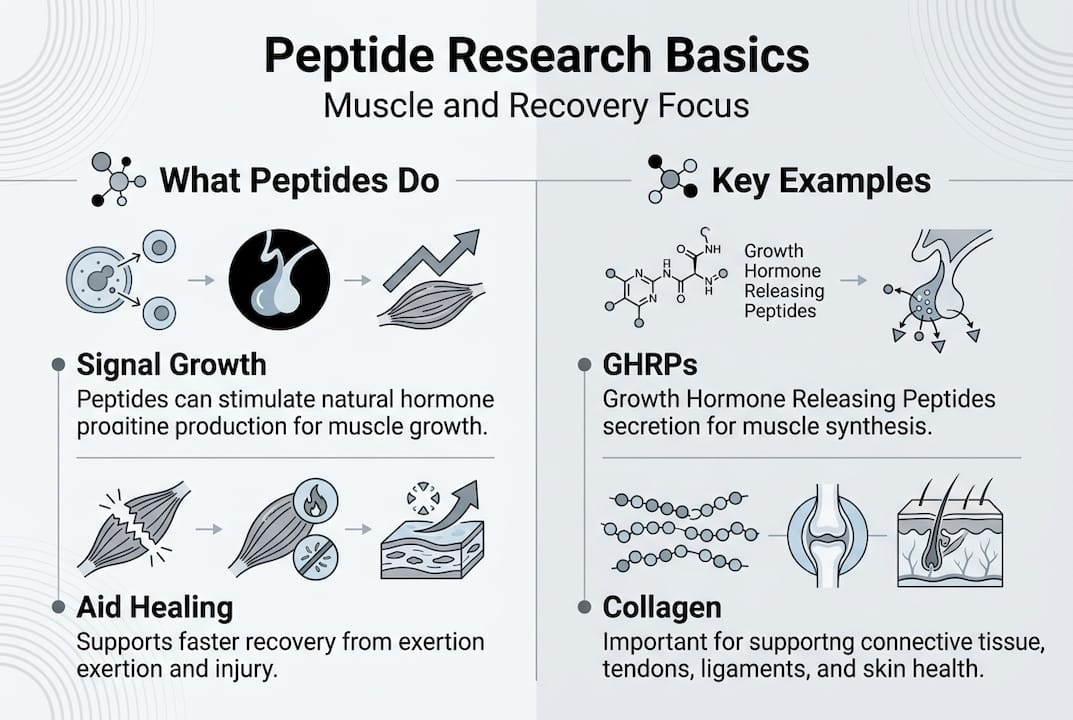
Here is where the science gets humbling. Collagen peptides aid connective tissue but do not directly cause muscle hypertrophy. GH-axis peptides like Ipamorelin show indirect muscle effects via IGF-1 in animal models, but human morphology gains remain unconfirmed. That gap between animal data and human outcomes is where most peptide hype lives.
Understanding peptide science basics before you spend a dollar is the single best investment you can make. And exploring the full range of bioactive peptide benefits helps you set realistic expectations from the start.
What peptides are:
- Short amino acid chains with specific biological signaling roles
- Potentially supportive for connective tissue, GH release, or cellular repair
- Research chemicals in most cases, not approved therapeutic drugs
- Highly context-dependent in their effects
What peptides are not:
- Guaranteed muscle builders with confirmed human hypertrophy data
- Interchangeable with anabolic steroids or proven supplements
- Regulated for purity or safety in most markets
- A shortcut that bypasses training, nutrition, or sleep
“The gap between what peptide marketing promises and what peer-reviewed science confirms is not a small one. It is the size of an entire phase of clinical trials that has not happened yet.”
Gather trusted research sources and avoid misinformation
Once you understand what peptides actually are, the next step is learning where to find reliable information and, just as importantly, where not to look. The internet is full of confident voices with no credentials and no citations.

Start with PubMed and PMC, the two most accessible databases for peer-reviewed biomedical research. Search specific peptide names alongside terms like “randomized controlled trial,” “human subjects,” or “clinical outcomes.” Use the filters to narrow results to the last five years and to human studies only. This alone will cut out the majority of noise.
The reality check is sobering. BPC-157 accelerates tendon healing by 20 to 50% in rat models, which sounds impressive until you realize there are no Phase III human trials for bodybuilding applications, and long-term safety data simply does not exist. Preclinical promise is not the same as clinical proof.
| Source type | Reliability | Why it matters |
|---|---|---|
| PubMed/PMC peer-reviewed studies | High | Vetted methodology, reproducible results |
| Government health databases | High | Regulatory and safety benchmarks |
| University research blogs | Medium | Interpretation varies, check citations |
| Fitness forums and Reddit | Low | Anecdotal, no controls, bias risk |
| Supplement brand websites | Very low | Conflict of interest, cherry-picked data |
| Single-person testimonials | Very low | No generalizability, placebo confounds |
Pro Tip: Use PubMed’s advanced search to filter by “Clinical Trial” under Article Type. If a peptide has zero clinical trials in humans, that tells you more than any forum post ever could.
Stay current on current peptide regulations because legal status affects what research even gets funded. Tracking peptide research trends also helps you spot which compounds are moving from preclinical to human trials.
Red flags that signal unreliable sources:
- No citations or references to peer-reviewed journals
- Claims based entirely on personal testimonials
- Before/after photos without controlled variables
- Blanket statements like “proven to build muscle” with no linked study
- Sites selling the product they are also reviewing
Evaluate safety, legality, and contamination risks
Research quality is only half the equation. Even if a peptide shows promise in legitimate studies, you still need to assess whether it is safe and legal for you to use. This step stops most athletes cold because the answers are rarely comfortable.
On the regulatory side, WADA bans a wide range of peptides including GHRPs and IGF-1 variants. The FDA has not approved any peptide for performance enhancement. That means if you compete in any tested sport, the risk of a positive test is real and career-ending. Check the safety tips for peptides before you make any purchasing decision.
“Pro-angiogenic effects, meaning the stimulation of new blood vessel growth, are theoretically concerning for cancer risk with compounds like BPC-157 and TB-500. This is not confirmed in humans, but it is not dismissed by researchers either. The absence of evidence is not evidence of absence.”
Purity issues lead to 15 to 25% contamination rates in online peptide markets, meaning roughly one in four products may contain incorrect dosages, bacterial endotoxins, or entirely different compounds. That is not a small risk when you are injecting something.
| Peptide type | WADA status | Main risk | FDA status |
|---|---|---|---|
| GHRPs (e.g., Ipamorelin) | Banned | Hormonal disruption | Unapproved |
| IGF-1 variants | Banned | Cancer promotion risk | Unapproved |
| BPC-157 | Not listed (2026) | Contamination, angiogenesis | Unapproved |
| Collagen peptides | Permitted | Minimal, well-tolerated | Generally recognized safe |
| TB-500 (Thymosin Beta-4) | Banned | Pro-angiogenic concern | Unapproved |
Steps to verify vendor quality:
- Request a Certificate of Analysis (COA) for every batch
- Confirm the COA comes from an independent third-party lab, not the vendor’s own testing
- Cross-reference the batch number on the COA with your specific order
- Look for HPLC purity testing showing at least 98% purity
- Check for endotoxin testing results, not just peptide identity confirmation
Pro Tip: “Research only” labels on peptide vials are not a legal shield for the seller or a safety guarantee for you. Without full documentation including third-party batch testing, that label means nothing.
Interpreting evidence: What matters for muscle, recovery, and performance
Knowing how to find and vet sources is one skill. Knowing how to read a study and extract what actually applies to your goals is another. Most athletes skip this step entirely and end up misinterpreting results.
When you open a research paper, go straight to the methods section first. Check who the subjects were (rats, healthy adults, elderly patients, injured athletes), what the intervention was, and how outcomes were measured. Self-reported outcomes like “felt stronger” or “recovered faster” are weak. Imaging-confirmed muscle cross-sectional area, force plate measurements, and validated recovery scores are strong.
Steps to interpret peptide research for real-world goals:
- Identify the subject population and ask whether it matches you
- Check the primary endpoint and confirm it measures what you care about
- Look at effect size, not just statistical significance
- Compare the result to a control group, not just baseline
- Ask whether the dosing protocol is even feasible outside a clinical setting
Pro Tip: Before adding any peptide to your research list, benchmark it against creatine and protein. Both have imaging-confirmed hypertrophy data in human trials. If a peptide cannot outperform or meaningfully complement those, it belongs lower on your priority list.
For deeper context on how specific compounds stack up, the performance evidence for peptides guide breaks down the data by compound. And if you are thinking about administration routes, the peptide bioavailability guide covers how delivery method affects what actually reaches your target tissue.
The honest summary: for muscle hypertrophy, no peptide currently has the human trial depth that creatine or protein does. For recovery and connective tissue support, collagen peptides have the most legitimate backing. For everything else, you are working with preclinical data and significant unknowns.
The overlooked truth: Why most peptide research won’t beat the basics (yet)
Here is the part most peptide content skips. The gap between what is marketed and what is proven is not closing as fast as the industry wants you to believe. Every year brings new compounds, new anecdotal reports, and the same shortage of rigorous human trials.
We have seen this pattern repeat. A peptide shows exciting animal data, forums light up, vendors stock it, and then human trials either never happen or produce modest results that do not justify the risk profile. The business model of the peptide industry does not require clinical proof. It only requires enough curiosity and hope to drive a purchase.
For bodybuilders focused on real outcomes, creatine and protein outperform unverified peptides in imaging-confirmed hypertrophy trials. That is not a knock on peptide research. It is a call to apply the same critical eye to peptides that you already apply to your training program. Follow the muscle growth science and let the evidence lead.
Skepticism is not pessimism. It is the most performance-oriented mindset you can bring to this space. When the human data catches up to the hype, and it may for certain compounds, you will be positioned to act on real evidence rather than marketing momentum.
Ready to take action? Research peptides with evidence and safety in mind
You now have the framework. The next step is putting it into practice with resources you can actually trust.

At PrimeGen Labs, we build our approach around the same principles covered in this guide: verified quality, transparent sourcing, and education-first content. Whether you want to go deeper on the muscle growth peptide guide or review the performance and benefits breakdown for specific compounds, the resources are there. When you are ready to explore products, our full peptide catalog includes batch-tested options with documentation you can verify. Research smart, then act with confidence.
Frequently asked questions
Are peptides legal for bodybuilding or sports performance in 2026?
WADA bans many peptides including GHRPs and IGF-1 variants, and the FDA has not approved any for performance enhancement, making them broadly off-limits for competitive athletes in tested sports.
Can peptides really build muscle better than creatine or protein?
Not based on current human evidence. Creatine and protein outperform unverified peptides in imaging-confirmed hypertrophy trials, making them the stronger choice for muscle growth today.
What are the hidden risks of buying peptides online?
Contamination rates of 15 to 25% in online markets mean a significant portion of products contain incorrect doses or harmful impurities, and safety testing is rarely adequate.
How can I tell if a peptide study is trustworthy?
Look for peer-reviewed human trials published in credible journals, and avoid drawing conclusions from animal-only studies or testimonials without controlled variables.
One thought on “How to research peptides for muscle and recovery”