

Peptide absorption process: Optimize recovery and performance


TL;DR:
- Most oral peptide supplements face significant biological barriers that limit their systemic absorption and effectiveness. Di- and tri-peptides are absorbed more efficiently via PepT1 transporters, but longer peptides are heavily degraded before reaching circulation. To improve uptake, strategies like formulation enhancements and delivery routes are necessary, but many products still cannot reliably deliver peptides systemically through oral administration.
Most athletes swallow peptide supplements expecting direct muscle benefits, but the reality is far more complicated. The peptide absorption process is riddled with biological obstacles that the fitness industry rarely discusses openly. Enzymatic degradation, limited intestinal permeability, and transport bottlenecks mean that a large percentage of what you consume never actually reaches your muscles. Understanding exactly how peptides move through your body, and where they fail to, gives you a real advantage in building an effective supplementation and recovery strategy.
Table of Contents
- The science behind peptide absorption
- Oral vs. non-oral absorption routes
- Mechanism details: What happens during the peptide absorption process?
- Strategies to enhance peptide absorption
- A fitness-focused perspective: The uncomfortable truth about peptide absorption
- Unlock advanced peptide solutions for performance and recovery
- Frequently asked questions
Key Takeaways
| Point | Details |
|---|---|
| Oral challenges | Most systemic peptides have extremely low oral absorption due to digestive and barrier limitations. |
| PepT1 transport | Small peptides are absorbed via PepT1 but not all peptides reach muscles for recovery benefits. |
| Route matters | Choosing the right administration route is crucial for effective peptide supplementation. |
| Enhancement strategies | Enzyme inhibitors and formulation tricks help but rarely solve oral bioavailability issues completely. |
| Rational selection | Use scientific evidence—not hype—when picking peptide supplements for performance and recovery. |
The science behind peptide absorption
Peptides are short chains of amino acids, typically between 2 and 50 amino acids long. They’re smaller than full proteins but larger than free amino acids, and that in-between size is exactly what makes their absorption so complicated. For muscle recovery, peptides matter because many bioactive peptides directly signal tissue repair, stimulate growth hormone release, and support anabolic processes throughout your body. You can read more in our muscle growth and recovery guide to see how specific peptides interact with recovery pathways.
The core challenge is this: your gut was designed to absorb nutrients, not to deliver intact complex molecules straight into your bloodstream. Digestion breaks most peptides down further before they can even reach intestinal cells. When they do reach those cells, their size determines whether they can cross at all.
Here’s what the research tells us about how absorption actually works:
- Di-peptides and tri-peptides (chains of two or three amino acids) are the primary units your gut can efficiently absorb intact.
- Larger peptides face increasing degradation and permeability barriers the longer their chain becomes.
- PepT1 transporters are the main gateway for small peptide uptake at the intestinal lining.
- Free amino acids use separate transport channels, meaning broken-down peptides still enter your system but not in their bioactive form.
- Molecular charge and shape affect how well any individual peptide interacts with transport proteins.
“Dietary proteins are digested into di-/tripeptides and free amino acids, and di-/tripeptides can be absorbed into enterocytes via the proton-dependent peptide transporter PepT1.”
PepT1 is a proton-coupled transporter sitting on the brush border membrane of intestinal cells. It works fast, has high capacity, and handles an enormous variety of di- and tri-peptide structures. But here’s the critical limitation: it is highly selective by size. Anything longer than three amino acids generally cannot use this route efficiently.
Beyond PepT1, transport by PepT1 is the key mechanistic route for small peptide absorption, though experimental research does suggest that other transporter-linked mechanisms can contribute to blood appearance of certain peptides. These secondary pathways are far less efficient and less predictable, which is why the fitness world should not rely on them.
Understanding the peptide vs protein differences helps you see why peptide supplements and protein powders serve fundamentally different physiological roles, even though both start as amino acid sources.
Oral vs. non-oral absorption routes
Now that we’ve defined how peptide absorption works at the cellular level, let’s break down how different administration routes affect how much of a peptide actually reaches your bloodstream and muscles.
| Route | Typical bioavailability | Main barrier | Fitness use case |
|---|---|---|---|
| Oral (swallowed) | Often less than 1 to 2% for systemic peptides | Enzymatic degradation plus intestinal wall | Dietary peptides, some collagen products |
| Buccal (under tongue or cheek) | Moderate, highly formulation-dependent | Mucosal epithelial membrane | Experimental, some hormone-related peptides |
| Subcutaneous injection | High, generally above 90% | Minimal, bypasses GI entirely | Research peptides, medical applications |
| Intravenous | Near 100% | None, direct blood delivery | Clinical and research settings only |
For most fitness-focused individuals, oral is the dominant route because it’s accessible and convenient. But oral bioavailability for many peptides is often extremely low because peptides must first survive enzymatic degradation in the GI tract and then achieve limited epithelial permeability, even under optimized conditions.
This is not a minor issue. It means that the majority of the peptide you ingest is dismantled before it can do anything systemic. What you may feel from an oral peptide supplement is often the effect of free amino acids produced during digestion, not intact bioactive peptides at all.
Buccal delivery sidesteps part of the GI problem by absorbing through oral mucosa directly into nearby blood vessels. But buccal absorption is still limited by epithelial permeability, though engineered devices applying physical and transport-enhancing mechanisms can improve this. Think of specialized patches, gels, or films that physically open absorption channels. These are real technologies used in pharmaceutical research but remain far from mainstream fitness supplement products.
For practical purposes:
- Oral peptide supplements are best suited for dietary peptides like collagen hydrolysates where partial digestion still provides useful amino acid building blocks.
- Buccal delivery holds promise for small, fast-acting peptides where systemic delivery speed matters.
- Injectable routes deliver the highest consistency and bioavailability for research-grade or medical-grade peptides.
You can explore how specific muscle performance recovery peptides are typically administered and why route choice directly shapes expected outcomes.
Pro Tip: If you’re evaluating a peptide supplement, always ask which route it uses and check whether published data supports systemic delivery at that dose via that route. Most marketing skips this critical detail entirely.
The practical implication for you as a fitness athlete is clear. If a supplement promises systemic performance enhancement through an oral peptide product with no formulation technology, treat that claim with healthy skepticism. The biology simply doesn’t support it without significant engineering.
Mechanism details: What happens during the peptide absorption process?
With the administration routes compared, let’s look closely at the molecular journey of a peptide from the moment you swallow it to the point where it either reaches your tissues or gets destroyed along the way.
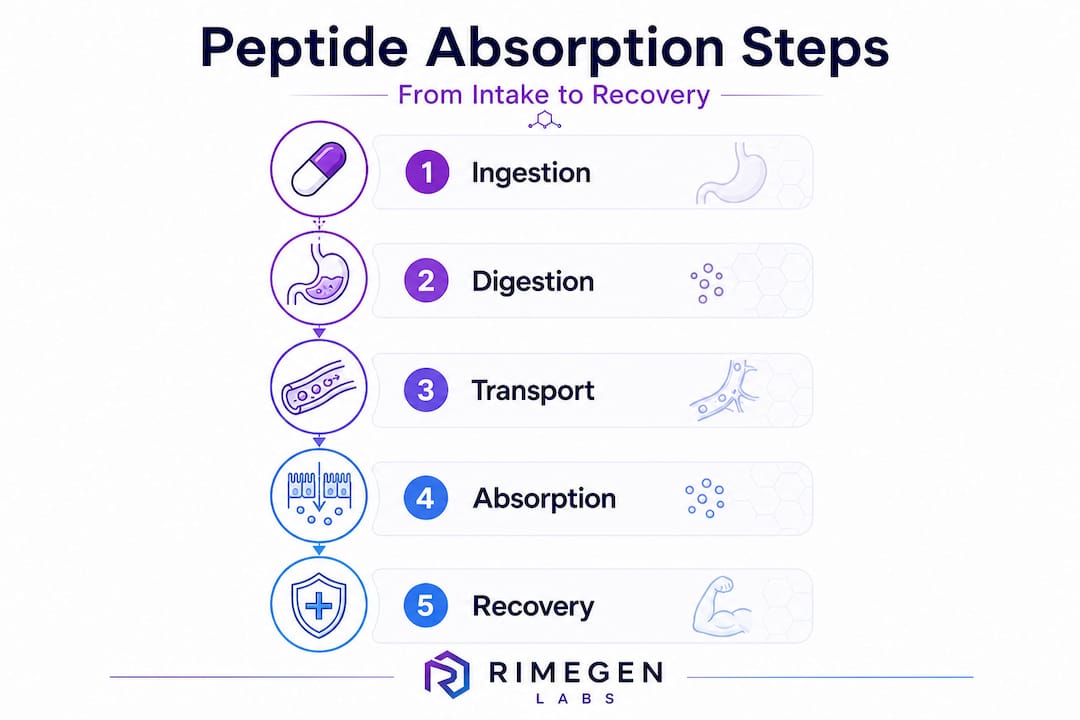
Step-by-step breakdown of oral peptide absorption:
- Gastric phase: Stomach acid and pepsin begin breaking peptide bonds immediately, reducing protein chains into smaller fragments.
- Duodenal phase: Pancreatic enzymes including trypsin, chymotrypsin, and elastase continue hydrolysis, generating a mix of di-peptides, tri-peptides, and free amino acids.
- Brush border phase: Enzymes on the surface of intestinal cells, called peptidases, cleave many remaining peptides into free amino acids before they can be transported.
- PepT1 transport: Di- and tri-peptides that survive reach PepT1 on enterocyte surfaces, where they are actively transported into intestinal cells.
- Intracellular fate: Once inside the cell, many peptides are further hydrolyzed by cytoplasmic peptidases into free amino acids before reaching the bloodstream.
- Portal circulation: What survives this process enters portal blood and travels to the liver, where additional metabolism can occur.
The gut is remarkably efficient at digestion, and that’s actually the core problem for fitness peptide use. Di-/tripeptides are absorbed into enterocytes via PepT1, but longer, more complex peptides with specific bioactive sequences often don’t survive long enough to be transported intact.
| Peptide size | Likely fate in GI tract | Probability of intact absorption |
|---|---|---|
| Di-peptide (2 AA) | PepT1 transport, moderate cellular survival | Moderate to high |
| Tri-peptide (3 AA) | PepT1 transport, partial cellular survival | Moderate |
| 4 to 10 AA peptide | Extensive brush border degradation | Low |
| Greater than 10 AA peptide | Near-complete degradation before transport | Very low without formulation aids |
Beyond PepT1, experimental work supports transporter-linked mechanisms that can include routes beyond PepT1 alone, meaning some peptides may find alternative pathways, particularly paracellular routes or transcytosis. But these remain unpredictable and cannot be relied upon for consistent dosing outcomes.
Pro Tip: Focus on collagen di-peptides and tri-peptides, such as hydroxyproline-glycine, which have demonstrated measurable blood appearance after oral ingestion. These are among the few oral peptide forms with solid absorption data for fitness applications. For more on this, explore our guide on peptide bioavailability tips and the role of bioactive peptide benefits in practical training contexts.
Strategies to enhance peptide absorption
Understanding the obstacles, you can now make smarter choices. There are real, evidence-backed strategies that researchers and formulators use to improve how much of a peptide actually gets into your system.
Key enhancement strategies include:
- Enzyme inhibitors: Co-administered compounds that reduce proteolytic activity in the GI tract, giving peptides more time before they’re broken down. These are used experimentally but not common in consumer products yet.
- pH modulation: Some peptides are more stable in specific pH environments. Enteric coatings on capsules can help peptides survive stomach acid and reach the small intestine less degraded.
- Chemical modifications: Techniques like PEGylation (adding polyethylene glycol chains) or N-methylation of peptide bonds reduce enzymatic susceptibility without necessarily destroying bioactivity.
- Nanoparticle encapsulation: Lipid nanoparticles, polymeric nanoparticles, and liposomes can physically protect peptides and improve mucosal permeability.
- Permeation enhancers: Compounds that temporarily loosen tight junctions between intestinal cells, increasing paracellular absorption. These include certain fatty acids and chitosan derivatives.
- Cyclization: Cyclic peptides are structurally more resistant to enzymatic cleavage compared to their linear counterparts.
Delivery strategy research emphasizes both protection against enzymatic degradation and methods to enhance permeation across intestinal barriers, because neither approach alone solves the full absorption problem.
This is where understanding how to improve peptide outcomes becomes practically useful. Choosing a well-formulated product over a raw peptide powder can make a measurable difference in what you actually absorb and what your body can use for recovery.
A key distinction that researchers call the “route triage” problem is worth knowing: some peptides are intrinsically unsuitable for oral delivery regardless of formulation improvements, because their pharmacokinetic profiles are simply incompatible with that route. No amount of encapsulation will fix a peptide whose systemic half-life is measured in seconds and whose absorption window is vanishingly narrow.
Pro Tip: When researching peptide supplements, look for products that specify formulation technology rather than just listing the peptide name. A well-formulated tri-peptide product will consistently outperform a poorly formulated longer-chain peptide product, even if the longer chain has more impressive-sounding bioactivity on paper.
A fitness-focused perspective: The uncomfortable truth about peptide absorption
Here’s what the supplement industry won’t put on the label: most oral peptide products are not delivering what they claim to deliver systemically. After years of watching the fitness community chase the next recovery shortcut, the pattern is always the same. A peptide with fascinating research gets packaged into a capsule, and suddenly it’s marketed as a recovery revolution. The absorption science never gets discussed.
The inconvenient reality is that peptide recovery and performance expectations should be tempered for oral ingestion because most systemic-acting peptides face low and variable systemic exposure, even when absorption enhancers and formulation improvements are used. Variable is the key word. Even on your best absorption day, you cannot predict how much of an oral peptide is actually reaching your target tissues.
This doesn’t mean peptide supplementation is useless. It means you need a rational framework. Dietary peptides from collagen hydrolysates, certain dairy-derived peptides, and specifically engineered small peptide formulations do have meaningful, documented effects. But those effects operate through different mechanisms than what most marketing implies.
A given peptide’s pharmacokinetic constraints can make oral delivery intrinsically untenable even with formulation advances. Understanding this prevents you from spending months and significant money on a product that is, by its own biology, unable to deliver systemic results via the oral route.
Our honest recommendation is to approach peptide selection with the same rigor you bring to your training program. Ask for evidence. Check the administration route used in the studies. Look for formulation transparency. A solid science-backed peptide guide is your best starting point for cutting through the noise and making decisions grounded in how peptides actually work inside your body.
Unlock advanced peptide solutions for performance and recovery
After clarifying the science and realistic expectations, you might want to explore more targeted solutions and resources for peptide-based performance and recovery.
At Primegen Labs, we’ve built our resources specifically for athletes who want to understand what they’re putting in their bodies before committing to a supplementation protocol. Our guides connect the biological mechanics of peptide absorption to real fitness outcomes, giving you clarity rather than hype. Explore our deep-dive on research peptides for muscle recovery, review the evidence on peptides and performance to weigh benefits and cautions side by side, and use our muscle growth and recovery science resource to build a protocol that actually makes biological sense for your training goals.
Frequently asked questions
Why is oral peptide bioavailability so low?
Oral bioavailability is extremely low because most peptides are broken down by digestive enzymes before they reach the intestinal wall, and even surviving fragments often can’t cross the epithelial barrier into the bloodstream at meaningful concentrations.
Can dietary peptides boost muscle recovery better than protein powders?
Dietary proteins are digested into di-/tripeptides that can be absorbed via PepT1, making small peptides from hydrolyzed sources potentially faster-acting than intact protein powders, though protein powders still provide the full range of amino acids your muscles need over time.
What absorption strategies really improve peptide uptake?
Delivery strategy research shows that combining enzymatic protection with permeation enhancers offers the best results, though no single strategy guarantees high oral bioavailability for every peptide type.
Are buccal or injectable routes better for peptide supplementation?
Buccal absorption is limited by epithelial permeability but is significantly better than oral for many peptides, while injectable routes consistently deliver the highest systemic exposure by bypassing GI barriers altogether.
How do I choose a peptide supplement for my fitness goals?
Match the peptide’s documented absorption route to your actual goal, prioritize products with published formulation technology, and verify that the clinical evidence for the peptide uses the same delivery route the product actually provides.