

What Are Nootropic Peptides? a 2026 Science Guide


TL;DR:
- Nootropic peptides are short amino acid chains that modulate neuronal signaling to enhance cognition and protect brain tissue. They operate at the receptor and neurotrophic levels, offering high potency but requiring proper administration and supervision. Their effectiveness depends on careful sourcing, personalized protocols, and integration with fundamental health practices.
Nootropic peptides are among the most discussed yet least understood tools in cognitive enhancement today. If you’ve been researching ways to sharpen focus, protect memory, or reduce mental fatigue, you’ve likely come across these compounds without a clear explanation of what separates them from a standard supplement stack. Unlike caffeine or herbal adaptogens, nootropic peptides operate at the molecular level, interacting directly with the brain’s signaling infrastructure. This guide cuts through the noise and gives you the science, the examples, and the practical considerations you need to make sense of them.
Table of Contents
- Key takeaways
- What are nootropic peptides and how do they work?
- Examples of nootropic peptides for fitness and mental performance
- The molecular science behind cognitive enhancement
- Safety, regulations, and practical considerations
- Nootropic peptides vs. other cognitive enhancers
- My honest take on the peptide hype
- Explore Primegenlabs’ peptide resources
- FAQ
Key takeaways
| Point | Details |
|---|---|
| Peptides are not supplements | Nootropic peptides are amino acid chains that target neuronal signaling, not broad nutritional support. |
| Potency varies dramatically | Noopept is roughly 1,000 times more potent than piracetam, requiring milligram rather than gram dosing. |
| Delivery method matters | Most nootropic peptides require intranasal or injectable administration due to poor oral bioavailability. |
| Regulatory status is uneven | Semax and Selank are approved in Russia; most others remain unregulated research compounds outside clinical settings. |
| Medical supervision is non-negotiable | Baseline health testing and professional guidance are required before starting any peptide protocol. |
What are nootropic peptides and how do they work?
Nootropic peptides are short amino acid chains that modulate neuronal signaling pathways to enhance cognition and protect brain tissue. “Short” matters here. Standard proteins can contain hundreds of amino acids; these peptides typically contain between two and fifteen. That compact structure allows them to cross biological barriers, interact with specific receptors, and influence neurotransmitter systems in ways that larger molecules simply cannot.
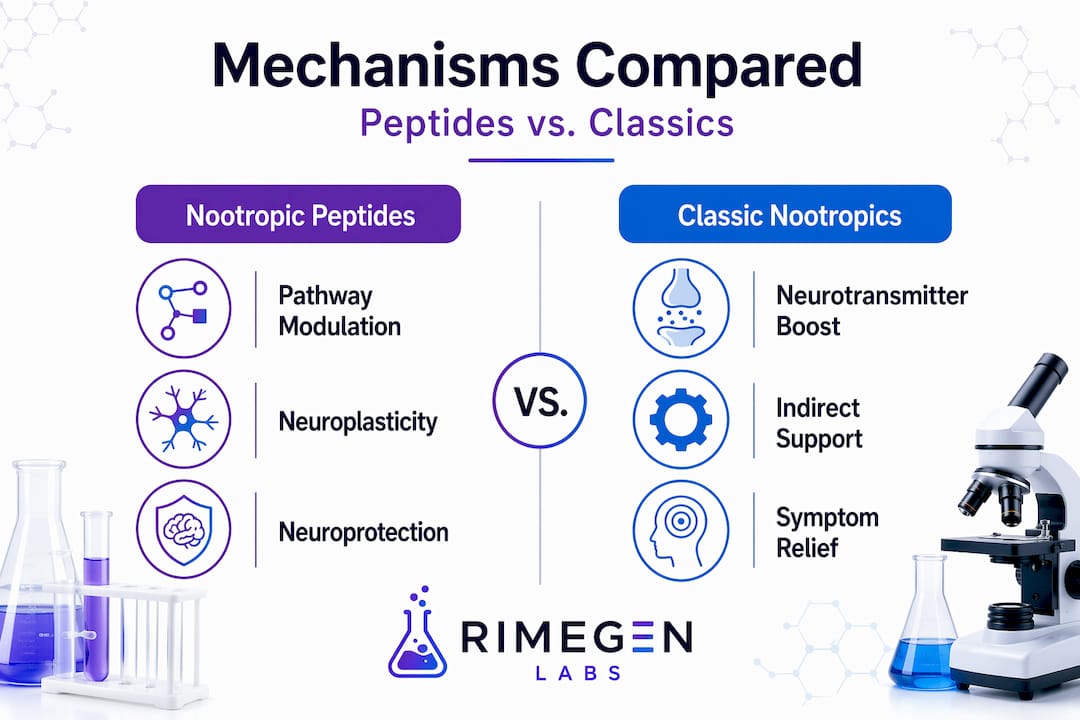
The key distinction from traditional nootropics is mechanism. Most classic cognitive enhancers work by broadly increasing neurotransmitter availability or blocking reuptake. Nootropic peptides go further. They can upregulate neurotrophic growth factors, modulate receptor sensitivity, and promote synaptic plasticity at the cellular level.
The most studied nootropic peptides
Here is a breakdown of the peptides researchers and clinicians most commonly reference when discussing nootropic peptides for cognitive enhancement:
- Semax: A synthetic derivative of ACTH that acts on MC3R/MC4R receptors and upregulates BDNF and NGF. Approved in Russia. Administered intranasally.
- Selank: Modulates GABA-A receptors and serotonin levels. Used clinically in Russia for anxiety and cognitive support. Administered intranasally.
- Noopept (Omberacetam): A synthetic dipeptide with pronounced effects on memory consolidation and neuroprotection. Approved in Russia as a prescription drug since 2006.
- Dihexa: Binds to HGF/c-Met pathways and shows strong neurogenic activity in animal models. No human trials completed.
- P21: A CNTF-derived peptide studied for its ability to promote neurogenesis. Primarily a research compound.
| Peptide | Primary mechanism | Administration | Regulatory status |
|---|---|---|---|
| Semax | BDNF/NGF upregulation, MC3R/MC4R | Intranasal | Approved in Russia |
| Selank | GABA-A modulation, serotonin | Intranasal | Approved in Russia |
| Noopept | Acetylcholine/glutamate modulation | Oral, intranasal | Approved in Russia |
| Dihexa | HGF/c-Met receptor binding | Subcutaneous | Research only |
| P21 | CNTF receptor pathway | Subcutaneous | Research only |
Pro Tip: If you are new to this space, start with peptides that have the longest human use history. Semax and Selank have decades of clinical use in Russia, which gives them a stronger safety record than newer research compounds like Dihexa.
Examples of nootropic peptides for fitness and mental performance
When people ask about examples of nootropic peptides fitness applications, the conversation usually centers on output: better focus during training, faster cognitive recovery after intense sessions, and sharper decision-making under physical stress.
Noopept is the most referenced starting point. Developed in 1996 and approved in Russia since 2006), it is roughly 1,000 times more potent than piracetam, the original racetam nootropic. That means effective doses sit around 10 to 30 mg versus the 1,200 to 4,800 mg typically required with piracetam. For practical use, that difference is significant.
The reported benefits of nootropic peptides across cognitive and fitness contexts include:
- Improved working memory: Users report faster recall and better information retention during cognitively demanding tasks.
- Reduced anxiety under load: Selank in particular is reported to lower generalized anxiety without sedation, which supports focus during high-pressure performance scenarios.
- Neuroprotection after exertion: Physical stress creates oxidative load on brain tissue. Several nootropic peptides appear to reduce that damage by upregulating protective signaling factors.
- Enhanced learning capacity: BDNF upregulation, triggered by peptides like Semax, is directly tied to the brain’s ability to form and consolidate new information.
- Mental clarity and stamina: Users in biohacking communities frequently stack peptides with other compounds to sustain mental clarity over extended work sessions.
One pattern seen consistently in wellness and biohacking contexts is combination use. Rather than relying on a single peptide, practitioners often pair compounds for complementary effects. For example, Semax for focus and neurotrophin support alongside Selank for anxiolytic effects creates a profile that addresses both cognitive drive and stress resilience simultaneously. Consulting a peptide specialist’s guidance before stacking is strongly recommended.
The molecular science behind cognitive enhancement
Nootropic peptides influence neuroplasticity, neuroprotection, neurotransmitter balance, and receptor modulation to improve learning, memory, and mental clarity. That sentence covers a lot of ground, so it’s worth unpacking each pathway.

Neurotransmitter modulation is where most people start. Noopept increases acetylcholine activity and modulates glutamate receptors. Acetylcholine is the primary neurotransmitter for learning and memory formation. Glutamate governs synaptic plasticity, the brain’s ability to strengthen connections through repeated use. When these systems are running efficiently, your ability to acquire and retain information improves measurably.
Neurotrophic factors are where nootropic peptides separate themselves from most other cognitive tools. BDNF (brain-derived neurotrophic factor) and NGF (nerve growth factor) are proteins that support neuron survival, growth, and differentiation. Most nootropic supplements cannot meaningfully raise BDNF levels. Semax can. That distinction is scientifically significant.
Neuroprotection is the third major mechanism. Several of these peptides demonstrate antioxidant properties and reduce neuroinflammation, which matters more for long-term cognitive health than any short-term boost.
Pro Tip: Think of neurotrophic factors as the brain’s maintenance crew. Raising BDNF through peptide use is not just about feeling sharper today. It’s about preserving the structural integrity of your neural networks over time. That longer view is what separates serious cognitive enhancement from stimulant-driven performance.
Safety, regulations, and practical considerations
This is where clarity matters most. FDA-approved therapeutic peptides differ significantly from research-grade nootropic peptides, and consumers need to understand that line before starting any protocol.
Semax and Selank have established clinical use histories in Russia. Most other compounds in this category, including Dihexa and P21, remain research compounds without completed human trials. That does not mean they are dangerous, but it does mean the risk-benefit calculation rests on limited data.
Known side effects and practical concerns include:
- Injection site reactions: Subcutaneous administration can cause localized redness, swelling, or discomfort.
- Hormonal fluctuation: Some peptides can affect cortisol or serotonin systems, requiring monitoring in sensitive individuals.
- Mood shifts: Users report elevated mood with some peptides and irritability during discontinuation.
- Interaction risk: Combining nootropic peptides with prescription medications is poorly studied and requires physician oversight.
- Sourcing quality: Because most nootropic peptides are sold as research compounds, purity varies significantly by supplier. Contamination is a real risk without proper peptide safety practices.
Cognitive peptide costs can reach around $350 per vial depending on the compound and dosing schedule, which makes sourcing decisions financially significant as well.
Administration also creates a learning curve. Most nootropic peptides require intranasal or injectable routes due to poor oral bioavailability and rapid degradation in the bloodstream. That is a meaningful barrier for people accustomed to capsule-based supplements.
Pro Tip: Before starting any peptide protocol, baseline health marker testing covering liver function, kidney function, and standard longevity panels is non-negotiable. These tests can surface issues that would make certain peptides risky for your specific biology, and they give you a reference point to measure results against.
Nootropic peptides vs. other cognitive enhancers
Understanding what nootropic peptides are requires knowing what they are not. The cognitive enhancement category spans four broad types of compounds, and each operates differently.
| Category | Examples | Mechanism | Bioavailability | Regulatory status |
|---|---|---|---|---|
| Dietary supplements | Lion’s mane, bacopa | Indirect neurotrophin support | High (oral) | OTC, unregulated |
| Racetams | Piracetam, aniracetam | Acetylcholine/glutamate modulation | High (oral) | Gray market in US |
| Nootropic peptides | Semax, Noopept, Selank | Receptor binding, neurotrophins | Low (oral), requires alternative route | Varies by country |
| Prescription stimulants | Modafinil, Adderall | Dopamine/norepinephrine | High (oral) | Prescription only |
The practical takeaway from this comparison is nuanced. Supplements like lion’s mane offer indirect BDNF support through oral use with minimal side effects. They are a reasonable starting point for most people. Racetams offer more targeted acetylcholine activity with good oral bioavailability but modest potency. Nootropic peptides offer the highest mechanistic specificity and potency, but they require more careful handling, administration expertise, and access to quality-controlled sources.
Prescription stimulants work, but they address symptom management rather than building underlying cognitive capacity. They are borrowed energy. Nootropic peptides, at their best, aim to build.
Who benefits most from peptides? People who have already optimized sleep, nutrition, and training and want to push into the next level of cognitive performance. People managing post-injury cognitive recovery. Clinically supervised patients working on age-related cognitive decline. For general wellness, natural nootropic peptides like Semax and Selank offer the best evidence-to-risk ratio in this class.
My honest take on the peptide hype
I’ve spent years watching the cognitive enhancement space cycle through waves of enthusiasm, and nootropic peptides are riding a particularly steep one right now. Let me share what I actually think.
The science is real. The mechanisms are not theoretical. BDNF upregulation, receptor-level modulation, and synaptic plasticity effects are documented in serious research. Medical experts confirm that personalized, supervised peptide therapy produces better outcomes than self-directed biohacking, and that matches everything I’ve seen.
What concerns me is the framing. Most people who ask about the best nootropic peptides are looking for a shortcut past the harder work of sleep quality, stress management, and cardiovascular health. Those fundamentals drive BDNF production naturally. A peptide that upregulates BDNF on top of a solid foundation? That’s worth exploring. A peptide used to compensate for chronic sleep deprivation and a poor diet? That’s just expensive noise.
My practical advice is this: if you’re genuinely considering nootropic peptides for cognitive enhancement, take the unsexy step first. Get your baseline panels done. Review what’s already limiting your cognition. Then explore peptides as a precision tool within a broader protocol, not as the whole strategy. The compounds are interesting. The research is promising. But the people who get the best results are the ones who respect both the potential and the limits.
— Yvette
Explore Primegenlabs’ peptide resources
If you’ve read this far, you’re past the “just curious” stage. You’re researching seriously, and that means you need resources that match that standard.

At Primegenlabs, we’ve built a library of evidence-based guides specifically for people at this stage of research. Whether you’re preparing for your first peptide protocol or refining an existing one, our peptide performance overview covers the clinical context, safety considerations, and practical application of the compounds discussed in this article. For those still building foundational knowledge, the science-backed peptide guide is an ideal next step. Our content is written by people who take the science seriously because you do too. Explore the full Primegenlabs resource library and build your protocol on solid ground.
FAQ
What are nootropic peptides in simple terms?
Nootropic peptides are short chains of amino acids that interact with brain signaling systems to support cognitive function, memory, and neuroprotection. Unlike standard supplements, they work directly at the receptor and neurotransmitter level.
Are nootropic peptides safe to use?
Safety depends heavily on the compound, dosage, source quality, and individual health status. Peptides like Semax and Selank have established clinical use histories, while others remain research compounds. Medical supervision and baseline health testing are strongly recommended before use.
How are nootropic peptides different from racetams?
Racetams primarily modulate acetylcholine and glutamate receptors through oral dosing. Nootropic peptides offer greater mechanistic specificity, including neurotrophic factor upregulation, but require intranasal or injectable administration due to low oral bioavailability.
What are the most researched nootropic peptides?
Semax, Selank, and Noopept have the strongest research and clinical use records. Semax and Selank are approved prescriptions in Russia. Noopept has been in clinical use since 2006 with documented effects on memory and neuroprotection.
Can nootropic peptides help with fitness performance?
Yes, in the context of cognitive fitness. Improved focus, reduced anxiety under physical stress, and neuroprotection from oxidative exertion load are among the reported benefits. They do not replace physical training but can support the mental demands that surround it.