
What Is a Pegylated Peptide? Benefits and Uses Explained


TL;DR:
- Pegylated peptides are standard peptides chemically modified with polyethylene glycol (PEG) chains, significantly extending their half-life and stability. This modification allows for fewer injections and improved circulation by shielding the peptide from enzymatic degradation and immune clearance. However, excessive PEGylation can hinder receptor binding, and repeated use may provoke immune responses, necessitating informed application and sourcing.
If you’ve spent time researching peptides for fitness, weight loss, or therapeutic purposes, you’ve likely encountered the term “pegylated peptide” and wondered what separates it from a standard peptide. The short answer is chemistry. A pegylated peptide is a standard peptide that has been chemically modified by attaching polyethylene glycol (PEG) chains to its structure, a process known as PEGylation. This modification changes how the peptide behaves in the body in ways that matter significantly for dosing, effectiveness, and longevity. Understanding PEGylation helps you make sense of why certain peptides perform so differently from their unmodified counterparts.
Table of Contents
- Key Takeaways
- What PEGylation is and how it works
- How pegylated peptides work in the body
- Benefits and trade-offs of pegylated peptides
- Applications of pegylated peptides in therapy and fitness
- My take: what most people miss about pegylated peptides
- Explore pegylated peptide options at Primegenlabs
- FAQ
Key Takeaways
| Point | Details |
|---|---|
| PEGylation is a chemical process | PEG chains are covalently attached to peptides to improve stability and half-life. |
| Half-life extends dramatically | Modified peptides can last days in the body instead of minutes, reducing dosing frequency. |
| Stealth effect reduces immune clearance | PEG chains shield peptides from immune detection, improving circulation time. |
| Trade-offs exist | Steric hindrance and anti-PEG antibodies are real risks that affect efficacy over time. |
| Real-world examples confirm benefits | CJC-1295 DAC and PEG-MGF demonstrate practical gains in fitness and muscle repair contexts. |
What PEGylation is and how it works
PEGylation is the process of covalently bonding one or more polyethylene glycol chains to a peptide molecule. PEG itself is a water-soluble, non-toxic polymer made up of repeating ethylene oxide units. It is biologically inert, meaning it does not trigger a reaction on its own, which makes it an ideal candidate for pharmaceutical modifications.
The PEG chains attached during this process typically range from 2 kDa to 40 kDa in molecular weight. Smaller chains (2 to 5 kDa) are often used when you want minimal steric interference with the peptide’s function. Larger chains (20 to 40 kDa) offer stronger shielding and longer circulation time but can physically block the peptide from reaching its receptor.
Here is where the chemistry gets practical. PEG can be attached at several locations on a peptide:
- N-terminus: The most common site, generally well-tolerated and straightforward to modify
- Lysine side chains: Allows for multiple PEG attachment points on a single peptide
- Cysteine residues: Used when site-specific precision is required
- C-terminus: Less common but viable depending on peptide structure and target receptor
The choice of attachment site matters more than many researchers acknowledge. Steric hindrance at active sites can block receptor binding entirely, leaving you with a stable molecule that does almost nothing therapeutically.
Pro Tip: When evaluating a pegylated peptide product, look for information about where the PEG chain is attached. N-terminal attachment generally preserves biological activity better than random-site PEGylation, especially for shorter peptides.
One more thing worth knowing: PEGylation is a physical modification, not a biological one. The peptide’s amino acid sequence does not change. What changes is how that sequence interacts with its environment inside the body.
How pegylated peptides work in the body
The biological effects of PEGylation are substantial, and most of them come down to one core mechanism: the modified peptide is harder for the body to break down or remove quickly.
Unmodified peptides are notoriously short-lived. Many have a half-life measured in minutes because enzymes degrade them rapidly and the kidneys filter them out before they can reach their target tissue in meaningful amounts. PEGylation addresses this through several overlapping mechanisms.
- Enzymatic shielding: PEG chains physically surround the peptide, blocking proteases from cleaving it apart. The peptide survives longer in circulation simply because degradation enzymes cannot access it as easily.
- Reduced renal clearance: The PEG chains increase the hydrodynamic size of the molecule. Larger molecules pass through kidney filtration more slowly, extending the time the peptide stays active in the bloodstream.
- Stealth effect: PEG shields peptides from immune recognition, which lowers immunogenicity and improves how long the peptide circulates before being flagged and cleared.
- Extended half-life: The combined effect of these protections means half-life extends from minutes to days, changing the practical dosing picture entirely.
A concrete example makes this clearer. CJC-1295 without the Drug Affinity Complex (DAC) modification has a half-life of roughly 30 minutes. CJC-1295 DAC enables weekly dosing by extending growth hormone effects to 6 to 8 days. That shift from multiple daily injections to a once-weekly protocol is not a minor convenience. It reflects a fundamental change in pharmacokinetics.
“PEGylation must strike a balance between extending half-life and maintaining bioactivity to avoid reducing therapeutic effect.” — Pepperpedia, PEGylation
There is a counterpoint worth understanding, though. Anti-PEG antibodies can develop with repeated dosing, triggering a faster clearance response and reducing the peptide’s effectiveness over time. This is not a theoretical concern. It is a documented pharmacological challenge that researchers are actively working to address, and it is something any serious user of pegylated compounds should be aware of from the start.
Benefits and trade-offs of pegylated peptides
The advantages of PEGylation are well-established across both clinical and fitness contexts. But the picture is not uniformly positive, and the nuances matter.

The real benefits
Pegylated peptides improve solubility, reduce enzymatic degradation, and decrease renal clearance, making them more practical for real-world use. These are not marginal improvements. They translate directly into fewer injections, more predictable blood levels, and better patient or user compliance. Improved pharmacological profiles from PEGylation lead to measurably better clinical outcomes in therapeutic settings.
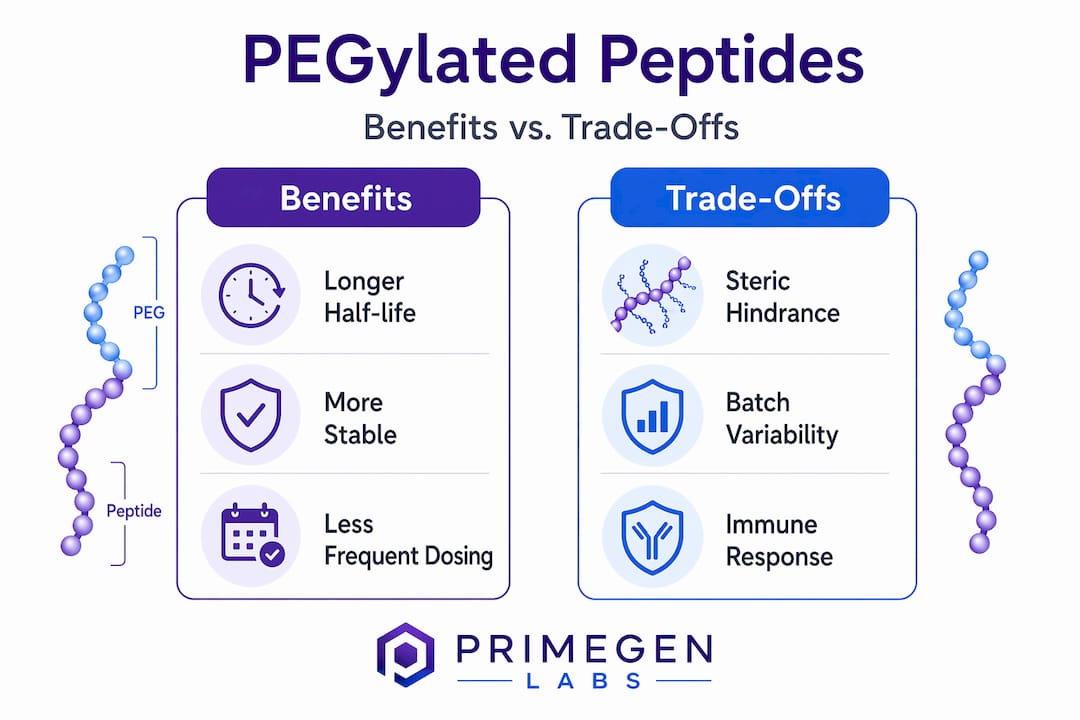
Here is a side-by-side comparison of pegylated versus non-pegylated peptides across the metrics that matter most:
| Factor | Non-pegylated peptide | Pegylated peptide |
|---|---|---|
| Half-life | Minutes to a few hours | Hours to days |
| Dosing frequency | Multiple times daily | Weekly or less frequent |
| Immunogenicity | Higher | Significantly reduced |
| Solubility | Moderate | Improved |
| Receptor binding | Unobstructed | Potentially reduced (steric hindrance) |
| Batch consistency | Generally consistent | Varies with PEG polydispersity |
The trade-offs you cannot ignore
Steric hindrance is the most commonly overlooked downside. When a large PEG chain is attached near or at the peptide’s active site, it physically blocks the receptor from making contact. You get a molecule with outstanding stability and essentially no functional output. This is why site-specific PEGylation is considered superior to random-site approaches.
The second issue involves manufacturing consistency. PEG is polydisperse by nature, meaning each batch contains PEG chains of slightly different lengths. This creates variability in the final product’s behavior. Monodisperse PEG reagents solve this problem but increase cost significantly, which is why not all suppliers use them.
Pro Tip: When sourcing pegylated peptides for research or personal use, ask whether the manufacturer uses monodisperse PEG. The answer tells you a great deal about their quality control standards.
The third trade-off is the accelerated blood clearance phenomenon. After repeated doses, the immune system can develop antibodies to PEG itself, causing subsequent doses to be cleared faster rather than slower. This is particularly relevant for anyone planning a long-term protocol.
You can explore peptide stability factors in more depth to understand how storage and formulation choices interact with these trade-offs.
Applications of pegylated peptides in therapy and fitness
The clinical track record for PEGylated compounds is substantial. More than 40 PEGylated therapies have reached the market since the first FDA approval in 1990. These span oncology, autoimmune disease, anemia, and infectious disease treatment. PEGylated interferon alfa-2a for hepatitis C and PEGylated epoetin beta for anemia are two of the most recognized examples.
In the fitness and performance space, the applications are more targeted but equally meaningful:
- CJC-1295 DAC stimulates growth hormone release with a duration that allows weekly dosing, making consistent GH elevation practical for body composition goals
- PEG-MGF aids muscle repair by persisting long enough in the bloodstream to activate satellite cells after mechanical overload from training
- Weight loss protocols increasingly incorporate pegylated GLP-1 analogs and related peptides because the extended half-life allows for weekly rather than daily administration
- Research applications benefit from pegylated peptides because longer active windows allow more controlled experimental observation
From a practical compliance standpoint, the difference between daily and weekly dosing is enormous for most people. Fewer injections mean less disruption to a daily routine, lower risk of injection site complications, and better consistency in maintaining target blood levels. Better clinical adherence is not a minor footnote. It is one of the strongest arguments for PEGylated formulations in both medical and performance contexts.
Emerging research is also exploring ways to improve PEGylation precision, including enzymatic attachment methods that guarantee site-specific placement and minimize the steric hindrance problem. For fitness enthusiasts tracking the science, this direction is worth following.
My take: what most people miss about pegylated peptides
I’ve worked closely enough with PEGylated compounds to know that most people approach them with one question: does it last longer? The answer is almost always yes. But that is where the thinking tends to stop, and that’s a problem.
What I’ve found matters far more is the balance between half-life extension and retained bioactivity. A pegylated peptide that lasts a week but only activates its receptor at 40% efficiency is not categorically better than an unmodified version dosed twice daily. The math on that particular trade-off often surprises people when they actually do it.
The anti-PEG antibody issue is something I think gets dramatically underplayed in most discussions I’ve seen. Current research is focused specifically on mitigating this challenge, and the fact that it requires active research attention tells you something about its real-world significance. Anyone running repeated pegylated peptide cycles without accounting for this mechanism is making decisions with incomplete information.
Quality sourcing is where I keep coming back to in practice. Peptide safety fundamentals and proper quality control are not optional for PEGylated compounds. The polydispersity issue I mentioned means that two products with identical labels can behave quite differently if one manufacturer is using polydisperse PEG and the other is using monodisperse. That gap in outcomes gets attributed to the peptide when it’s really a sourcing issue.
My overall view: PEGylation is one of the most genuinely useful tools in peptide pharmacology. It solves real problems. But it is a tool that requires informed use, not just a modifier that makes everything better across the board.
— Yvette
Explore pegylated peptide options at Primegenlabs

If this breakdown has clarified what PEGylation actually does and why it matters, the next step is knowing where to apply that understanding. At Primegenlabs, you will find a curated selection of peptides relevant to fitness, muscle repair, and weight management goals, along with educational resources designed for people who want to understand what they are using and why. Our performance peptide guide walks through the evidence, benefits, and cautions for the compounds most relevant to your goals. If you are newer to peptides overall, the science-backed fitness guide is the right starting point. For anyone ready to go further, our dosing protocols resource covers how PEGylation-driven half-life changes should influence your approach to timing and frequency.
FAQ
What is a pegylated peptide in simple terms?
A pegylated peptide is a peptide that has been chemically modified by attaching polyethylene glycol (PEG) chains to extend its half-life, improve solubility, and reduce how quickly the body breaks it down or clears it.
How long does a pegylated peptide stay active in the body?
Depending on the PEG chain size and attachment site, half-life can extend from minutes to several days, with compounds like CJC-1295 DAC remaining active for 6 to 8 days compared to roughly 30 minutes for the unmodified version.
Are there risks associated with repeated pegylated peptide use?
Yes. Repeated exposure can trigger the development of anti-PEG antibodies, which accelerate clearance of subsequent doses and reduce the peptide’s effectiveness over time.
What are the most well-known pegylated peptide examples?
CJC-1295 DAC and PEG-MGF are the most referenced examples in fitness contexts. In clinical medicine, PEGylated interferon and PEGylated epoetin are among the most established approved therapies.
Does PEGylation affect how a peptide binds to its receptor?
It can. If the PEG chain is attached near the peptide’s active site, steric hindrance can physically block receptor binding, which is why attachment site selection is critical for maintaining efficacy.