

Peptide Storage Explained: Keep Your Peptides Potent

TL;DR:
- Most people correctly handle peptides but often fail to recognize that degradation occurs silently without visible signs. Proper storage involves maintaining low temperatures, protecting from moisture and light, and adhering to strict discard timelines, especially for reconstituted solutions. Accurate labeling, aseptic technique, and awareness of microbial risks are essential for preserving peptide efficacy and safety over time.
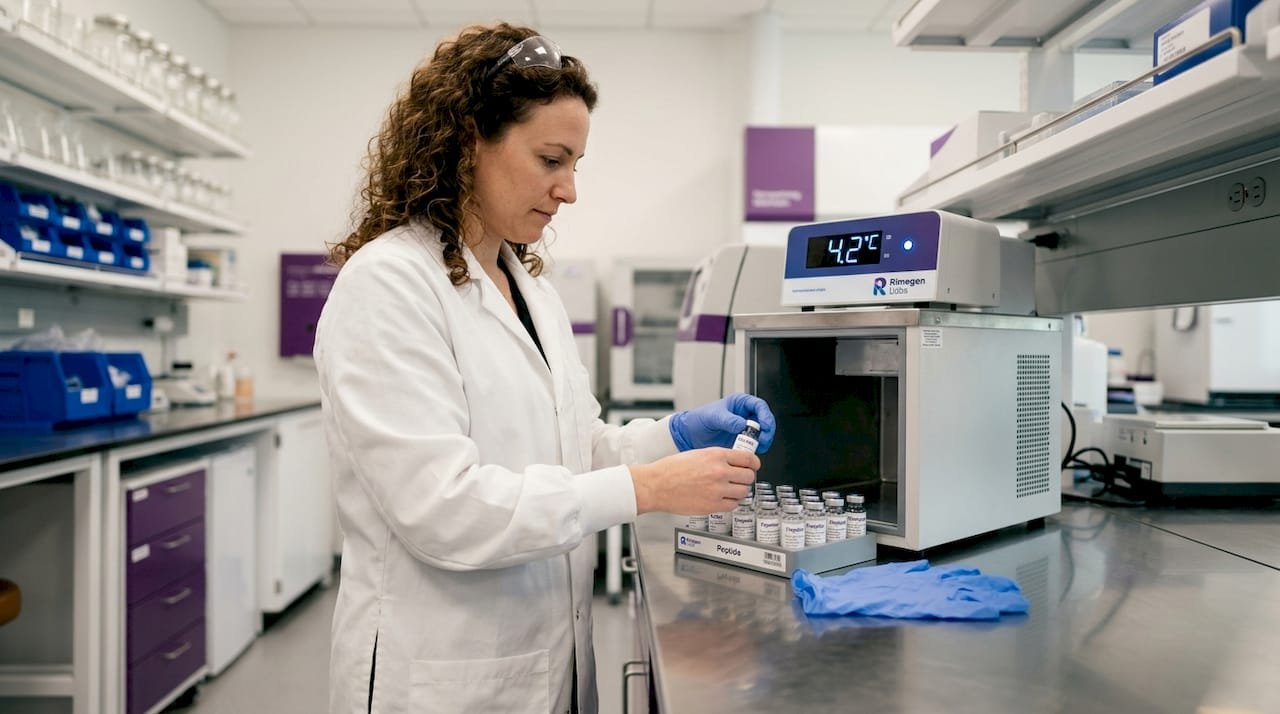
Most people handling peptides for fitness or medical use get the basics right. They refrigerate their reconstituted vials, keep dry peptides away from direct sunlight, and feel confident they’ve done enough. What they don’t realize is that peptide degradation doesn’t announce itself. Your solution can look perfectly clear while the peptide inside has lost meaningful potency, or worse, become a microbial risk. Getting peptide storage explained correctly from the start is the difference between a product that performs and one that quietly fails you.
Table of Contents
- Key takeaways
- Why peptides degrade: the core science
- Storing dry (lyophilized) peptides correctly
- Handling and storing reconstituted peptide solutions
- Common mistakes that compromise your peptides
- Quick reference: storage conditions and peptide longevity
- My honest take on where people actually go wrong
- Primegenlabs: quality peptides with the guidance to match
- FAQ
Key takeaways
| Point | Details |
|---|---|
| Temperature drives degradation | Every 10°C rise doubles the peptide degradation rate, making freezer storage critical for dry peptides. |
| Dry peptides stay stable for years | Lyophilized peptides stored at -20°C hold potency for 2 to 5 years; at -80°C, stability extends over a decade. |
| Reconstituted peptides have a hard deadline | Refrigerated reconstituted peptides must be discarded within 28 days regardless of how clear the solution looks. |
| Bacteriostatic water is non-negotiable | Using standard sterile water for multi-dose vials creates serious microbial contamination risk without preservative protection. |
| Labeling prevents costly errors | Every reconstituted vial needs the date mixed, concentration, and discard date written on it before first use. |
Why peptides degrade: the core science
Understanding what breaks peptides down makes every storage rule feel logical rather than arbitrary. Four main factors drive peptide degradation, and they often work together.
Temperature is the biggest variable. The Arrhenius principle tells us that chemical reactions speed up with heat, and peptides are no exception. Research confirms that peptides degrade 30 to 60 times faster at room temperature (25°C) compared to freezer storage at -20°C. That’s not a small margin. Leaving a dry peptide on a countertop for a weekend isn’t the same as storing it in the freezer for six months. It can represent more cumulative degradation than months of proper cold storage.
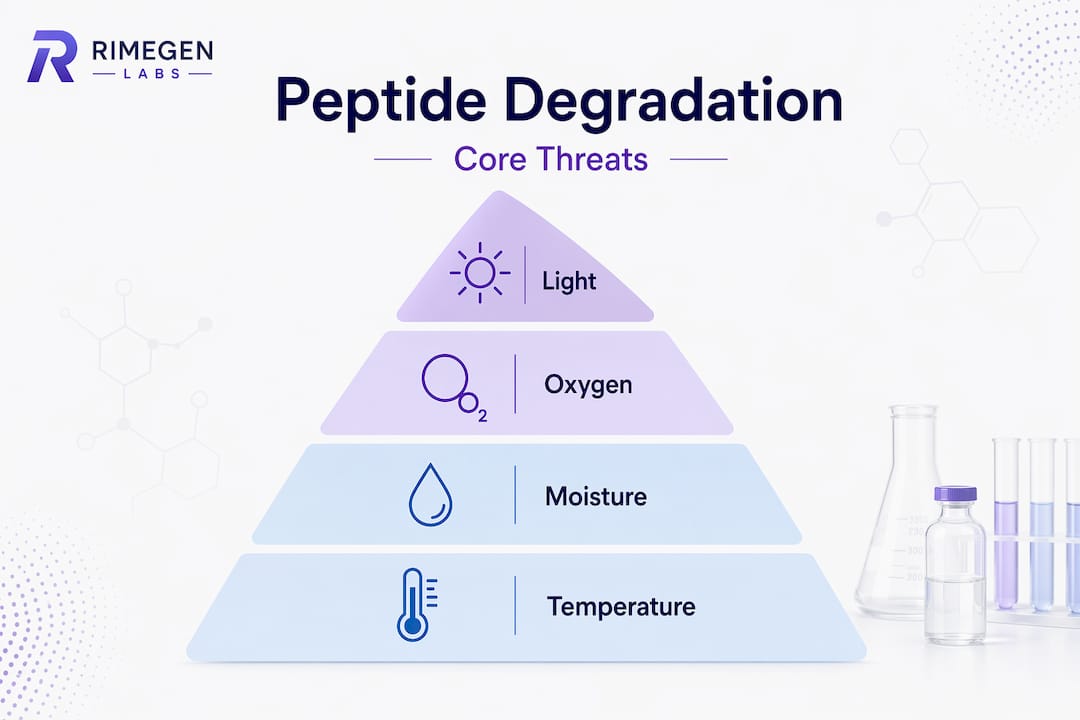
Moisture is the second major threat. When water contacts a peptide, it can trigger hydrolysis, a reaction that cleaves the peptide bonds holding the amino acid chain together. This is why lyophilized (freeze-dried) peptides in sealed, desiccated vials last so much longer than reconstituted solutions. The freeze-drying process removes moisture to stop this reaction before it starts.
Oxygen causes oxidative damage, particularly to peptides containing methionine, cysteine, or tryptophan residues. Oxygen exposure can alter the molecular structure of these amino acids before any visible sign of degradation appears in the vial.
Light, specifically UV radiation, drives photodegradation. Light exposure damages key amino acid residues without leaving visible evidence, which is why amber vials or foil-wrapped storage are standard recommendations. A clear glass vial sitting near a window is a peptide’s worst-case scenario.
Pro Tip: If your peptides came in clear glass vials, wrap them in aluminum foil before placing them in the freezer. It takes seconds and protects against both ambient light and fluorescent freezer lights that cycle on during opening.
Storing dry (lyophilized) peptides correctly
Lyophilized peptides are the format most people receive from a reputable peptide store. The freeze-drying process removes moisture and suspends the peptide in a highly stable state, but that stability depends on maintaining appropriate conditions from that point forward.
Here’s a practical comparison of expected shelf life across common storage environments:
| Storage Condition | Expected Stability | Notes |
|---|---|---|
| -80°C (ultra-low freezer) | 10+ years | Best for long-term research stock |
| -20°C (standard freezer) | 2 to 5 years | Recommended for personal use |
| 2 to 8°C (refrigerator) | Several months | Acceptable only for near-term use |
| Room temperature (20 to 25°C) | Days to weeks | Only acceptable during shipping |
| Above 25°C | Hours to days | Active degradation, avoid entirely |
Lyophilized peptides maintain over 90% purity after two to five years at -20°C, and stability extends beyond a decade at -80°C. For most personal-use scenarios, a dedicated freezer compartment that stays at or below -20°C is sufficient.
Keep dry peptides in their original sealed vials until you’re ready to reconstitute. Oxygen and moisture are your enemies here. If you’re storing multiple peptides, keep each one in its own labeled, resealable bag inside the freezer to prevent frost accumulation on the vials and cross-contamination from condensation during handling. Never store them in a frost-free freezer if you can avoid it. The auto-defrost cycles create temperature fluctuations that accelerate degradation over time. Proper peptide preservation methods start with eliminating these subtle but cumulative stressors.
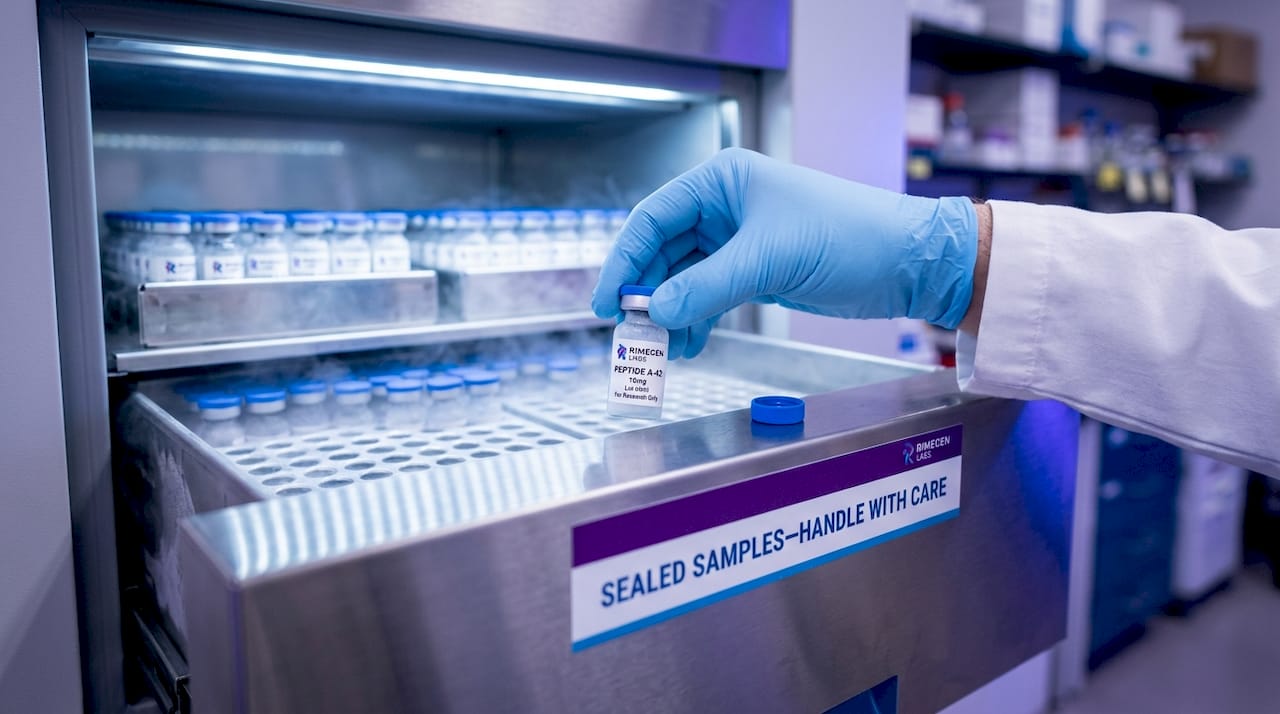
Pro Tip: Take your dry peptide vial out of the freezer and let it come to room temperature inside its sealed bag before opening. This prevents atmospheric moisture from condensing on the cold vial and immediately contacting the lyophilized powder.
Handling and storing reconstituted peptide solutions
This is where most peptide failures happen. Reconstitution introduces water, biological activity, and microbial risk in a single step. Getting the process right sets the ceiling for how long your reconstituted solution will remain safe and effective.
The single most important choice you make is your diluent. Bacteriostatic water with 0.9% benzyl alcohol is the standard for any multi-dose vial. The benzyl alcohol inhibits bacterial growth, making it safe to puncture the vial multiple times over a period of weeks. Plain sterile water contains no preservative. A single puncture with a needle introduces skin flora and ambient bacteria directly into the solution, with nothing to stop them from multiplying.
Once reconstituted, store your vials at 2 to 8°C. Do not freeze reconstituted solutions unless absolutely necessary. Freezing creates ice crystals that can physically damage the peptide structure and cause aggregation. If you do freeze reconstituted peptides, aliquot them first into single-dose portions and freeze in small aliquots to avoid thawing the full vial each time. Repeated freeze-thaw cycles accelerate degradation and aggregation significantly.
The shelf life clock starts the moment you add diluent. Reconstituted peptides refrigerated at 2 to 8°C should be used within 28 to 30 days. After that point, microbial risk rises sharply even if the solution still looks clear. The USP mandates discarding bacteriostatic water within 28 days of first puncture because the benzyl alcohol’s preservative efficacy wanes over that timeline regardless of how much liquid remains.
Watch for these signs that a reconstituted solution should be discarded immediately:
- Cloudiness or visible particles in the solution
- Any color change from the original clear appearance
- Unusual smell upon opening
- Solution that won’t fully dissolve with gentle swirling
- Any vial stored beyond 28 days from reconstitution date
Label every vial with the date mixed, the concentration you prepared, and the discard-by date before you use it once. Not after you’ve already drawn a dose. Before. This isn’t bureaucratic habit. It’s the only reliable way to avoid using a degraded or contaminated solution.
Pro Tip: Reconstitute only what you plan to use within three to four weeks. Keeping the majority of your supply as dry lyophilized stock in the freezer preserves maximum potency and gives you a fresh reconstitution for every cycle.
Common mistakes that compromise your peptides
Even people following general storage guidance make predictable errors that silently reduce peptide quality. Here are the most frequent ones, ranked from most to least common.
-
Treating refrigeration as indefinite safety. This is the most common and most damaging misconception. Users often misunderstand refrigeration as a permanent solution, when reconstituted peptides have a hard 28-day usable window tied directly to preservative efficacy and microbial risk, not just chemical potency.
-
Shaking the vial during reconstitution. Shake-induced turbulence can damage peptide structure and reduce biological activity. Inject your diluent slowly along the vial wall, then gently swirl. Never vortex or shake.
-
Using plain sterile water for multi-dose vials. Sterile water is appropriate only for single-dose use. Without a bacteriostatic preservative, every subsequent needle puncture increases contamination risk exponentially.
-
Skipping the cold chain during transport. Leaving peptides in a car glove box or letting a shipment sit on a warm porch for hours causes real degradation. If your peptide store ships with ice packs, transfer the vials to your freezer immediately upon arrival.
-
Ignoring light exposure. Storing in amber vials or wrapped in foil protects against photodegradation. Leaving clear vials on a countertop or windowsill during daily use is a common oversight.
-
Trying to salvage cloudy or discolored solutions. A compromised vial is a discarded vial. Cloudiness signals aggregation or microbial contamination. Neither is recoverable, and using it carries real health risk.
Pro Tip: Set a phone calendar reminder for 25 days after each reconstitution. You’ll get a prompt with three days of buffer before the 28-day limit, giving you time to plan your next reconstitution rather than scrambling at the deadline.
Quick reference: storage conditions and peptide longevity
Putting everything together in one place helps when you’re making practical decisions about your peptide handling procedure day to day.
| Peptide State | Optimal Storage | Maximum Usable Window | Key Risk if Mishandled |
|---|---|---|---|
| Lyophilized (dry) | -20°C to -80°C | 2 to 10+ years | Moisture, heat, light damage |
| Reconstituted (solution) | 2 to 8°C refrigerator | 28 days | Microbial growth, aggregation |
| Reconstituted (aliquoted, frozen) | -20°C per single dose | Several months | Freeze-thaw degradation if repeated |
| Dry, room temperature | Short-term only | Days to weeks | Rapid chemical degradation |
A few rules apply across all formats:
- Always minimize the time any peptide spends outside its target storage temperature
- Protect from light regardless of the storage form
- Never allow moisture contact with dry peptides before intentional reconstitution
- Discard anything past its usable window rather than estimating “it’s probably fine”
The core principle of best peptide storage practices is simple: keep dry stock frozen, keep reconstituted solutions cold and tracked, and respect the 28-day rule as absolute. Storing peptides safely is less about complex equipment and more about consistent discipline.
My honest take on where people actually go wrong
I’ve seen a lot of well-intentioned peptide users do almost everything right and still end up with degraded products. In my experience, the real problem isn’t ignorance of the rules. It’s overconfidence in what those rules protect against.
Refrigeration gives people a false sense of security that’s hard to shake. A vial sitting at 4°C in a clean fridge looks identical on day five and day thirty-five. There’s no visible signal that the benzyl alcohol has lost efficacy and the microbial risk has crossed a threshold. The 28-day limit isn’t a conservative guideline. It’s the point where the pharmacological contract between you and that bacteriostatic water expires.
What I’ve found causes the most actual failures is a combination of poor labeling and optimistic assumptions. People reconstitute a vial, use it sporadically, forget exactly when it was mixed, and then talk themselves into using it because it “looks fine.” The solution appearing clear tells you nothing about microbial load or peptide integrity at the molecular level.
The other overlooked area is aseptic technique. Home users often treat a quick alcohol wipe on the stopper as sufficient, but real sterile practice involves proper hand hygiene, keeping the needle sterile, and not touching the vial stopper after wiping. It sounds like overkill until you’re the one dealing with an injection site infection.
My practical advice: reconstitute small quantities, keep your dry stock frozen until needed, label every vial the moment you reconstitute it, and follow a step-by-step reconstitution guide until it becomes second nature. These habits cost you almost nothing in time and protect everything you’ve invested in your peptides.
— Yvette
Primegenlabs: quality peptides with the guidance to match
Knowing how to store peptides correctly only matters if you start with peptides worth protecting. At Primegenlabs, every product is manufactured to high purity standards with stability in mind, so your storage practices actually translate into results. Whether you’re using peptides for muscle growth and recovery or targeted medical applications, having access to quality stock is the foundation everything else is built on.
Primegenlabs also carries bacteriostatic water to make sure your reconstitution setup is complete and correct from day one. You won’t find yourself cutting corners with the wrong diluent. Beyond the products, the Primegenlabs resource library covers everything from reconstitution procedures to peptide selection guidance, so you have practical support at every step. Start with quality. Store it right. Get the results you’re working toward.
FAQ
How long do reconstituted peptides last in the refrigerator?
Reconstituted peptides stored at 2 to 8°C remain safe and potent for up to 28 days. After this point, bacteriostatic preservative efficacy declines and microbial risk increases sharply, even if the solution still appears clear.
What is the best temperature for storing dry peptides?
Lyophilized peptides store best at -20°C for personal use, where they maintain over 90% purity for two to five years. Ultra-low storage at -80°C extends stability beyond a decade for long-term research supply.
Why does it matter whether I use bacteriostatic water or sterile water?
Bacteriostatic water contains 0.9% benzyl alcohol, which inhibits bacterial growth through repeated vial punctures over 28 days. Sterile water has no preservative, making it safe only for single-dose use. Multi-dose vials reconstituted with sterile water carry a significant contamination risk after the first use.
Can I freeze reconstituted peptide solutions?
Freezing reconstituted peptides is generally discouraged because ice crystal formation can damage peptide structure. If you need to freeze a reconstituted solution, divide it into single-dose aliquots first and thaw each portion only once.
What signs indicate a peptide solution should be discarded?
Discard any reconstituted solution that appears cloudy, contains visible particles, has changed color, or has been stored beyond 28 days from the date of reconstitution. A clear appearance does not guarantee safety after the recommended window has passed.