

How to Plan Peptide Schedules for Peak Results


TL;DR:
- Managing your peptide protocol requires strategic planning to avoid missed doses and vial degradation, ensuring optimal results. Setting clear goals, understanding your peptides’ half-lives, and using organized tools are essential for effective scheduling and long-term success. Proper tracking and adherence prevent organizational errors from compromising your cycle’s effectiveness.
Managing your peptide protocol without a clear plan is one of the fastest ways to waste both money and potential gains. When you’re running one or more peptides for recovery, fat loss, or performance, knowing how to plan peptide schedules isn’t optional. It’s the difference between a protocol that delivers measurable results and one that quietly fails because of missed doses, degraded vials, or mistimed injections. This guide walks you through the exact steps to build a schedule that works with your goals, your peptides’ pharmacokinetics, and your real-world routine.
Table of Contents
- Key takeaways
- How to plan peptide schedules: the foundations
- Building your peptide dosing calendar step by step
- Common mistakes in peptide schedule management
- Verifying and optimizing your peptide protocol
- My take on where most peptide protocols actually go wrong
- Ready to build your protocol with Primegenlabs?
- FAQ
Key takeaways
| Point | Details |
|---|---|
| Set goals before scheduling | Your specific fitness or recovery objectives should determine cycle length, dosing frequency, and peptide selection. |
| Account for half-life and vial stability | Peptide half-lives determine how often you dose; reconstituted vials last 4 to 5 weeks and must be planned around. |
| Cycle on and off consistently | Most protocols use 8 to 12 week on-cycles with 4-week breaks to prevent receptor desensitization. |
| Track everything from day one | Logs, progress photos, and symptom notes are the most reliable way to catch problems before they undermine your cycle. |
| Poor organization, not biology, causes most failures | Missed doses and expired vials are organizational problems. Build systems first, then start dosing. |
How to plan peptide schedules: the foundations
Before you write a single injection on your calendar, you need three things in place: a clear goal, a working knowledge of your peptides, and the tools to stay organized. Skipping any of these turns schedule planning into guesswork.
Start with your goal
Your goal shapes everything. Recovery-focused protocols (think BPC-157 or TB-500) often run shorter, targeted cycles. Growth hormone secretagogues like CJC-1295 or Ipamorelin typically run longer. Fat loss peptides may require specific within-day timing tied to meals or fasted states. Write out your primary goal, your secondary goal if you have one, and the timeline you’re working with. These decisions lock in your cycle structure before you touch a syringe.
Know your peptides before you dose
Each peptide has a different half-life, and that directly controls how often you need to inject. Steady-state plasma concentrations are reached after approximately 4 to 5 half-lives of consistent dosing, meaning peptides with short half-lives (like Ipamorelin at around 2 hours) need multiple daily doses to stay effective, while longer half-life compounds can be dosed once daily or less. Understanding this prevents one of the most common scheduling errors: dosing based on convenience rather than pharmacology.
Here’s a quick reference for common peptide types and their general dosing frequency:
| Peptide | Approximate half-life | Typical dosing frequency |
|---|---|---|
| BPC-157 | 4 hours | 1 to 2x daily |
| Ipamorelin | 2 hours | 2 to 3x daily |
| CJC-1295 (no DAC) | 30 minutes | 2 to 3x daily |
| CJC-1295 (with DAC) | 6 to 8 days | 1 to 2x weekly |
| TB-500 | Unknown | 2x weekly loading, then monthly |
The tools you actually need
Good peptide schedule management does not require anything fancy. What it requires is consistency. At minimum, use a dedicated notebook or an app like a habit tracker to log every injection. A refrigerator thermometer is non-negotiable for storage. Set phone alarms or calendar alerts for each dosing window. And keep a simple spreadsheet or paper log with date, dose, time, vial batch, and any notable reactions.

Pro Tip: Label each reconstituted vial with the date it was mixed. This prevents you from accidentally dosing with degraded peptide past its stability window.
Building your peptide dosing calendar step by step
With your goals set and your peptides understood, you’re ready to build an actual schedule. Here’s how to do it without overcomplicating it.
-
Choose your cycle length. Most protocols follow 8 to 12 week on-cycles with a 4-week break, or extended 16-week cycles with 4 to 6 weeks off. A 5 days on/2 days off weekly structure within those cycles also reduces tolerance buildup on daily injectable peptides.
-
Map vial stability to your timeline. Reconstituted peptide vials are stable for about 4 to 5 weeks when stored at around 4°C. This means a 12-week cycle requires you to reconstitute roughly three vials in sequence. Plan those reconstitution dates in advance so you never run dry mid-cycle.
-
Anchor injection timing to half-life, not habit. Within-day timing should be tied to the peptide’s half-life and intended effect rather than arbitrary time slots. Growth hormone secretagogues are most effective when dosed before sleep or after fasted training. BPC-157 for gut healing performs better taken on an empty stomach. Build your injection windows around these pharmacological realities.
-
Set non-negotiable reminders. Consistent dose timing with logged reminders is one of the biggest drivers of protocol success. Set two alarms for each dosing window: one 10 minutes before and one at the exact time. This removes the “I forgot” variable entirely.
-
Plan your stacks carefully. If you’re running multiple peptides, list them with their individual schedules side by side. Look for conflicts in timing and storage requirements before you start. Do not assume all peptides can be combined in one syringe. Mixing multiple peptides in the same syringe can create inconsistent exposure and ambiguous side effects unless you’ve confirmed it’s safe for that specific combination.
Pro Tip: Build your full calendar before day one. Print it or put it in a shared notes app. Protocols that exist only in your head are protocols waiting to fail.
A useful comparison when deciding between a daily protocol and a 5-on/2-off structure:
| Schedule type | Best for | Main consideration |
|---|---|---|
| Daily dosing | Short half-life peptides requiring steady state | Higher organizational demand, must not miss doses |
| 5 days on / 2 days off | Reducing tolerance risk on daily injectables | Slightly less consistent plasma levels |
| Weekly or bi-weekly | Long half-life peptides (CJC-1295 with DAC) | Easier to manage, less room for error |
Common mistakes in peptide schedule management
Even well-intentioned protocols fall apart at the organizational level. Poor planning and inconsistent documentation are far more common causes of protocol failure than biological non-response. Here’s what to watch for:
- Ignoring vial expiration. A reconstituted vial used at week 6 or 7 is likely degraded. Schedule reconstitutions proactively and discard anything past the 4 to 5 week window without exception.
- Skipping doses because of schedule conflicts. Life happens, but consistently skipping doses disrupts steady state. If travel or work interferes with your protocol, plan for it in advance by adjusting timing, not by defaulting to missed injections.
- Continuous use without cycling. Running peptides indefinitely without off-cycle breaks leads to receptor desensitization, progressively reducing the compound’s effectiveness. Off-cycles are not optional.
- Mixing peptides without verifying compatibility. Drawing two peptides into the same syringe without checking their stability and compatibility is a shortcut with real consequences: degraded peptides, unreliable dosing, and harder-to-diagnose side effects.
- Starting without a written schedule. This is the biggest one. A mental plan is not a plan.
Peptide schedule failure is almost never a biological problem. It’s almost always an organizational one. The athletes who get results from their protocols are the ones who treat scheduling with the same seriousness as training programming.
Pro Tip: Review your schedule at the start of every week. Check your vial dates, confirm your next reconstitution, and note any doses you missed in the prior 7 days. This 5-minute review catches 90% of problems before they compound.
Verifying and optimizing your peptide protocol
Building the schedule is step one. Knowing whether it’s working and adjusting accordingly is what separates a one-cycle experiment from a long-term optimized protocol.
Here’s a tracking routine that actually produces useful data:
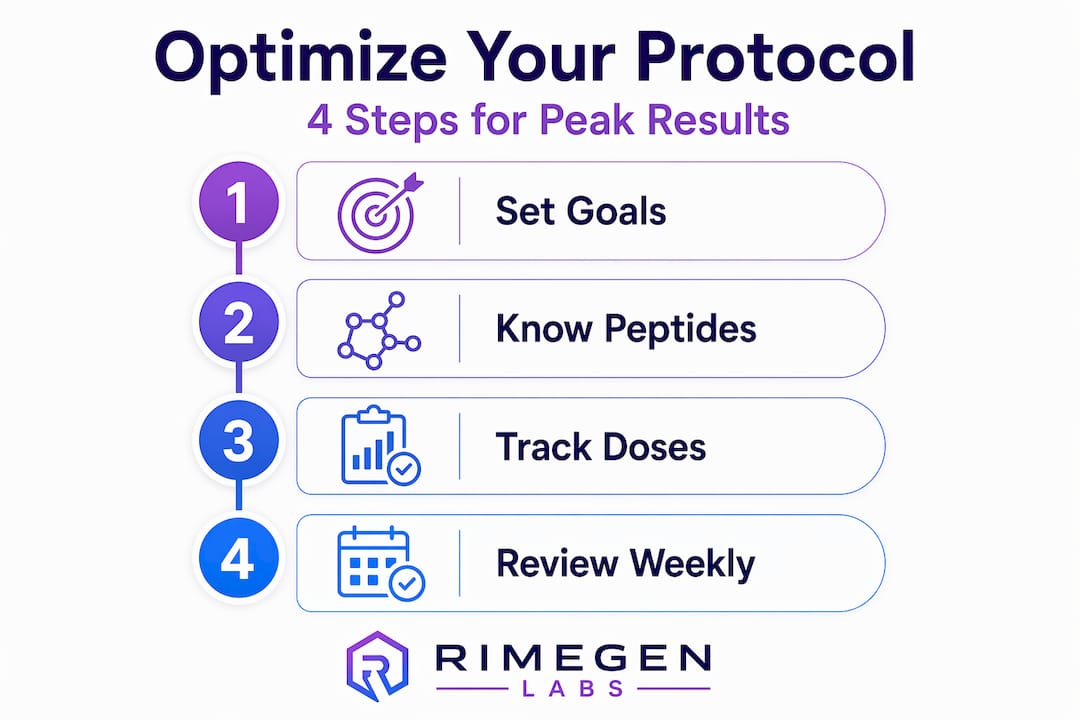
- Log every injection. Date, time, dose, which peptide, which vial. This takes 30 seconds and gives you a complete record to reference when you’re evaluating results or troubleshooting.
- Take weekly progress notes. These don’t need to be long. Rate sleep quality, recovery speed, any side effects, and subjective energy levels on a simple 1 to 10 scale. Patterns become visible within 2 to 3 weeks.
- Schedule objective markers at week 4 and end of cycle. Blood panels checking IGF-1 for growth hormone peptides, inflammatory markers for recovery compounds, and performance benchmarks in the gym give you data beyond subjective feeling. You can learn more about tracking peptide results effectively to set this up before you start.
- Plan your off-cycle period. The break between cycles is not dead time. Use it to assess what carried over, what faded, and whether the protocol achieved your original goal. Decide before you start the next cycle whether you’re repeating, adjusting, or switching entirely.
Here’s a simple weekly tracking table you can adapt:
| Day | Doses taken | Side effects noted | Recovery rating (1-10) | Notes |
|---|---|---|---|---|
| Monday | CJC + Ipamorelin (AM) | None | 8 | Good sleep prior night |
| Wednesday | CJC + Ipamorelin (AM) | Mild flushing | 7 | Flushing resolved in 20 min |
| Friday | CJC + Ipamorelin (AM) | None | 9 | Best workout of week |
Tracking this way lets you connect dose timing to performance and side effects with real data, not guesswork. If you see a consistent pattern of lower recovery scores on days following a particular dosing window, that’s information you can actually use to optimize your dosage workflow for the next cycle.
My take on where most peptide protocols actually go wrong
I’ve seen a lot of people approach their first peptide protocol with enormous enthusiasm and a surprisingly thin plan. They know their compound, they know their goal, but they haven’t thought past week one.
What I’ve found is that the failure point is almost always structural. Someone miscounts vial doses, realizes mid-cycle that they need to reconstitute but don’t have bacteriostatic water ready, or forgets three doses in a row during a travel week. The peptides never had a chance to prove themselves because the protocol was never actually followed.
The other issue I see is overambition in stacking. Running three or four peptides on your first organized cycle looks good on paper. In practice, it makes it impossible to tell what’s working, what’s causing a side effect, or what to adjust. Start with one or two compounds, nail the organizational side of things, verify your results, then add complexity.
There’s also an underappreciated value in reading the peptide regulations landscape before starting any protocol. Sourcing, storage, and administration requirements shift. Knowing where your compounds stand from a regulatory standpoint is part of responsible planning, not an afterthought.
Plan the whole cycle before day one. Know your vial math. Build your tracking system before you reconstitute anything. Then execute.
— Yvette
Ready to build your protocol with Primegenlabs?

Primegenlabs offers a research-backed catalog of peptides focused on muscle growth, recovery, and performance. Whether you’re structuring your first cycle or refining an existing stack, the resources here are built to support serious practitioners. Explore the peptide guide for muscle growth for in-depth breakdowns of recovery and performance compounds, or check out the performance and evidence overview to evaluate options before committing to a protocol. Every product comes with dosing guidance and storage specs so your schedule planning starts with reliable information.
FAQ
How often should you inject peptides?
Injection frequency depends on the peptide’s half-life. Short half-life peptides like Ipamorelin require 2 to 3 daily injections to maintain steady-state plasma levels, while long half-life compounds like CJC-1295 with DAC need only 1 to 2 injections per week.
How long should a peptide cycle last?
Most protocols run 8 to 12 weeks on followed by a 4-week off period, though some extended cycles run 16 weeks with a 4 to 6 week break. Cycling prevents receptor desensitization and maintains long-term effectiveness.
How long do reconstituted peptide vials last?
Reconstituted vials remain stable for approximately 4 to 5 weeks when refrigerated at around 4°C. Always label vials with the reconstitution date and discard anything older than 5 weeks regardless of appearance.
Can you mix multiple peptides in one syringe?
You can in some cases, but it carries risk. Mixing peptides improperly can cause inconsistent dosing and make side effects harder to attribute. Confirm compatibility for your specific combination before attempting it.
What’s the best way to track peptide doses?
Log every injection with date, time, dose, and vial batch. Combine this with weekly recovery ratings and objective markers like blood panels at weeks 4 and 8 to build a complete protocol record you can actually learn from.