

Safe Peptide Practices for Your Fitness Routine


TL;DR:
- Peptides have rapidly become common in everyday wellness routines, but safety knowledge often lags behind.
- Verifying peptide purity through third-party Certificates of Analysis and proper storage is essential for safe, effective use.
Peptides have moved from clinical settings into everyday fitness and wellness routines at a pace that has outrun the safety education around them. If you are using peptides or considering adding them, safe peptide practices are not optional. They are what separates a protocol that delivers real results from one that creates real problems. The market is loaded with variable quality products, incomplete information, and confident online advice that skips the critical steps. This guide covers what you actually need to know: how to verify quality, store and handle peptides correctly, inject safely, monitor your health, and stay on the right side of the law.
Table of Contents
- Key takeaways
- 1. Verify peptide quality before you buy anything
- 2. Follow proper storage and handling protocols
- 3. Master safe injection technique
- 4. Monitor your health markers throughout your protocol
- 5. Understand the legal and regulatory framework
- A frank perspective on what the fitness world gets wrong
- How Primegenlabs supports your safe peptide journey
- FAQ
Key takeaways
| Point | Details |
|---|---|
| Always verify purity | Only buy peptides with a third-party Certificate of Analysis showing purity at 98% or higher. |
| Storage determines potency | Reconstituted peptides must stay refrigerated at 2-8°C and be discarded after 28 days. |
| Rotate injection sites | Consistent site rotation reduces tissue damage and lowers infection risk significantly. |
| Monitor bloodwork regularly | Baseline labs and follow-up panels at 6-8 weeks catch adverse effects before they become serious. |
| Medical oversight is non-negotiable | Most peptides are prescription therapies legally and must be used under licensed provider supervision. |
1. Verify peptide quality before you buy anything
This is where safe peptide practices begin, and where most people skip a step. The peptide market has no single governing body enforcing universal standards, which means vendor quality varies enormously. A low price or a slick website tells you nothing about what is actually in the vial.
The first document to request is a Certificate of Analysis (CoA) from a third-party laboratory. Products with purity verified at 98% or above are the baseline standard. A CoA from the vendor’s own in-house lab is not adequate. Third-party testing from accredited labs removes the conflict of interest.
When you receive a CoA, look for two specific tests:
- HPLC (High-Performance Liquid Chromatography): Confirms purity percentage and screens for unwanted compounds
- Mass spectrometry: Verifies the molecular weight matches what the peptide should be, confirming identity
Unregulated vendors frequently lack GMP certification and proper testing protocols, which leads directly to mislabeled products and contamination risks. The red flags are straightforward: peptides sold pre-mixed in liquid form (which degrades faster and hides purity issues), no physical contact information on the vendor’s site, and pricing that seems too far below market rate for a quality product.
Pro Tip: Search the vendor’s name alongside “CoA” or “third-party testing” before ordering. Legitimate suppliers make this documentation easy to find. If you have to ask three times and still get no documentation, move on.
Understanding how purity shapes results is worth reading before you commit to any supplier.
2. Follow proper storage and handling protocols
Peptide handling protocols matter as much as what you buy. A genuine, high-purity peptide stored incorrectly is a wasted investment at best and a contamination risk at worst.
Here is how storage requirements break down by form:
- Lyophilized (freeze-dried) powder, long-term: Store at -20°C. This keeps peptides stable for months without degradation.
- Lyophilized powder, working stock: Move to 2-8°C refrigeration when you plan to use within weeks. Avoid placing near the freezer section of a standard fridge where temperatures fluctuate.
- Reconstituted peptides: Always store at 2-8°C. Discard after 28 days regardless of how much remains in the vial. Bacterial growth is the concern, and it is not visible.
- Protect from light: UV exposure degrades peptide bonds. Keep vials in their original packaging or a dark container.
- Never shake a vial: Swirl gently if needed. Shaking denatures the peptide structure.
- Store vials upright: Storing with the stopper facing up prevents contamination from rubber stopper leaching into the solution.
- Avoid freeze-thaw cycles: Each cycle degrades potency. Aliquot larger quantities into single-use portions before freezing.
Pro Tip: Label every vial with the reconstitution date. Memory is unreliable when you have multiple peptides running simultaneously.
The table below shows storage requirements at a glance:
| Peptide form | Recommended temperature | Maximum storage time |
|---|---|---|
| Lyophilized powder (long-term) | -20°C | 12-24 months |
| Lyophilized powder (working stock) | 2-8°C | Up to 4 weeks |
| Reconstituted in bacteriostatic water | 2-8°C | 28 days |
| Reconstituted in plain sterile water | 2-8°C | 24-48 hours |
For reconstitution, bacteriostatic water containing 0.9% benzyl alcohol is the correct choice for multi-dose vials. Plain sterile water lacks the preservative that prevents bacterial growth and should never be used for vials you will draw from multiple times. Get familiar with safe lab practices for peptide handling before you reconstitute anything.
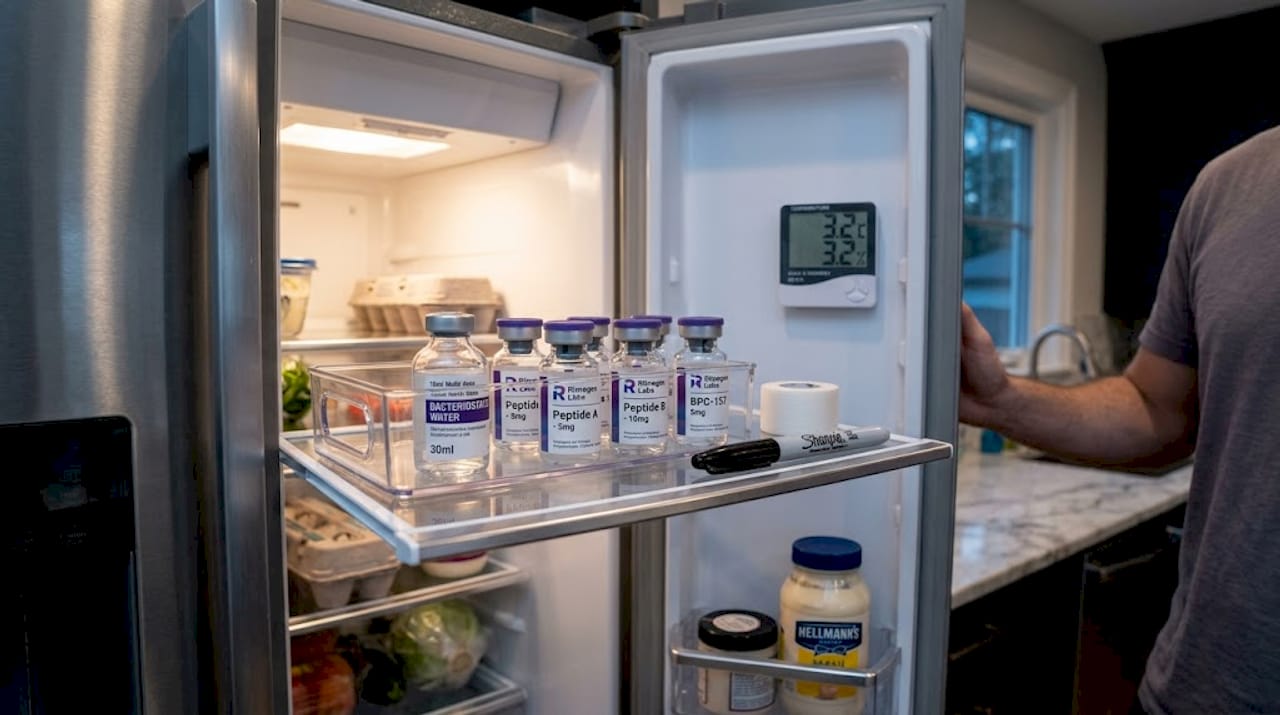
Also worth knowing: certain peptides like HGH 191AA lose potency in solution within 14 days, which is significantly shorter than the standard 28-day window. Know the specific requirements for each peptide you use.
3. Master safe injection technique
Subcutaneous injection is the most common delivery method for peptides, and proper injection technique is one of the most frequently underestimated aspects of a safe protocol. Mistakes here create real consequences: infection, lipodystrophy (tissue damage from repeated injections in the same spot), and abscess formation.
The key steps every person using injectable peptides should practice:
- Sterilize the injection site with an alcohol swab and let it dry completely before injecting. Wet alcohol carries bacteria into the puncture.
- Use a new needle every single time. Needles dull after one use, and reusing creates both contamination and tissue trauma risks.
- Choose the correct gauge. For subcutaneous peptide injections, 27 to 31 gauge needles are standard. Thinner gauges hurt less and cause less damage.
- Insert at a 45-degree angle for subcutaneous delivery. Pinch the skin gently to lift tissue away from muscle.
- Rotate sites systematically. Abdomen quadrants, outer thighs, and upper arms are common. Returning to the same spot repeatedly creates scar tissue over time.
- Check for air bubbles before injecting. Flick the syringe and push the plunger slightly to clear them.
- Never recap needles by hand. Use a one-handed scoop method or a needle cap device to prevent accidental sticks.
Common side effects at injection sites include mild redness, itching, or temporary swelling. These typically resolve within hours. Persistent redness, warmth, swelling, or pain after 24 hours can indicate infection and warrants medical attention immediately.
4. Monitor your health markers throughout your protocol
Peptide regimen safety tips that skip bloodwork are incomplete. Monitoring is what separates genuinely safe peptide use from guesswork dressed up as optimization.
Before starting any peptide protocol, get a baseline panel that includes:
- CBC (Complete Blood Count): Establishes baseline blood cell levels and flags any pre-existing conditions
- Comprehensive metabolic panel: Checks kidney and liver function, electrolytes, and blood glucose
- Fasting glucose and insulin: Particularly relevant because some peptides affect insulin sensitivity
- Lipid panel: Cholesterol and triglyceride levels as a cardiovascular baseline
- IGF-1 (if using growth hormone secretagogues): Target physiological range of 100-300 ng/mL with re-testing at 6-8 weeks and every 3-6 months thereafter
Baseline and routine bloodwork allows early detection of adverse effects and provides the data you need to adjust dosing intelligently rather than reactively. A personalized approach built on lab data is far more effective than copying someone else’s protocol online.
When it comes to stacking peptides, the guidance is conservative for good reason. Introducing one peptide at a time lets you identify which compound is responsible for any effect. Stacking multiple peptides that act on the same pathway amplifies both effects and risks without proportionally increasing your safety data. If you are managing a protocol involving multiple compounds, review a solid peptide dosing guide before making changes.
| Marker | Why it matters | Testing frequency |
|---|---|---|
| IGF-1 | Tracks GH secretagogue effect; prevents excess | Baseline, 6-8 weeks, every 3-6 months |
| Fasting glucose | Detects insulin sensitivity changes | Baseline, every 3 months |
| CBC | Flags immune or hematological changes | Baseline, every 6 months |
| Liver enzymes (ALT/AST) | Monitors hepatic stress | Baseline, every 6 months |
Signs that warrant immediate dose reduction or cessation include persistent joint pain, fluid retention, tingling in extremities, elevated fasting glucose compared to baseline, or significant mood changes. These are your body’s signals. Pay attention to them.
5. Understand the legal and regulatory framework
Peptides marketed as wellness products are legally prescription therapies in the United States and must be administered under licensed provider oversight. That is not a technicality. It is a legal standard that protects you and creates accountability in your care.
What this means practically:
- FDA-approved peptides like semaglutide have established safety profiles backed by clinical trials. Newer, non-FDA peptides may carry unknown risks because they have not completed the same rigorous review process.
- Grey market peptides sold “for research only” exist in a legal gray zone. Purchasing them for personal use carries regulatory risk and no quality assurance.
- 2026 regulatory environment: Enforcement around compounded and research-grade peptides has tightened. Staying current with FDA communications on specific peptides is part of responsible use.
- Working with a licensed provider gives you access to pharmaceutical-grade compounded peptides when appropriate, legitimate prescriptions, and medical oversight for your protocol.
- Preventing peptide misuse starts with treating these compounds as what they are: biologically active therapies with real effects, not supplements you can self-prescribe based on forum recommendations.
The short version: work with a provider who knows peptides. It is not just safer. It gives you better outcomes because the protocol is built around your actual biology.
A frank perspective on what the fitness world gets wrong
I have watched the peptide space evolve from niche clinical use into mainstream fitness culture, and the gap between what people are doing and what is actually safe is real. The enthusiasm is understandable. The shortcuts are not.
In my experience, the most common mistake is not storage or injection technique. It is starting without any baseline data. People stack two or three peptides simultaneously, feel a response, and call it a success. When something goes sideways three months later, there is no reference point. No way to know what changed or why.
The assumption that natural origin means safe is also one I see repeatedly. Non-FDA-approved peptides often rely on anecdotal evidence, and anecdotal success stories in fitness communities carry enormous selection bias. You hear from people who got results. You rarely hear from people who quietly dealt with adverse effects and stopped.
What I have found actually works is a disciplined, personalized approach. A safe peptide program built on lab testing tailored to your biology outperforms any generic protocol copied from a thread. One peptide at a time. Documented baselines. Medical oversight. These are not bureaucratic hurdles. They are what make long-term use sustainable and safe.
The people who get the most out of peptides over years, not just months, are the ones who treated the process seriously from day one.
— Yvette
How Primegenlabs supports your safe peptide journey

Primegenlabs was built around one principle: peptides work best when you know exactly what you are using and why. Every product in the Primegenlabs catalog comes with third-party CoA documentation so you can verify purity before anything enters your protocol. The educational resources on site cover performance evidence and safety data so you make decisions based on real science, not marketing language.
Whether you are focused on recovery, body composition, or general wellness, the muscle growth and recovery guide at Primegenlabs gives you a research-backed starting point. From sourcing transparency to dosing protocols to storage guidance, Primegenlabs gives health-focused individuals the tools to build a protocol they can trust.
FAQ
What purity level should a peptide CoA show?
Third-party CoA documentation should confirm purity at 98% or higher. Anything below this threshold indicates a higher risk of contaminants or mislabeled compounds.
How long can I keep a reconstituted peptide?
Reconstituted peptides stored at 2-8°C in bacteriostatic water are safe to use for up to 28 days. After that point, discard the remaining solution regardless of volume.
Do I need a doctor to use peptides?
Yes. Most peptides are legally classified as prescription therapies in the United States. Using them without licensed provider oversight carries both regulatory and health risks.
What bloodwork should I get before starting a peptide protocol?
Start with a CBC, comprehensive metabolic panel, fasting glucose, lipid panel, and IGF-1 if you are using a growth hormone secretagogue. This baseline gives you a reference point for monitoring changes.
Is it safe to stack multiple peptides at once?
The conservative standard is to introduce one peptide at a time and monitor your response before adding another. Stacking multiple peptides that target the same pathway increases risk without established safety data for most combinations.