

Explaining Oral Peptides: What You Need to Know


TL;DR:
- Most oral peptides are poorly absorbed, with less than 2% bioavailability without specialized technology like SNAC. Only FDA-approved oral semaglutide (Rybelsus) has well-established safety and efficacy, while other products outside regulation pose significant risks of low purity and contamination. Using oral peptides safely requires strict adherence to dosing protocols, verified sourcing, and medical supervision, as most market options lack solid human evidence.
Most people assume peptides work the same whether you swallow them or inject them. That assumption is wrong, and it’s at the heart of why explaining oral peptides clearly matters so much right now. Of all the peptide compounds generating buzz in health, fitness, and weight loss circles, only one oral peptide has cleared FDA approval as of 2026. The rest exist in a gray zone that ranges from promising to genuinely risky. If you’re researching oral peptide supplements, understanding how they work, what the science actually says, and how to use them safely is not optional.
Table of Contents
- Key takeaways
- Explaining oral peptides: how they actually work
- FDA approval, safety, and the unregulated market
- Popular peptides in wellness and performance
- Practical guidance for using oral peptides safely
- My take on oral peptides after years in this space
- Ready to go deeper with Primegenlabs?
- FAQ
Key takeaways
| Point | Details |
|---|---|
| FDA approval is narrow | Only oral semaglutide (Rybelsus) is FDA-approved; all other oral peptide supplements remain unregulated. |
| Bioavailability is a real barrier | Most oral peptides achieve less than 1-2% absorption without specialized delivery technology. |
| Gray market products carry serious risk | Compounded peptides have tested as low as 5% purity with toxic metal contamination. |
| Dosing precision matters | Oral semaglutide requires empty stomach intake, minimal water, and a 30-minute fast or efficacy drops sharply. |
| Evidence gaps are wide | Most wellness peptides like BPC-157 have zero human clinical trial data supporting their marketed benefits. |
Explaining oral peptides: how they actually work
Peptides are short chains of amino acids. They act as signaling molecules, telling your cells to do things like produce more growth hormone, regulate blood sugar, repair tissue, or modulate inflammation. When you hear about using oral peptides for health, you’re talking about ingesting these molecules and expecting them to reach your bloodstream intact and do their job.
Here’s the problem. Your digestive system is specifically designed to destroy proteins and peptides. Enzymes like pepsin, trypsin, and chymotrypsin, along with first-pass metabolism in the liver, break peptides down to a point where oral bioavailability typically falls below 1 to 2%. That’s not a rounding error. It means 98 cents of every dollar you invest in an oral peptide may never reach your bloodstream without pharmaceutical help.
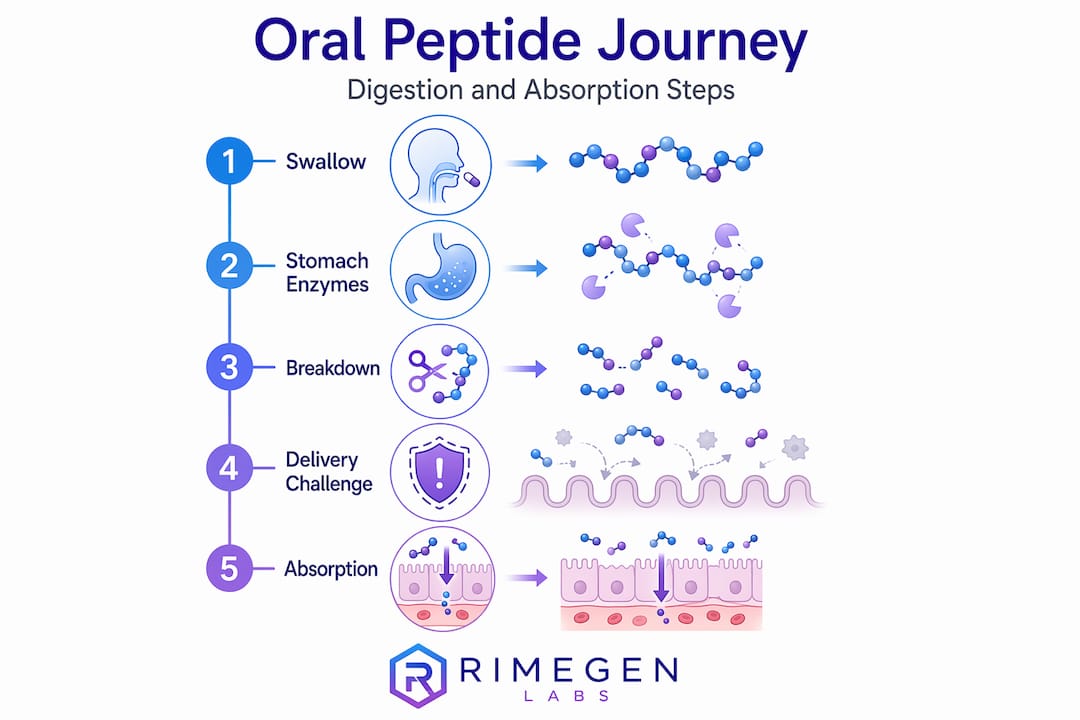
This is why the science of oral peptide delivery is so focused on workarounds. The most clinically validated solution right now is SNAC (sodium N-[8-(2-hydroxybenzoyl)amino]caprylate), a co-formulation agent used in oral semaglutide. SNAC raises gastric pH locally and protects semaglutide from pepsin degradation, enabling transcellular absorption through the stomach lining rather than the intestine. It’s a precise mechanism that depends entirely on exact administration conditions.
Beyond SNAC, researchers are actively exploring nanoparticles, enzyme inhibitors, and ingestible devices as delivery technologies for future oral peptides. None of these are commercially available yet for wellness purposes. They remain in early development, which tells you something important about where the science actually stands.
Oral vs injectable: a practical comparison
| Formulation | Bioavailability | Delivery method | Clinical status |
|---|---|---|---|
| Oral semaglutide (Rybelsus) | ~1% (SNAC-enhanced) | Tablet, fasted conditions | FDA-approved |
| Injectable semaglutide (Ozempic) | ~89% | Subcutaneous injection | FDA-approved |
| BPC-157 oral (compounded) | Unverified | Capsule or liquid | Not approved |
| TB-500 oral (compounded) | Unverified | Capsule | Not approved |
Pro Tip: If a company markets an oral peptide supplement claiming high bioavailability without disclosing a specific delivery mechanism like SNAC, nanoparticle encapsulation, or enzyme protection, treat that claim with real skepticism.
FDA approval, safety, and the unregulated market
Oral semaglutide, sold as Rybelsus, is the only FDA-approved oral peptide as of 2026. It is approved specifically for type 2 diabetes management, with a reformulated lower-strength version launched in 2025 maintaining equivalent therapeutic effect. That approval came after extensive clinical trials, strict manufacturing standards, and defined dosing protocols.

Everything else you’ll find marketed as an oral peptide supplement exists outside that regulatory framework. Compounded peptides, gray market products, and “research use only” items fill this space. The FDA has been explicit: “research use only” labeling is not a safety certification. It’s a legal loophole in peptide marketing that allows sellers to avoid drug claims while still selling to consumers looking for health benefits. FDA testing has found that up to 40% of online peptides have incorrect dosages or undeclared ingredients.
The safety picture gets worse when you look at actual adverse event data:
- The FDA received over 1,150 adverse event reports tied to compounded GLP-1 products alone.
- Analytical testing of gray market peptides found purity ranging between 5% and 75%, meaning you often cannot know the actual dose you’re consuming.
- Some samples contained toxic metals including arsenic and lead at levels exceeding injectable safety thresholds.
“Patients using wellness peptides have no reliable information about whether they are safe or effective.” — ECRI and ISMP joint safety warning, 2025
If you’re sourcing peptides outside of a licensed pharmacy or physician prescription, you are accepting significant unknowns. That’s not fearmongering. It’s the documented reality of the current market.
How to identify safer sources
Before purchasing any oral peptide supplement, ask these questions: Does the company provide third-party certificates of analysis? Are those certificates from an accredited lab with batch-specific testing? Is the product sold through a licensed pharmacy or under physician supervision? If the answer to any of these is unclear or no, reconsider. Learning about prescription peptide options versus gray market alternatives is a good starting point.
Popular peptides in wellness and performance
BPC-157, TB-500, and semaglutide compared
Here’s the comparison most oral peptide supplement marketing won’t show you:
| Peptide | Claimed benefits | Human trial data | Evidence quality |
|---|---|---|---|
| BPC-157 | Gut healing, tissue repair, anti-inflammatory | None (Phase 1) | Animal studies only |
| TB-500 | Muscle recovery, wound healing | None | Animal studies only |
| Oral semaglutide | Blood sugar control, weight loss | Extensive Phase 3 | FDA-approved |
| Collagen peptides | Skin, joint support | Limited human trials | Moderate, mixed |
BPC-157 is probably the most discussed wellness peptide online. Its proposed mechanisms around gut repair and tissue healing are genuinely interesting. But 35 of 36 published BPC-157 studies were conducted in animals. There is no Phase 1 human safety data. No controlled efficacy trials. The leap from rat studies to human supplementation is massive, and the marketing around these products rarely acknowledges it.
Semaglutide is the outlier in this group. Oral semaglutide mimics GLP-1 receptor activity, stimulating insulin secretion, reducing glucagon, slowing gastric emptying, and suppressing appetite. These effects are well-documented across thousands of trial participants. The gap between semaglutide’s evidence base and that of most wellness peptides is not a gap. It’s a canyon.
Pro Tip: When evaluating any oral peptide supplement, search PubMed for the compound name plus “human clinical trial.” If you find fewer than three peer-reviewed human studies, the benefit claims are speculative regardless of how compelling the mechanism sounds.
Understanding the fitness and performance angle
The appeal of peptides for performance comes from real biology. Peptides do signal muscle repair, fat metabolism, and recovery processes. The question is always whether that signal survives oral administration at a dose that matters. For most unregulated wellness peptides, the honest answer is: we don’t know. That uncertainty deserves more weight than most sellers give it.
Practical guidance for using oral peptides safely
If you’re considering oral peptides, here’s how to approach the process responsibly:
- Start with your physician. The only oral peptide with a clear, evidence-backed dosing protocol is oral semaglutide under a prescription. Any other starting point carries greater risk.
- Follow dosing protocols exactly. Oral semaglutide must be taken first thing in the morning with no more than 4 oz of plain water, followed by a 30-minute fasting period. Missing these steps significantly reduces absorption and clinical effect.
- Verify purity before anything else. If you’re purchasing any oral peptide supplement outside a pharmacy, demand a certificate of analysis from an accredited third-party lab. Batch number should match the certificate.
- Know the side effect profile. Common side effects of GLP-1 based oral peptides include nausea, vomiting, diarrhea, and reduced appetite. These typically ease over time but warrant monitoring.
- Build your foundation first. Protein intake, sleep quality, resistance training, and stress management affect the same pathways that peptides target. Getting these right before adding supplements is not just good advice. It’s how you maximize any intervention you add on top.
- Set realistic expectations. Oral peptides that are FDA-approved work within specific clinical parameters. Unapproved wellness peptides may do nothing. Plan accordingly.
For a deeper look at how to evaluate specific options, Primegenlabs has a detailed breakdown of criteria for choosing peptides worth reviewing before you spend anything.
My take on oral peptides after years in this space
I’ll be direct about what I’ve seen. The enthusiasm around oral peptides is not unfounded. The underlying biology is real, the signaling mechanisms are fascinating, and oral semaglutide’s results in diabetes and weight management are genuinely impressive. But what happens in the wellness supplement market around these compounds is something else entirely.
I’ve watched people spend significant money on compounded oral peptides with no verifiable purity, base their decisions on animal studies described as “clinical evidence,” and experience nothing beyond a lighter wallet. In some cases, adverse effects were real and the source was untraceable. The marketing has simply outpaced the science by years.
What troubles me most is not that people try new things. That’s human and understandable. What troubles me is that the framing rarely includes the honest version of peptide therapy explanations: most oral peptides in the wellness market have not been tested in humans at all. That’s not a minor caveat. That is the central fact of the field right now.
My strong advice: use oral semaglutide only under medical supervision if you’re eligible, treat anything else as experimental, and resist the urge to interpret animal data as a green light. The science will catch up. Until it does, the safest peptide is one you’ve verified, prescribed, and monitored properly.
— Yvette
Ready to go deeper with Primegenlabs?
If this breakdown clarified something for you, you’re not alone. Oral peptide research is genuinely complex, and the difference between what’s marketed and what’s proven can be significant. Primegenlabs exists to close that gap.
At Primegenlabs, you’ll find science-backed resources covering peptides for muscle growth, recovery, weight management, and performance, written for people who want real information rather than hype. Whether you’re comparing specific compounds or trying to understand how the clinical evidence stacks up against popular claims, the peptide evidence and benefits guide is a strong next read. For those focused on muscle development and recovery specifically, the muscle growth and recovery guide goes deep on compounds with the strongest evidence base.
FAQ
What are oral peptides?
Oral peptides are short chains of amino acids taken by mouth that are designed to act as signaling molecules in the body. The challenge is that the digestive system breaks most peptides down before they can be absorbed effectively.
What is the only FDA-approved oral peptide?
Oral semaglutide, sold as Rybelsus, is the only FDA-approved oral peptide as of 2026. It is approved for type 2 diabetes and uses SNAC co-formulation to enable absorption.
How do oral peptides differ from injectable peptides?
Injectable peptides achieve dramatically higher bioavailability, often above 85%, while oral peptides typically fall below 1 to 2% without specialized delivery technology. This is why most clinical peptide therapies rely on injections.
Are oral peptide supplements safe to buy online?
Many online oral peptide products are unregulated and have tested for purity as low as 5%, with some containing toxic metal contamination. The FDA recommends seeking only approved products through licensed pharmacies.
What is an oral peptide dosage guide for semaglutide?
Oral semaglutide should be taken first thing in the morning with no more than 4 oz of plain water, on an empty stomach, followed by at least 30 minutes before eating or drinking anything else. Deviating from this protocol significantly reduces its effectiveness.