

Peptide Dosing Guide: Steps, Protocols, and Safe Use


TL;DR:
- Peptides are mainly supported by animal studies and community protocols, requiring responsible use.
- Accurate dosing involves proper reconstitution, measurement, and monitoring during cycles.
- Safety, legality, and individual response vary, making self-education and tracking essential.
Peptides have carved out a serious place in the bodybuilding and performance world, and for good reason. They offer targeted effects on muscle growth, tissue repair, and recovery that few other compounds can match. But with that promise comes a flood of conflicting dosing advice online, from gym forums to half-read abstracts, leaving most athletes more confused than when they started. This guide cuts through the noise. You’ll find science-informed, step-by-step dosing strategies covering preparation, protocol selection, common peptide comparisons, and safety monitoring, everything you need to use peptides effectively and responsibly.
Table of Contents
- What you need to know before starting peptide dosing
- Step-by-step: How to accurately dose peptides
- Sample dosing protocols for common peptides
- How to monitor, troubleshoot, and cycle peptide use safely
- A real-world perspective: The truth about peptide dosing protocols
- Ready for next-level results? Access evidence-based peptide resources
- Frequently asked questions
Key Takeaways
| Point | Details |
|---|---|
| Start low, titrate slow | Begin peptide dosing at the lowest recommended amount and adjust based on your body’s response. |
| Use evidence-based protocols | Rely on researched dosing schedules and expert guides instead of anecdotal online advice. |
| Cycle and monitor | Follow on-off cycling and track your results to maximize benefits and minimize risks. |
| Sterility matters | Maintain sterile technique for all reconstitution and injections to avoid complications. |
What you need to know before starting peptide dosing
Before you load a syringe, you need to understand what you’re working with. Peptides are not a mature clinical field when it comes to bodybuilding. Most of what we know comes from animal studies, in vitro research, and community-driven protocols. Peptide use in sports is largely preclinical and anecdotal, with human randomized controlled trials still rare. That doesn’t mean peptides don’t work. It means you carry more personal responsibility to dose carefully, monitor outcomes, and stay current on the science.
Legally, most research peptides exist in a gray zone. They are sold as research chemicals, not approved drugs for human use, and regulations vary by country. Know your local laws before purchasing or using anything. Beyond legality, safety starts with sterile technique and quality sourcing. Poor-quality peptides and sloppy handling are behind most adverse reactions reported in the community.
Essential supplies checklist:
- Peptide vials (lyophilized powder, lab-verified)
- Bacteriostatic water for reconstitution
- Insulin syringes (typically 1 mL, 28-31 gauge)
- Alcohol swabs
- Sharps container
- Printed or digital dosing chart
- Refrigerator for storage
Pro Tip: Always inspect your peptide vials for cloudiness or particulate matter before reconstitution. Legitimate lyophilized peptides appear as a clean white powder or solid cake. If it looks off, do not use it.
For broader context on responsible use, review these peptide safety tips before starting any protocol. And if you’re newer to what peptides actually are at a biological level, understanding bioactive peptide benefits gives you the foundational knowledge to make smarter dosing decisions.
“The credibility of your results depends on the credibility of your process. Sterile technique, accurate measurement, and honest tracking are non-negotiable.”
| Supply | Purpose | Notes |
|---|---|---|
| Bacteriostatic water | Reconstitution | Use 1-2 mL per vial |
| Insulin syringe | Measuring and injecting | 100-unit markings |
| Alcohol swab | Sterilizing rubber stopper | Wipe before every draw |
| Sharps container | Safe needle disposal | Required for biohazard safety |
| Dosing chart | Accurate tracking | Log date, dose, and response |
Step-by-step: How to accurately dose peptides
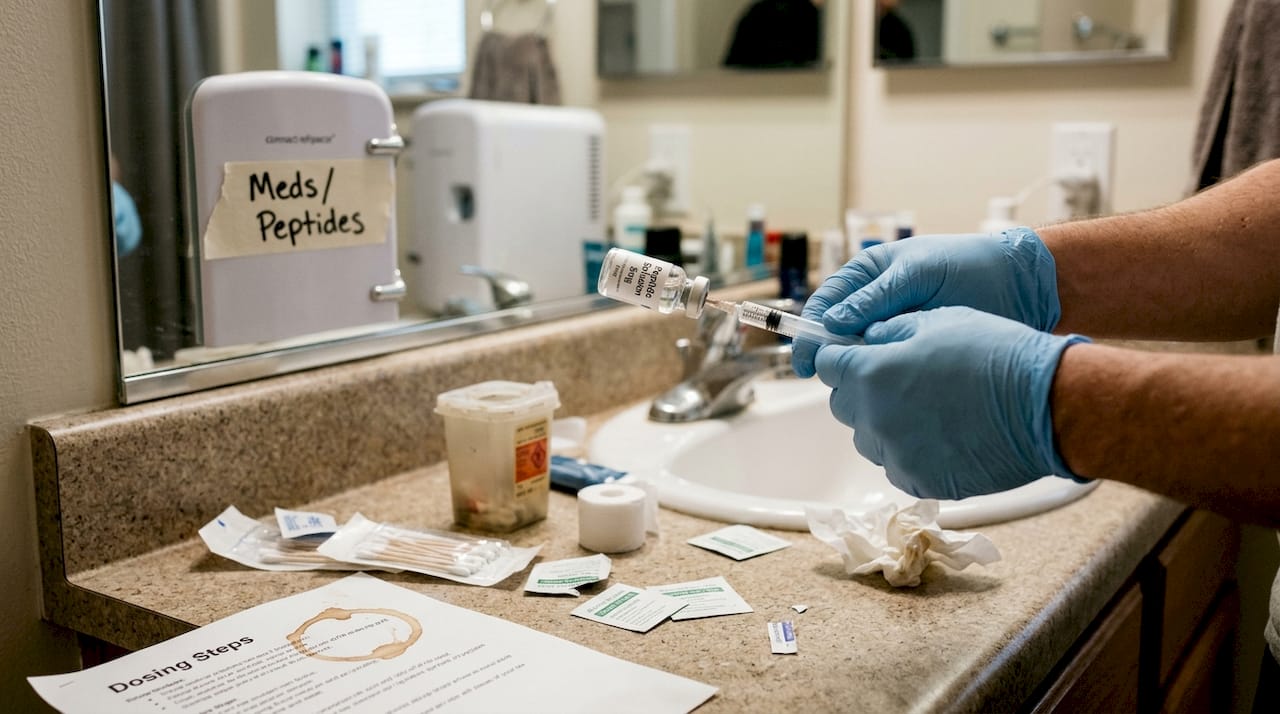
Once you’ve prepared your supplies and environment, you can focus on the precise steps that ensure dosing accuracy and safety. Reconstituting lyophilized peptides is where most beginners make their first mistake.
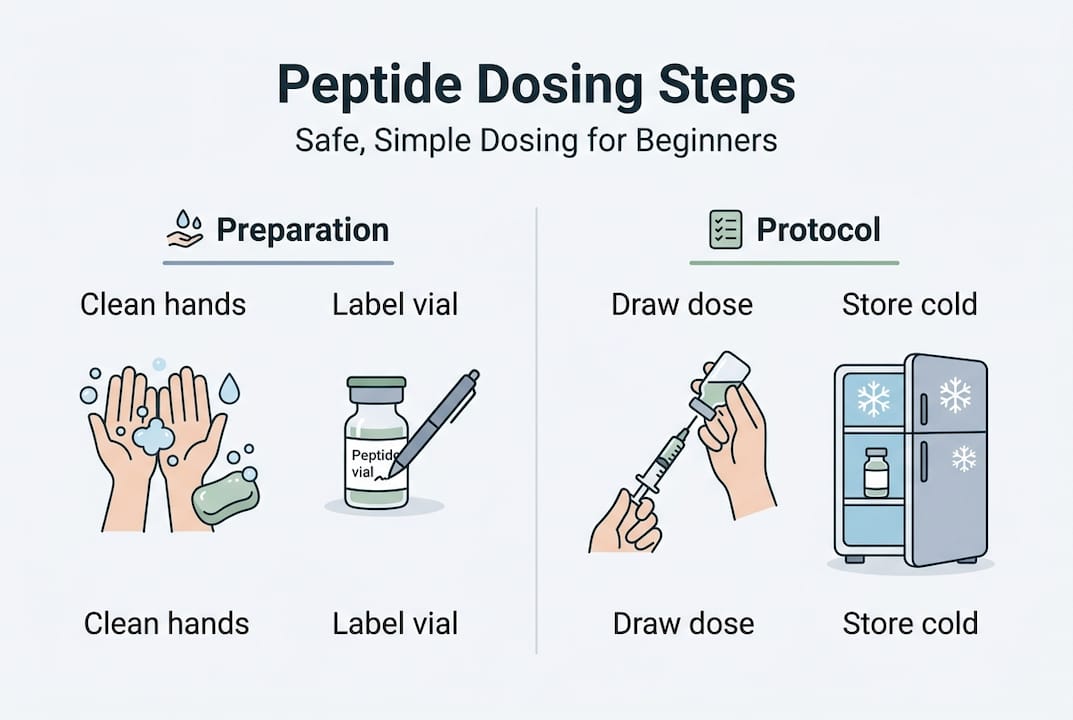
How to reconstitute and dose peptides accurately:
- Remove the plastic cap from both the peptide vial and the bacteriostatic water vial. Wipe both rubber stoppers with a fresh alcohol swab.
- Draw the desired amount of bacteriostatic water into your syringe (1-2 mL is standard for a 5 mg vial).
- Inject the water slowly down the side of the peptide vial. Never shoot it directly onto the powder, as this can damage the peptide structure.
- Gently swirl (do not shake) until the powder fully dissolves. The solution should be clear.
- Calculate your dose. If you added 2 mL of water to a 5 mg (5,000 mcg) vial, each 0.1 mL (10 units on an insulin syringe) equals 250 mcg.
- Draw your calculated dose into a fresh syringe. Pinch a fold of skin at your injection site, typically the abdomen or outer thigh for subcutaneous (subQ) delivery.
- Insert at a 45-degree angle, pull back slightly to check for blood, then inject slowly.
- Dispose of the needle immediately in your sharps container.
For healing and recovery peptides, BPC-157 dosing is commonly set at 250 to 500 mcg per day via subcutaneous injection, split one to two times daily over a 4 to 8 week cycle. That’s a reliable starting reference point.
Pro Tip: Store reconstituted peptides in the refrigerator at 36 to 46 degrees Fahrenheit. Most peptide solutions remain stable for 2 to 4 weeks under these conditions. Write the reconstitution date on the vial.
Common mistakes that kill your results include using regular sterile water instead of bacteriostatic water (which causes rapid degradation), not tracking your math before drawing a dose, and injecting into areas with poor blood supply. For full reconstitution steps, follow a detailed procedural guide alongside this one. And once you’re comfortable with technique, you can cross-reference specific peptide protocols to align your approach with your goals.
Sample dosing protocols for common peptides
Understanding technique is important, but matching your dosing strategy to specific goals is where results are made. Below is a practical reference table for the most widely used peptides in athletic communities.
| Peptide | Typical dose | Frequency | Cycle length | Primary goal |
|---|---|---|---|---|
| BPC-157 | 250-500 mcg | 1-2x daily | 4-8 weeks | Tissue and joint healing |
| TB-500 | 2-2.5 mg | 2x weekly (loading), 1x weekly (maintenance) | 4-6 weeks | Systemic recovery, inflammation |
| CJC-1295 | 100-300 mcg | 1-3x daily | 8-12 weeks | GH release, lean mass |
| Ipamorelin | 100-300 mcg | 1-3x daily | 8-12 weeks | GH pulse, fat loss |
| CJC-1295/Ipamorelin stack | 100-300 mcg each | Before bed or fasted | 8-12 weeks | Muscle growth, body comp |
The CJC-1295 and Ipamorelin stack is among the most popular for muscle growth, dosed at 100 to 300 mcg of each peptide, one to three times daily via subcutaneous injection, typically timed around sleep or fasted states when natural growth hormone pulses are strongest.
Who benefits most from each peptide:
- BPC-157: Athletes dealing with tendon, ligament, or gut issues
- TB-500: Those recovering from chronic inflammation or systemic overtraining
- CJC-1295 alone: Users wanting sustained GH elevation with longer half-life dosing
- Ipamorelin: Clean GH pulses with minimal cortisol or prolactin side effects
- Combined stack: Advanced users targeting simultaneous muscle growth and body recomposition
One of the most talked-about recovery combinations in bodybuilding is the Wolverine Stack, which pairs BPC-157 and TB-500 for synergistic healing.
This combination is popular among athletes for its complementary recovery mechanisms, with BPC-157 targeting localized repair and TB-500 addressing systemic tissue remodeling.
For those wanting to push results further by improving how well their body absorbs and utilizes peptides, understanding improving peptide effectiveness is a smart next step.
How to monitor, troubleshoot, and cycle peptide use safely
With protocols in hand, maximizing safety and results depends on consistent self-monitoring and understanding when and how to adjust. Tracking is not optional if you’re serious about this.
What to monitor during a peptide cycle:
- Recovery time between hard training sessions
- Joint and muscle soreness levels (rated weekly on a 1-10 scale)
- Sleep quality and morning energy
- Injury-specific healing milestones (range of motion, pain at rest vs. under load)
- Body composition changes (monthly photos, waist measurement)
- Any new physical symptoms, injection site reactions, or mood changes
Side effects vary by peptide but commonly include water retention with GH secretagogues, temporary injection site irritation, mild nausea, and tingling in extremities. These are usually dose-dependent. If any symptom escalates or persists, reduce your dose by 50% or pause entirely.
Peptide cycling best practices generally recommend 4 to 12 weeks on followed by a 4-week off period to prevent receptor desensitization. Start at the lower end of any dosing range and titrate upward only if your initial tolerance is good after two full weeks.
“Overconfidence kills progress faster than underdosing. The athletes who stick with peptides long-term are the ones who treat every cycle as a learning experiment, not a guaranteed shortcut.”
Pro Tip: Keep a simple cycle log in a notes app or spreadsheet. Record the peptide name, dose, injection time, and a brief daily wellness note. After four weeks, you’ll have real data instead of guesswork. For a structured system to track and improve your outcomes, check out optimizing peptide outcomes for a practical framework.
Know the red flags. Severe pain at injection sites, systemic symptoms like fever, significant hormonal changes, or unusual mood disruption all warrant stopping immediately and seeking medical advice.
A real-world perspective: The truth about peptide dosing protocols
Here’s something most guides won’t tell you: almost every bodybuilding peptide protocol in circulation is a patchwork of animal data, clinic-derived estimates, and community trial and error. There are no formal PubMed or Examine.com dosing standards for bodybuilding peptide use. What you find on forums and research sites reflects community consensus, not controlled clinical evidence. That’s not a reason to panic, but it is a reason to think critically.
The athletes who get the best results are not the ones following the most aggressive protocols. They’re the ones who understand bioindividuality. Your age, bodyweight, hormonal baseline, training load, and genetics all influence how you respond to any given peptide or stack. One person’s ideal BPC-157 dose is another person’s threshold for side effects.
Continuous education matters more than rigid adherence to a single protocol. Read the differences between peptides and proteins so you understand the mechanism, not just the method. Start low, keep records, and value what your own body tells you over any online guru’s numbers. The most sustainable results in this space come from informed, patient self-experimentation, not blind protocol copying.
Ready for next-level results? Access evidence-based peptide resources
You now have the foundation to dose peptides with real precision and genuine understanding. But knowledge without quality resources is only half the equation.

At Primegen Labs, we’ve built a library of evidence-based peptide guidance designed specifically for athletes who want science behind their strategy. Explore in-depth content on peptides and performance evidence to stay ahead of what the research actually supports. And when you’re ready to put it all into practice, browse our full peptide product catalog for lab-tested options that match the protocols you’ve just learned. Better results start with better inputs.
Frequently asked questions
What’s the safest starting dose for BPC-157 in muscle recovery?
Most protocols start BPC-157 at 250 mcg once to twice daily by subcutaneous injection. The standard BPC-157 range is 250 to 500 mcg per day, run over 4 to 8 weeks for muscle and connective tissue recovery.
How long should a peptide cycle typically last?
Most peptide cycles run 4 to 12 weeks, followed by a mandatory 4-week break. Cycling 4 to 12 weeks on and then off prevents receptor desensitization and keeps the compound effective over multiple cycles.
Is stacking peptides like BPC-157 and TB-500 safe and effective?
The Wolverine Stack combining BPC-157 and TB-500 is widely used for synergistic recovery, and combining these peptides is popular in athletic communities. Human long-term safety data remain limited, so conservative dosing and careful monitoring are essential.
How do I monitor if my peptide regimen is working?
Track weekly recovery time, soreness ratings, sleep quality, and injury-specific progress markers. Use these monitoring strategies to build an objective picture of your response across a full cycle, and consult a knowledgeable provider if results are unclear.
One thought on “Peptide Dosing Guide: Steps, Protocols, and Safe Use”