

What is a custom peptide? Guide for performance & recovery


TL;DR:
- Custom peptides are synthetically designed molecules targeting specific biological pathways.
- Manufacturing quality and purity are critical for safety and effectiveness.
- Human clinical evidence for fitness benefits remains limited, requiring cautious use.
Not all peptides are built the same. While generic peptide blends flood the supplement market, custom peptides represent something fundamentally different: molecules engineered with a specific amino acid sequence to hit a precise biological target. For athletes and fitness enthusiasts pushing beyond conventional recovery, this distinction matters enormously. The problem is that most information out there either oversimplifies the science or overhypes the results. This guide breaks down what custom peptides actually are, how they’re made, what the evidence says about fitness and recovery applications, and what you need to watch for before using them.
Table of Contents
- What is a custom peptide? The basics explained
- How are custom peptides made? Methods, quality, and purity
- Custom peptides in fitness and recovery: Potential and evidence
- Regulations, risks, and what to look for in fitness supplementation
- Why most people misunderstand custom peptides: A reality check for fitness enthusiasts
- Explore custom peptides safely and effectively
- Frequently asked questions
Key Takeaways
| Point | Details |
|---|---|
| Targeted design | Custom peptides are tailored molecules designed for specific health and fitness effects. |
| Manufacturing quality matters | Pharma-grade synthesis and purity are critical for safety and results, especially in fitness use. |
| Regulatory guidance | US and EU regulations treat custom peptides like drugs, requiring GMP sourcing and strict oversight. |
| Evidence is evolving | Most performance claims rest on preclinical data, so manage expectations when considering therapy. |
| Smart supplementation | Verify legitimacy and opt for education-first approaches before using custom peptides. |
What is a custom peptide? The basics explained
A peptide is simply a short chain of amino acids, the same building blocks that make up proteins. What makes a peptide “custom” is that its sequence is deliberately designed and synthetically built for a specific purpose, whether that’s stimulating tissue repair, triggering growth hormone release, or modulating inflammation. You’re not getting a naturally occurring compound pulled from food or a biological source. You’re getting a molecule that was written, letter by letter, in a lab.
Generic peptides are often broad-spectrum, meaning they may influence multiple pathways without precision. Custom peptides, by contrast, are fine-tuned. Think of it like the difference between a blunt instrument and a scalpel. A custom peptide can be optimized for receptor affinity, stability in the body, and bioavailability in ways that off-the-shelf products simply cannot match.
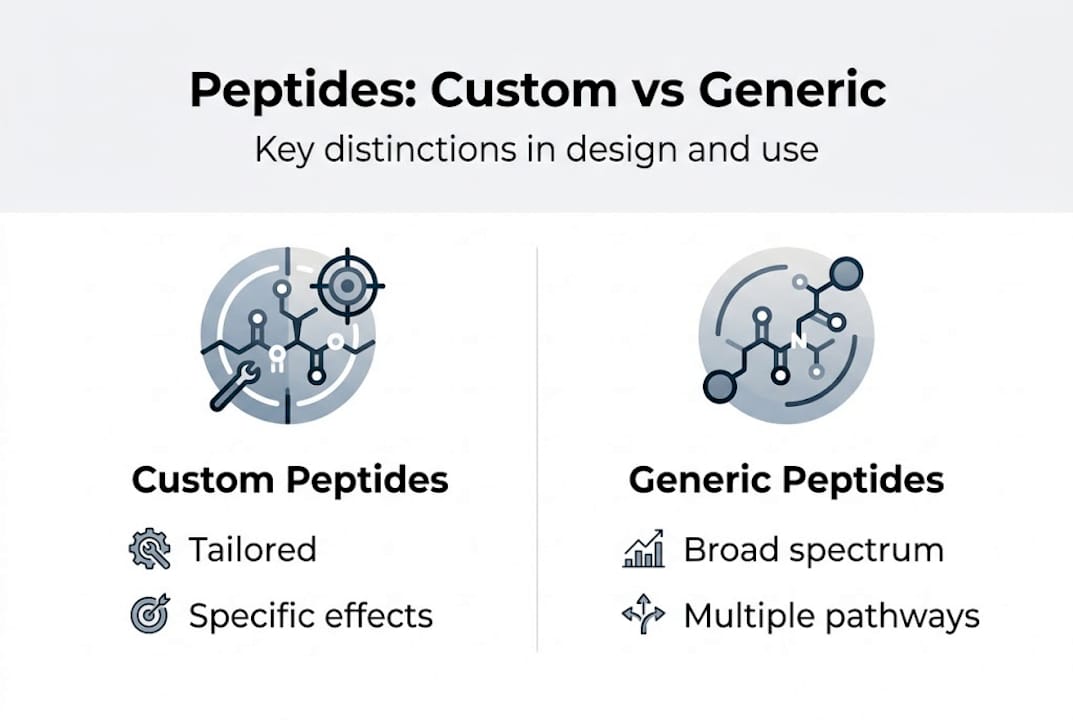
The primary technology behind this is solid-phase peptide synthesis (SPPS). In SPPS, amino acids are added one at a time to a growing chain anchored to a solid resin. Scientists can design specific peptide sequences for highly targeted applications, which is why SPPS has become the gold standard for custom peptide production. The process gives researchers and manufacturers precise control over the final molecule’s structure.
Custom peptides are used across multiple fields: drug development, diagnostics, cosmetics, and increasingly, fitness and performance optimization. In the fitness context, they’re typically designed to interact with receptors involved in muscle growth, fat metabolism, or recovery signaling.
- Custom peptides have a defined, intentional amino acid sequence
- They’re synthesized, not extracted from natural sources
- They target specific biological pathways with greater precision than generic blends
- They can be optimized for stability, potency, and receptor selectivity
- Understanding muscle growth peptide basics is a solid starting point before exploring custom options
Pro Tip: Always seek pharma-grade or GMP-certified custom peptides for health and fitness use. Lower-grade products carry a real risk of impurities that can blunt results or cause harm.
How are custom peptides made? Methods, quality, and purity
Most custom peptides are built using SPPS, but the process isn’t one-size-fits-all. Longer or more structurally complex sequences often require advanced techniques like microwave-assisted synthesis, which speeds up coupling reactions and reduces side products, or native chemical ligation (NCL), which allows scientists to join multiple peptide fragments together to build longer chains that SPPS alone can’t efficiently produce.
Why does manufacturing method matter to you as a fitness user? Because each step in synthesis introduces the potential for errors. Incomplete reactions can produce truncated or deleted sequences, meaning the final product contains fragments that don’t behave like the intended peptide. These impurities aren’t just ineffective; they can be biologically active in ways you don’t want.
Purity standards are where the real divide happens:
| Grade | Purity Level | Typical Use | Risk Level |
|---|---|---|---|
| Pharma-grade | >95% | Clinical, therapeutic use | Low |
| Research-grade | 80-95% | Lab research, animal studies | Moderate |
| Low-grade | <80% | Not recommended for human use | High |
Quality control is done through two key methods: HPLC (high-performance liquid chromatography), which separates and measures peptide components, and mass spectrometry (MS), which confirms the molecular weight matches the intended sequence. Pharma-grade peptides require HPLC and mass spec verification, while research-grade products may carry more impurities with less rigorous testing.
Here’s what the production timeline typically looks like:
- Sequence design and feasibility review
- Resin loading and amino acid coupling (SPPS)
- Cleavage and deprotection of the finished chain
- Purification via preparative HPLC
- QC analysis (HPLC + MS confirmation)
- Lyophilization (freeze-drying) and packaging
From order to delivery, expect 2 to 6 weeks depending on sequence complexity. Understanding how purity affects fitness outcomes is critical before you commit to any product. You can also explore core peptide synthesis methods for a deeper technical overview.
Pro Tip: Before purchasing any custom peptide for fitness or wellness, ask the supplier for a certificate of analysis (COA) showing HPLC purity and MS data. If they won’t provide it, walk away.
Custom peptides in fitness and recovery: Potential and evidence
The fitness world’s interest in custom peptides centers on a handful of well-studied compounds. Understanding what each does, and what the evidence actually supports, keeps you grounded in reality.
Growth hormone-releasing peptides (GHRPs) like GHRP-6 stimulate the pituitary gland to release growth hormone. More GH means faster muscle repair, improved fat metabolism, and better sleep quality. BPC-157 (Body Protection Compound) is a synthetic peptide derived from a protein found in gastric juice. It’s shown strong preclinical results in tendon and ligament healing. TB-500 (Thymosin Beta-4) promotes cell migration and angiogenesis, which is the growth of new blood vessels, supporting faster tissue repair after injury.

| Peptide | Primary Mechanism | Evidence Level | Main Fitness Application |
|---|---|---|---|
| GHRP-6 | GH release stimulation | Preclinical + early human | Muscle growth, recovery |
| BPC-157 | Tissue repair, anti-inflammatory | Preclinical (animal) | Injury healing, gut health |
| TB-500 | Cell migration, angiogenesis | Preclinical (animal) | Soft tissue recovery |
BPC-157 and TB-500 show promise in tissue repair and GH stimulation, but most supporting evidence remains preclinical. Animal studies consistently show accelerated recovery and reduced inflammation, but translating those results to human performance is not straightforward.
“The mechanistic data is compelling, but the leap from rodent models to elite human athletes involves enormous variables in dosing, delivery, and individual biology. Caution is warranted before drawing clinical conclusions.” — Sports medicine researcher perspective on peptide translation
This is where many fitness communities get ahead of the science. The bioactive peptide benefits are real at a mechanistic level, but human clinical trials remain limited. You can also review strategies to improve peptide outcomes through proper protocols.
Watch out for these red flags when evaluating peptide providers:
- Claims of guaranteed muscle gain or injury recovery timelines
- No mention of clinical evidence or regulatory status
- No QC documentation available
- Promises that mirror athletic peptide evidence without acknowledging its preclinical limitations
Regulations, risks, and what to look for in fitness supplementation
The regulatory picture around custom peptides is genuinely complex, and it’s shifting. In the US, the FDA classifies peptides of 40 amino acids or fewer as drugs, not dietary supplements or biologics. That means FDA treats peptides ≤40 AA as drugs, requiring them to go through drug approval pathways before they can be legally marketed for therapeutic use. Buying them outside of a licensed medical context puts you in a legal gray zone.
In the EU, 2026 guidelines from the EMA now mandate strict impurity controls, detailed labeling, and GMP manufacturing for synthetic peptides. The EMA 2026 guidelines require strict impurity control across the production process, raising the bar for what’s considered compliant. Understanding 2026 peptide regulations is essential if you’re sourcing internationally.
“Regulatory frameworks exist not to block access but to protect users from the real harms that come from poorly manufactured or mislabeled products. Ignoring them is a risk most serious athletes shouldn’t take.”
Here’s how to verify a custom peptide product before you use it:
- Request a certificate of analysis with HPLC purity and MS confirmation
- Confirm the manufacturer holds GMP certification
- Check that the peptide’s amino acid count and intended use align with current FDA or EMA rules
- Verify the supplier can provide batch-specific QC data, not just generic documentation
- Consult a physician or sports medicine specialist before starting any peptide protocol
Risks of skipping these steps include contamination with bacterial endotoxins, mislabeled concentrations, and unknown impurities that could trigger immune reactions. For anyone with existing health conditions or who competes under anti-doping rules, medical supervision is not optional. Review essential peptide safety tips before making any purchasing decision.
Key red flags to avoid:
- No regulatory disclosure on the product page
- Miracle recovery claims without citing any clinical data
- Pricing far below market rate (often signals low-grade synthesis)
- No accessible customer support or scientific team
Why most people misunderstand custom peptides: A reality check for fitness enthusiasts
Here’s the uncomfortable truth: the fitness industry has taken a legitimate and genuinely exciting class of molecules and wrapped them in the same marketing language used to sell overpriced protein powders. Custom peptides are not magic bullets. Their effects depend entirely on synthesis quality, dosing precision, delivery method, and whether the specific compound has been studied in humans at all.
The hardest lesson in this space is that animal evidence and mechanistic promise rarely translate into guaranteed human outcomes. A peptide that regenerates rat tendons in two weeks does not mean you’ll be back on the platform in two weeks. Biology is messier than that.
What separates serious users from the hype-chasing crowd is patience and rigor. The path to elite performance through peptide therapy is built on verified sourcing, medical oversight, and realistic expectations. Reviewing evidence and cautions on peptides before committing to a protocol is the kind of due diligence that actually pays off. The science is promising. The shortcuts are not.
Explore custom peptides safely and effectively
If this guide has made one thing clear, it’s that custom peptides reward the educated user. The gap between a well-sourced, properly dosed peptide protocol and a poorly manufactured product bought on impulse is enormous, both in results and in safety.
At Primegen Labs, we’ve built our resources around giving you the science-first foundation you need. Whether you’re starting with muscle recovery peptides, reviewing the full peptide performance evidence, or ready to browse vetted peptide options, every step is backed by transparent quality standards and educational depth. Make your next move an informed one.
Frequently asked questions
Are custom peptides safe for fitness and recovery?
When sourced from GMP or pharma-grade suppliers and used with medical oversight, custom peptides carry a lower risk profile, but impurities and legal gray areas are real concerns. Pharma-grade peptides should exceed 95% purity for the best safety margin.
How do custom peptides differ from regular peptides or proteins?
Custom peptides are synthetically designed for targeted, precise effects, unlike generic peptides or full proteins that act more broadly. SPPS enables highly specific sequences that off-the-shelf products simply can’t replicate.
What results can I expect from custom peptide therapy?
Most human results remain anecdotal; animal and lab studies show real promise for healing and growth, but outcomes depend on quality, compound type, and individual biology. Preclinical data supports custom peptides for tissue repair, but human evidence is still catching up.
Is it legal to buy and use custom peptides in the US and EU?
In the US, most custom peptides are classified as drugs if they contain 40 or fewer amino acids, requiring medical oversight for legal use. In the EU, EMA and FDA have specific manufacturing requirements that became stricter under 2026 guidelines.