

What is peptide resistance? A fitness guide


TL;DR:
- Peptide resistance occurs when tissues adapt by reducing peptide effectiveness through degradation and receptor downregulation. It is slower to develop than antibiotic resistance because peptides target multiple intracellular sites, making adaptation more complex. Strategies like cycling protocols, using high-quality peptides, and combining with proper training help maintain long-term efficacy.
Many fitness enthusiasts assume peptides deliver the same results every time, for every person. That assumption is exactly where results start to slip. What is peptide resistance? At its core, it is the biological process by which cells, bacteria, or tissues reduce how well a peptide can do its job, whether that job is fighting infection, triggering growth hormone release, or accelerating fat breakdown. For anyone using peptides to build muscle or lose weight, understanding peptide resistance is not just academic. It is the difference between a protocol that keeps working and one that quietly stops.
Table of Contents
- Understanding peptide resistance in antimicrobial and fitness contexts
- Why peptide resistance is harder to develop but still possible
- How peptides can enhance fitness results and overcome resistance hurdles
- Applying peptide resistance knowledge for better muscle growth and weight loss
- Why understanding peptide resistance changes how we approach fitness peptides
- Explore effective peptide solutions to beat resistance and boost your fitness
- Frequently asked questions
Key Takeaways
| Point | Details |
|---|---|
| Peptide resistance defined | Peptide resistance occurs when cells or bacteria adapt to reduce peptide effectiveness, mainly by altering membranes or degrading peptides. |
| Slower resistance than antibiotics | Peptides face less rapid resistance development compared to antibiotics due to their multi-target action on cell membranes. |
| Membrane remodeling is key | Changes in membrane charge and structure are central mechanisms cells use to resist peptide effects. |
| Strategic peptide use | Optimizing peptide use with good timing and combinations can reduce resistance and improve fitness results. |
| Knowledge empowers fitness | Understanding peptide resistance leads to smarter peptide choices and better muscle growth and fat loss outcomes. |
Understanding peptide resistance in antimicrobial and fitness contexts
Most of what we know about peptide resistance comes from antimicrobial research, where scientists have studied how bacteria fight back against antimicrobial peptides (AMPs). That research gives us a clear framework for understanding peptide resistance mechanisms that also apply to fitness peptide use.
Bacteria have developed several strategies to neutralize AMPs. Here is what peptide resistance involves at the biological level:
- Proteolytic degradation: Bacteria produce enzymes that physically break down the peptide before it can act.
- Surface modifications: Bacteria alter their outer membrane charge or composition so the peptide cannot bind effectively.
- Physical shielding: Some bacteria produce capsules or biofilms that physically block peptide access.
- Immunomodulation: In some contexts, bacteria hijack immune signals to reduce the host’s peptide-driven response.
Each of these strategies has a parallel in the fitness and therapeutic world. When you use a peptide like CJC-1295 or BPC-157 over a long period, receptor downregulation and enzyme degradation are real factors. Your body is not passive. It adapts. That adaptation is the core of understanding peptide resistance in a fitness context.
To see how this connects to how peptides work biologically, it helps to know that peptides signal receptors, enzymes, and cells. Any of those targets can become less responsive. The result is that the same dose produces a weaker signal over time, a phenomenon fitness users sometimes mistake for “the peptide stopped working” when the truth is more nuanced.
Why peptide resistance is harder to develop but still possible
Here is something that surprises most people: microbes actually struggle more to develop resistance to peptides than to conventional antibiotics. The reason is structural. AMPs disrupt multiple targets simultaneously, particularly membrane integrity, so a single random mutation cannot neutralize the threat. A bacterium would need to make several coordinated changes at once, which is statistically much harder.
Research confirms this directly. In controlled lab studies, antibiotics develop resistance significantly faster than AMPs over a 60-day period of experimental evolution in E. coli. That is a meaningful finding for anyone evaluating peptides as part of a long-term health or fitness strategy.
How does this apply to your fitness peptide use? Follow this logic:
- Multiple mechanism targeting reduces vulnerability. Peptides that work through several pathways at once are harder for your body to fully adapt around.
- Resistance is slower but not zero. Prolonged use of the same peptide at the same dose, without cycling or variation, can still produce diminishing returns.
- Receptor-level adaptation is the most common fitness concern. Unlike bacterial resistance, fitness peptide resistance is usually about receptor saturation or downregulation, not genetic mutation.
- Quality matters enormously. Low-purity peptides degrade faster and may trigger immune clearance, which mimics resistance effects even when true adaptation has not occurred.
Pro Tip: Cycling your peptide protocols, similar to how you cycle training phases, gives receptors time to reset and helps maintain consistent response over months of use.
Understanding this helps you apply peptide optimization strategies that account for biology rather than fighting against it. The goal is not to overpower your system. It is to work with it.
How peptides can enhance fitness results and overcome resistance hurdles
The research on overcoming peptide resistance is moving fast, and some of it has direct implications for how fitness users can structure their protocols. One of the most interesting findings involves peptides that do more than act directly. They act as adjuvants, meaning they change the environment so that other agents, or other peptides, work better.

Cationic peptides like TP2-5 demonstrate this clearly. They remodel bacterial membranes, making pathogens more sensitive to antibiotics and slowing the emergence of resistance in the process. Translated to fitness use, this same principle suggests that combination protocols, where one peptide prepares the cellular environment for another, may produce more sustained results than relying on a single peptide indefinitely.
Here is how that plays out practically:
| Strategy | Mechanism | Fitness benefit |
|---|---|---|
| Single peptide, fixed dose | Receptor-specific signaling | Effective short-term, diminishing returns over time |
| Cycled protocols | Receptor reset between periods | Sustained response over longer periods |
| Combination peptide use | Synergistic receptor and pathway activation | Broader effect with lower individual doses |
| Adjuvant-style stacking | One peptide primes pathways for another | Improved bioavailability and receptor sensitivity |
Combination approaches that slow resistance emergence also support more consistent fat loss and muscle recovery outcomes. Using a growth hormone secretagogue alongside a recovery peptide, for example, engages different pathways, reducing the risk that any single pathway becomes desensitized.
Key principles for maintaining peptide effectiveness:
- Rotate peptides every 8 to 12 weeks to prevent receptor downregulation from becoming entrenched.
- Start with the minimum effective dose rather than maxing out immediately. Lower doses reduce adaptation pressure.
- Pair peptides with the right training stimulus. A peptide that supports muscle protein synthesis delivers more when paired with progressive resistance training.
- Monitor your results with objective metrics, not just how you feel. Strength numbers, body composition data, and recovery time all tell you whether a peptide is still working.
Pro Tip: If you notice your results plateauing at the same point in each cycle, that is a signal the receptor is adapting. Switching peptide classes rather than simply increasing dose is usually the smarter move.
Explore the full peptides and performance evidence base, and see the detailed peptide guide for muscle growth and recovery to match your peptide choices to your actual goals.
Applying peptide resistance knowledge for better muscle growth and weight loss
Peptide resistance explained in theory only helps if you can recognize it and act on it in practice. Here is what to watch for and what to do.
Signs that peptide responsiveness may be declining:
- Fat loss slows or stops despite consistent dosing and diet
- Muscle recovery time returns to pre-peptide baseline
- Sleep quality improvements (common with peptides like GHRP-2) fade after several weeks
- You need a higher dose to feel the same effect you noticed at the start
Steps to optimize peptide delivery and effectiveness:
- Time your peptides correctly. Most growth hormone secretagogues are most effective on an empty stomach or away from high-fat meals, which slow absorption and reduce peak signaling.
- Maintain cold chain integrity. Peptides degrade at room temperature. Degraded peptides do not just stop working, they may trigger immune responses that accelerate clearance.
- Combine with targeted nutrition. High protein intake supports the muscle protein synthesis pathways that peptides activate. Without the raw material, the signal has nothing to build with.
- Audit your training. Peptides amplify adaptive stress. If your training has not progressed, the peptide signal has less to amplify.
- Review your peptide source. Purity directly affects both effectiveness and resistance development. Low-grade peptides introduce contaminants that your immune system flags and clears faster.
Understanding how to optimize peptide bioavailability is one of the highest-leverage moves you can make, because the most common cause of perceived peptide resistance is not receptor adaptation at all. It is delivery failure. And knowing how to improve peptide outcomes for fitness and recovery gives you a concrete framework to troubleshoot before assuming resistance has occurred.
Why understanding peptide resistance changes how we approach fitness peptides
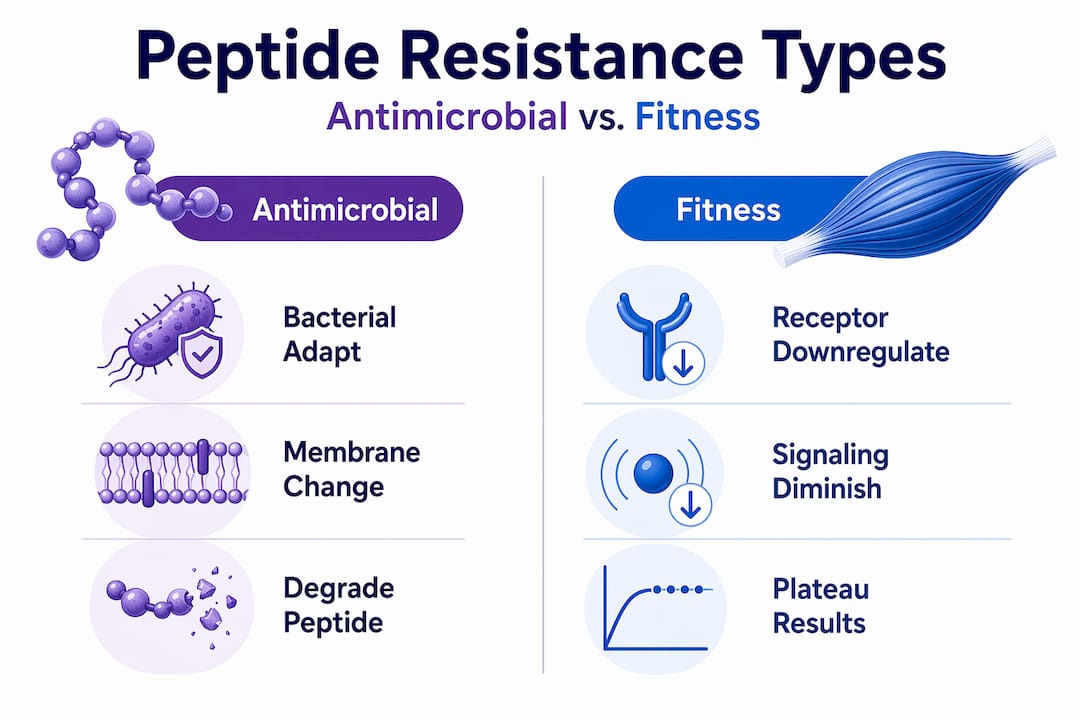
Here is the uncomfortable truth most peptide content will not tell you: the fitness industry often sells peptides as if biology is static. As if a peptide that worked in week one will work identically in month six, at the same dose, with the same frequency, without any adjustment. That is not how biology works, and peptide resistance mechanisms from complex membrane remodeling to receptor adaptation make fitness results genuinely variable.
The real shift in thinking is this: peptide resistance is not a failure of the peptide. It is information. When your results plateau, your biology is telling you something about how it has adapted. That is actually a sign a peptide was working. The goal from that point is to adapt your strategy, not chase a higher dose.
Fitness enthusiasts who develop scientific literacy about how peptides interact with biology over time will always outperform those chasing the next “stronger” compound. The most effective long-term users are not the ones taking the most peptides. They are the ones paying attention, cycling smart, and treating their protocol like a training program that needs progressive variation, not just progressive loading.
Stay current with top peptide research trends to keep your strategy grounded in what the science actually shows, not what marketing suggests.
Explore effective peptide solutions to beat resistance and boost your fitness
Knowing what peptide resistance is gives you a real advantage. The next step is putting that knowledge to work with products and resources built on the same scientific foundation.

At PrimeGen Labs, every peptide product is backed by transparent sourcing and research-based guidance designed for fitness enthusiasts who want results that hold up over time. Whether you are focused on muscle growth, fat loss, or recovery, our peptides and performance guide walks you through the evidence behind each compound. The peptide guide for muscle growth gives you the protocol structure to apply what you have learned here, and our peptide bioavailability optimization resource makes sure every dose actually reaches its target. Better science, better results.
Frequently asked questions
What exactly is peptide resistance?
Peptide resistance is when bacteria or cells reduce the effectiveness of peptides by adapting through degradation, surface changes, and shielding, making peptides less effective over time. In fitness contexts, it most often shows up as receptor downregulation or increased enzymatic clearance.
Can peptide resistance affect my muscle growth or fat loss?
Yes. If your cells become less responsive to peptides through adaptation mechanisms, the signaling that drives muscle protein synthesis or fat mobilization weakens, and your results plateau even when dosing remains consistent.
Are peptides better than antibiotics when it comes to resistance?
Generally, yes. Resistance to antibiotics emerges significantly faster than resistance to antimicrobial peptides because peptides attack multiple membrane targets at once, requiring more complex adaptation from the opposing biology.
How can I reduce the risk of peptide resistance when using peptides for fitness?
Cycle your peptide protocols every 8 to 12 weeks, use the minimum effective dose, prioritize high-purity products, and pair peptide use with consistent training and nutrition so your body has the right environment for the peptide signal to act on.