

Your Peptide Results Tracking Guide for 2026


TL;DR:
- Effective peptide tracking requires establishing baseline labs within 30 days before starting to accurately compare progress and detect issues early. Daily logs of symptoms, doses, and injection sites, combined with weekly trend reviews, ensure consistent data collection and better protocol adjustments. Proper documentation and patient patience help achieve meaningful results over 8 to 12 weeks, preventing common mistakes like skipping labs or unreliable subjective assessments.
Most people start a peptide protocol feeling hopeful, then spend weeks wondering if anything is actually working. Without a structured peptide results tracking guide, you’re left guessing whether that better sleep is from the peptide, the new mattress, or placebo effect. The truth is that peptides can produce measurable, meaningful changes in body composition, recovery, and metabolic health. But those changes only become clear when you track the right things, at the right intervals, with the right tools. This guide gives you exactly that.
Table of Contents
- Key takeaways
- Setting up your peptide results tracking guide
- Daily and weekly execution that actually holds up
- Reading the data: labs, trends, and when to adjust
- Common tracking mistakes to avoid
- What realistic progress actually looks like
- My honest take after years of watching people track (and not track) peptide protocols
- Take your peptide protocol further with Primegenlabs
- FAQ
Key takeaways
| Point | Details |
|---|---|
| Baseline labs are non-negotiable | Draw bloodwork within 30 days before your first dose to create a valid comparison point. |
| Daily logs beat memory | Record energy, sleep, side effects, and dosing every day so weekly reviews reveal real trends. |
| Photos need consistency | Standardized lighting, angles, and timing turn progress photos into objective data, not guesswork. |
| Lab values tell the full story | Tracking IGF-1, liver enzymes, and glucose markers lets you catch issues before they become problems. |
| Mistakes are preventable | Most tracking failures come from missing baselines, skipping logs, and ignoring reconstitution records. |
Setting up your peptide results tracking guide
Before your first injection, you need a system. Not a vague intention to “pay attention to how you feel.” A real system with baselines, logs, and scheduled reviews.
Baseline labs: your most critical starting point
Baseline labs drawn within 30 days before your first dose are the foundation of everything else. Without them, you have no reference point. You won’t know if your IGF-1 improved, stayed flat, or spiked into a danger zone. The specific labs you need depend on your peptide class. Growth hormone secretagogues like CJC-1295 or Ipamorelin require IGF-1, fasting glucose, and HbA1c at minimum. GLP-1 class peptides require a comprehensive metabolic panel, lipid panel, HbA1c, TSH, and lipase.
Pro Tip: Schedule follow-up labs at 6 to 8 weeks into your protocol, then every 3 months during maintenance. This cadence catches problems early and confirms the protocol is working.
After baseline labs, set up a daily symptom log. Give every metric a number. Rate your sleep quality from 1 to 10. Rate your energy at the same time every day. Rate any side effects on the same scale. Structured symptom tracking with daily quantification allows you to catch patterns that memory will never catch.
What else to log from day one
Here is what your pre-protocol setup should include:
- Peptide details: Peptide name, source, concentration in mcg/mL after reconstitution, lot number, and expiration date
- Injection site map: A rotation schedule (abdomen quadrant 1, then 2, then 3, etc.) to avoid tissue buildup and track where reactions occur
- Progress photos: Front, side, and back under identical lighting at the same time of day. Morning, fasted, is the standard
- Body weight and measurements: Waist, hips, chest, and upper arm at the same time, under the same conditions
- Dosing protocol: Exact dose in mcg, frequency, and time of administration
Use whatever format fits your life. Dedicated apps, a Google Sheets template, or a physical journal all work. The system that you will actually use consistently beats the “perfect” system you abandon after two weeks.
Daily and weekly execution that actually holds up
Knowing what to track is half the job. The other half is building the habit so it gets done every single day without friction.
Your daily tracking routine
Follow these steps every day during your protocol:
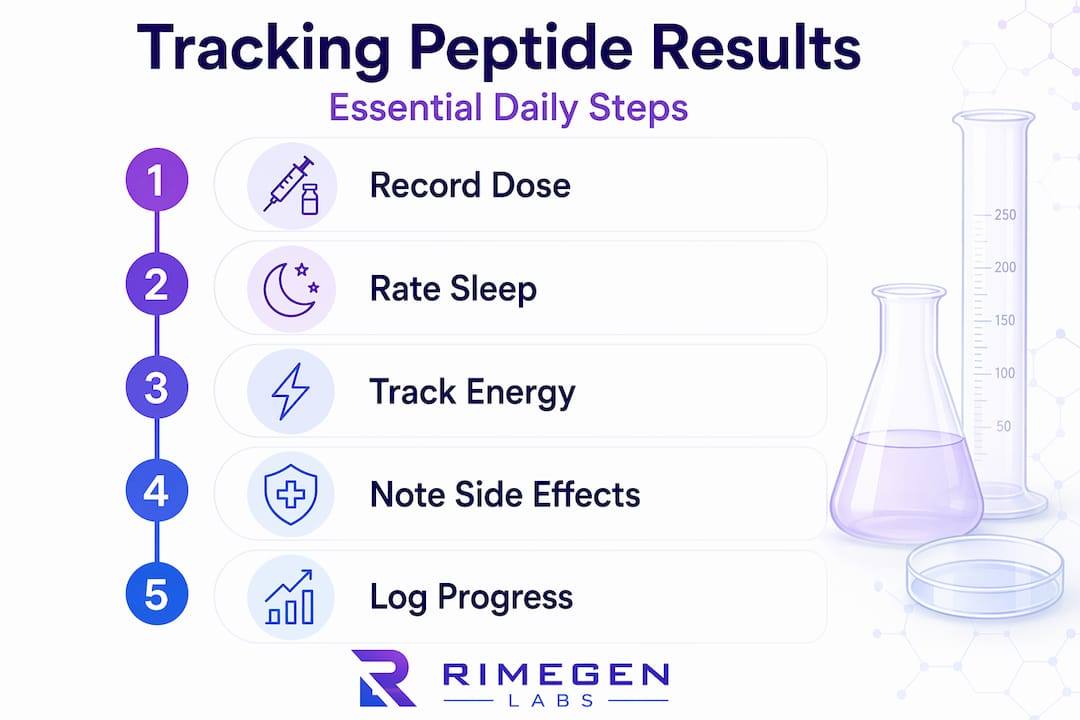
- Log your dose immediately after injecting. Record the time, dose in mcg, and injection site. Never rely on memory for this, since errors compound fast when you’re running multiple peptides.
- Rate your energy, sleep, and mood on a 1 to 10 scale at the same time each day. Mornings work best because the score reflects overnight recovery.
- Note any side effects in a separate column from desired effects. Tingling, water retention, hunger changes, and injection site reactions all belong here.
- Flag anything unusual in a notes field. This includes changes in appetite, libido, skin texture, or any symptom that feels out of the ordinary.
- Check peptide storage conditions. Reconstituted peptides require refrigerated storage between 2 and 8°C, protected from light. Confirm your vial is stored correctly each time you access it.
Weekly review: where trends become visible
At the end of every week, review the full 7 days of logs together. This is where fitness progress tracking with peptides gets genuinely useful. A single bad sleep night means nothing. Five bad nights in a row during week three means something worth investigating.

Weekly reviews identify trends instead of sending you spiraling after one rough day. Compare this week’s average energy score to last week’s. Compare your weekly photo to the one from four weeks ago, not yesterday. Look at your body weight average across the week rather than obsessing over a single morning’s number.
Pro Tip: Set a calendar reminder for Sunday evening as your weekly review time. Fifteen minutes of review saves you from weeks of wasted effort running a protocol that quietly stopped working.
Reading the data: labs, trends, and when to adjust
Tracking data only matters if you know how to act on it. This section covers interpreting lab results and recognizing when your protocol needs to change.
Key lab markers by peptide class
| Peptide class | Core lab markers | Review interval |
|---|---|---|
| GH secretagogues | IGF-1, fasting glucose, HbA1c | Every 6 to 8 weeks |
| GLP-1 agonists | CMP, lipid panel, HbA1c, TSH, lipase | Every 6 to 8 weeks |
| Healing peptides (BPC-157, TB-500) | CMP, kidney function (eGFR) | Every 8 to 12 weeks |
| General protocol | CBC, liver enzymes (ALT, AST) | Every 3 months |
For GH secretagogue users, IGF-1 levels more than 50% above the upper limit indicate supraphysiologic stimulation and require dose reduction. The goal is age-adjusted normal IGF-1, not the highest number possible.
Stop and adjust thresholds
Certain lab results require immediate cessation, not a “let’s wait another week” approach. Immediate stop criteria include ALT or AST exceeding twice the upper normal limit, eGFR falling below 60, or lipase and amylase exceeding three times the upper normal limit. Severe abdominal pain is a clinical red flag regardless of lab values.
“Lab results represent trends over time. A single anomalous test or one bad symptom day should not trigger dose changes on its own unless the finding persists across multiple data points.” Source: How to Design a Peptide Monitoring Protocol
Combine your objective lab data with your quantified symptom logs when you bring results to your healthcare provider. Predefined monitoring protocols with clear stop and adjust criteria dramatically reduce adverse events compared to improvising based on how you feel week to week.
Common tracking mistakes to avoid
Even motivated, detail-oriented people make these errors. Knowing them in advance keeps your data clean and your protocol safe.
- Skipping baseline labs. This is the single most damaging mistake. Without a pre-protocol reference, your follow-up labs are numbers without context.
- Relying only on subjective feelings. Predefined written dose adjustment rules prevent arbitrary changes driven by a single good or bad day. Feelings are useful data points, but they are not the whole picture.
- Not logging reconstitution details. Peptide solutions degrade if freeze-thawed, and reconstituted peptides have a shelf life of 2 to 6 weeks depending on class. If you are not tracking this, you may be injecting degraded peptide and blaming your protocol for poor results.
- Inconsistent photo conditions. Different lighting, angles, or time of day makes photo comparisons worthless. Set a standard and follow it every single time.
- Abandoning logs prematurely. Most people stop logging when they feel good. That is exactly when the logs matter most because trends shift gradually and you need the data to see it.
Pro Tip: Tracking injection sites with a rotation map prevents tissue fibrosis and gives you a paper trail if a localized reaction appears. This is one of those peptide safety tips that most beginners skip and regret.
What realistic progress actually looks like
One of the most common causes of protocol abandonment is misaligned expectations about when results appear and what they look like.
Here is how progress typically unfolds:
- Weeks 2 to 4: Early subjective changes. Better sleep quality, improved recovery after training, subtle mood or energy shifts. These are real effects. They just don’t show up in the mirror yet.
- Weeks 6 to 8: Objective changes start to emerge. Lab markers begin reflecting the protocol’s effect, and progress photos from week one versus week eight reveal meaningful body composition shifts.
- Weeks 8 to 12: This is where most users see the full range of benefits. Fat loss, lean mass retention, and recovery speed all show measurable improvement for well-designed protocols at this stage.
- Months 4 to 6: Peak effects for longer protocols. Consistent tracking at this point allows you to evaluate whether cycling off or continuing serves your goals better.
Normal week-to-week fluctuations are not setbacks. Weight varies by 2 to 3 pounds due to water, food volume, and hormonal cycles. Your weekly average across 7 days is the number worth analyzing. A single morning weigh-in is just noise.
When your logs show stalling improvements across 3 to 4 consecutive weeks and labs look stable, that is the signal to consider adjusting your dose, changing your protocol structure, or planning a cycle break. Consult your peptide dosing guide for protocol-specific recommendations before making changes.
My honest take after years of watching people track (and not track) peptide protocols
I’ve worked with a lot of fitness clients using peptides, and the pattern is almost always the same. The ones who get results are not necessarily the ones using the best peptides or the highest doses. They are the ones who show up to every weekly review with their logs filled out, their photos taken, and their lab results in hand.
What I’ve learned is that most protocol failures are not biological failures. They are documentation failures. Someone skips labs, makes a dose change based on a rough week, then can’t figure out why their results plateaued at week ten.
My take is that the tracking system is actually the protocol. The peptide is just the input. The data you collect determines whether you get meaningful output or spend months spinning your wheels.
Realistic outcomes matter too. I’ve seen people quit at week six because they expected dramatic body recomposition in 30 days and didn’t get it. The typical results timeline of 8 to 12 weeks for full benefits is not marketing spin. It’s how human physiology actually works. Your tracking system keeps you patient and informed through that window.
Build the habit, protect the data, and let the objective evidence guide every decision. That is the only version of this that works.
— Yvette
Take your peptide protocol further with Primegenlabs
If you’ve got your tracking system set up and you’re ready to pair it with quality peptides and real science, Primegenlabs has the resources you need.

Primegenlabs offers detailed guidance on peptide performance evidence so you understand exactly what each compound is doing in your body and what markers confirm it’s working. Whether you’re focused on recovery, lean muscle, or metabolic health, the site covers the specific protocols, safety considerations, and dosing structures that support each goal. You’ll also find guides on peptide reconstitution procedures to keep your vials potent and your data accurate from day one. Tracking works best when what you’re injecting is handled correctly from the start.
FAQ
What labs do I need before starting a peptide protocol?
Draw baseline bloodwork within 30 days of your first dose. For GH secretagogues, prioritize IGF-1, fasting glucose, and HbA1c. GLP-1 class peptides require a metabolic panel, lipid panel, TSH, and lipase.
How do I track peptide progress week by week?
Log daily metrics including energy, sleep, side effects, and dose details, then review all 7 days together at the end of each week to spot trends rather than reacting to individual data points.
When should I stop my peptide protocol based on labs?
Stop immediately if ALT or AST exceeds twice the upper normal limit, eGFR drops below 60, or lipase and amylase exceed three times the upper normal limit.
How long before peptides show measurable results?
Early subjective effects typically appear within 2 to 4 weeks, with objective and visual changes becoming clear between weeks 8 and 12 of a consistent protocol.
What is the most common mistake in tracking peptide results?
The most damaging mistake is skipping baseline labs. Without a pre-protocol reference point, your follow-up lab results have no valid comparison and cannot confirm whether the protocol is working or causing harm.