

How to Adapt Peptide Plans for Better Results


TL;DR:
- Most people start with generic peptide protocols, but personalized adjustments based on lab data are essential for optimal results. Conduct baseline blood tests, begin at low doses, and reevaluate after 4-8 weeks with follow-up labs to ensure safety and efficacy. Patience, monitoring, and lifestyle integration are crucial for sustainable, measurable progress with peptide therapy.
Getting your peptide plan right the first time is rare. Most fitness enthusiasts start with a generic protocol copied from a forum or a friend, see mixed results, and assume peptides just don’t work for them. The truth is that knowing how to adapt peptide plans is what separates people who get measurable gains in performance and recovery from those who plateau or run into avoidable side effects. This guide walks you through the full process of personalizing, monitoring, and refining your protocol based on your actual biomarkers, goals, and lifestyle.
Table of Contents
- Key takeaways
- How to adapt peptide plans: what you need first
- A step-by-step guide to personalizing your protocol
- Troubleshooting problems when modifying peptide protocols
- Knowing if your adapted plan is actually working
- My honest take on adapting peptide plans
- Start building your personalized peptide protocol
- FAQ
Key takeaways
| Point | Details |
|---|---|
| Start with baseline labs | Get CBC, CMP, IGF-1, and HbA1c before touching any peptide protocol. |
| Dose low, adjust slowly | Begin at the lowest effective dose and increase by 10-20% only after a 4-8 week evaluation window. |
| Lab data beats gut feeling | IGF-1 can rise to dangerous levels without any noticeable symptoms, so never rely on how you feel alone. |
| Stack carefully or not at all | Combining peptides can amplify results, but incompatible stacks create unpredictable risks without professional guidance. |
| Reevaluate as your goals change | Peptide protocols should evolve alongside your training phase, health status, and lifestyle shifts. |
How to adapt peptide plans: what you need first
Before you touch a single variable in your protocol, you need a clear picture of where you are starting from. Adjusting without baseline data is like changing your car’s fuel mixture without knowing the engine specs. You might get lucky, but you are far more likely to cause damage.
The non-negotiables before any modification include:
- Baseline bloodwork: CBC, CMP, and IGF-1 panels, along with HbA1c and fasting glucose if you are using GH-axis peptides like CJC-1295 or Ipamorelin. Lipid and thyroid panels round out a complete pre-protocol picture.
- Peptide class awareness: Growth hormone secretagogues, repair peptides like BPC-157, and metabolic peptides all work through different mechanisms and carry different risk profiles. Knowing which class you are working with shapes every downstream decision.
- Clear, measurable goals: “Feel better” does not count. Define whether you are targeting faster recovery, strength output, body composition, or sleep quality. Your goal determines which peptides are even worth considering.
- Legal and sourcing clarity: As of 2026, FDA enforcement has placed peptides like BPC-157, TB-500, and Ibutamoren in Category 2 Bulk Drug Substance status, which restricts compounding and availability. Know what you are legally accessing and from whom.
Pro Tip: Get your baseline labs drawn within 30 days of your intended start date. Labs pulled earlier than that may not accurately reflect your current metabolic state, especially if your training load or diet has recently shifted.
Setting goals aligned to your health status matters more than most people realize. A 45-year-old with slightly elevated fasting glucose and a 28-year-old competitive athlete do not need the same peptide plan. They may not even be safe on the same peptides. Peptide plan customization starts here, before any protocol decisions are made.
A step-by-step guide to personalizing your protocol
Once your baseline is established, you can start building and adjusting with real confidence. Here is a practical framework for modifying peptide protocols intelligently.
-
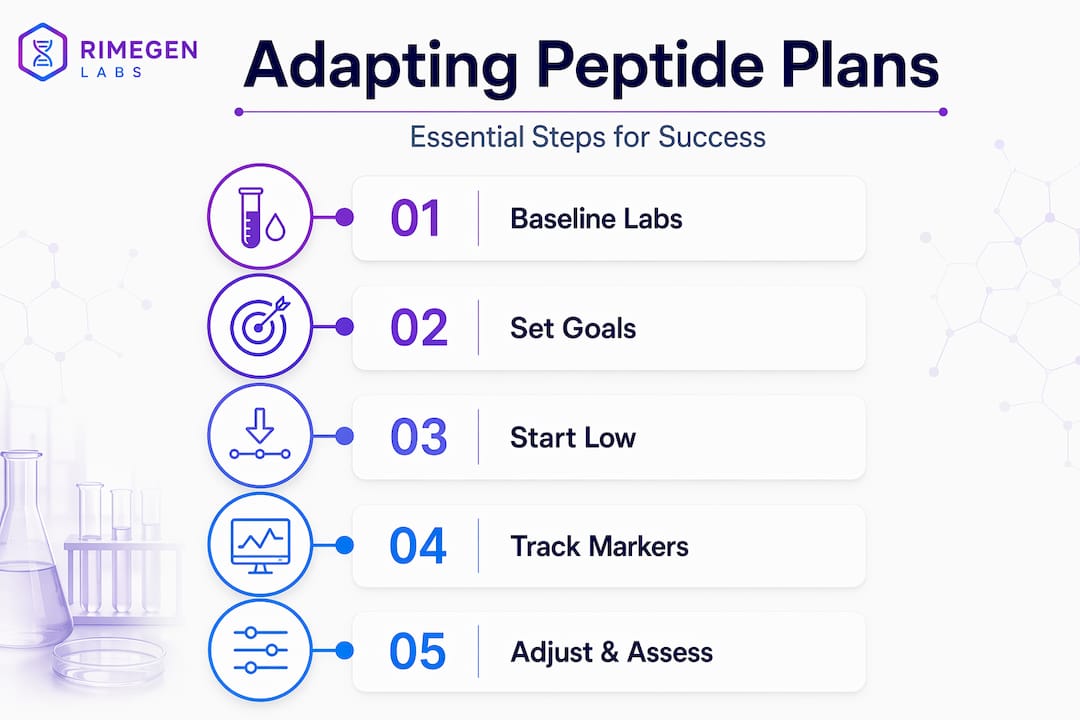
Start at the lowest effective dose. For BPC-157, that typically means 250 mcg per day. For CJC-1295 or Ipamorelin, start at 50-100 mcg per injection. Resist the urge to front-load. Peptides are not steroids. More is not better at the outset.
-
Run the dose for 4-6 weeks before changing anything. Your body needs time to respond. Changing variables too early makes it impossible to know what is working and what is not.
-
Reevaluate with follow-up labs at 6-8 weeks. For GH-axis peptides, IGF-1 reaches steady state at around 4-6 weeks, which makes the 6-8 week check the first real window to assess impact and safety.
-
Adjust dose by 10-20% if benefits are modest. Do not double doses or switch peptides impulsively. Incremental changes give you control and reduce adverse event risk.
-
Consider stacking only after a successful single-peptide run. Stacking peptides with complementary mechanisms can amplify energy, recovery, and body composition outcomes, but only if you already know how each peptide behaves in your body individually.
-
Integrate lifestyle factors into your tracking. Protocols are ineffective without addressing nutrition, sleep quality, training load, and stress. If your sleep has been poor for three weeks, that is a protocol variable, not just background noise.
-
Repeat labs every three months, with a 6-8 week interim check if any markers were abnormal on your previous panel.
Here is a practical reference for common peptide starting points and adjustment windows:
| Peptide | Starting dose | Evaluation window | Key lab marker |
|---|---|---|---|
| BPC-157 | 250 mcg/day | 4-6 weeks | CMP, general markers |
| CJC-1295/Ipamorelin | 50-100 mcg/injection | 6-8 weeks | IGF-1, fasting glucose |
| TB-500 | 2-2.5 mg/week | 4-6 weeks | CBC, inflammatory markers |
| Epitalon | 5-10 mg/cycle | End of cycle | Thyroid, CBC |
Pro Tip: Reconstitution volume directly affects your actual dose per injection. Dosing errors from reconstitution are one of the most common and easily preventable mistakes. Always use a reconstitution calculator and double-check your math before every vial.
Adjusting peptide strategies requires patience. The process is iterative by nature, not a one-time setup. The fitness athletes who get the best long-term results treat their protocol like a training program. They test, log, and tweak based on data, not feelings.

Troubleshooting problems when modifying peptide protocols
Even well-designed protocols hit problems. Knowing what to look for, and what to do when you find it, keeps complications from becoming serious.
Watch for these red flags during any active protocol:
- Elevated IGF-1 on labs: Supraphysiologic IGF-1 is a sign you are overdoing GH-axis stimulation. Symptoms like joint pain appear late, which is why you cannot rely on how you feel to catch this early.
- Rising fasting glucose or HbA1c: GH-axis peptides can reduce insulin sensitivity. If these markers start climbing, reduce dose or pause the protocol and retest in four weeks.
- Injection site reactions beyond mild redness: Persistent swelling, hardness, or discoloration can indicate improper reconstitution, contaminated product, or an incompatible carrier solution.
- No response after eight weeks at a standard dose: Before increasing dose, rule out product quality issues, incorrect injection technique, and lifestyle factors that might be blunting response.
Common errors in peptide plan customization tend to cluster around a few predictable patterns. Skipping baseline or follow-up labs is the most dangerous. It removes your only objective safety net. Stacking peptides before establishing single-compound tolerability is another frequent mistake. The third is ignoring concentration differences between vials from different batches, which makes your effective dose unpredictable even if you are injecting the same volume.
If lab markers go out of range, the protocol is not working for your current biology. Pause the offending compound, retest in four weeks, and only restart at a lower dose once markers normalize. Trying to power through abnormal labs is how adaptable peptide therapy becomes a medical problem.
“Skipping monitoring labs can lead to severe complications. Lab work is indispensable for safety, not optional due diligence.” — Clinical Monitoring Guidance
For safe protocol adjustments, always taper down rather than abruptly stopping long-running protocols, particularly with GH-axis compounds. The goal is a controlled exit, not a hard stop.
Knowing if your adapted plan is actually working
Results from peptides are not always dramatic or fast. Setting realistic expectations is part of the process.
Here is what to track and when:
- Recovery time between sessions: Most users on BPC-157 or TB-500 notice measurable improvement in recovery within three to six weeks. Track this by logging soreness levels and time-to-readiness after hard sessions.
- Strength and endurance output: Log training data weekly. Small but consistent improvements over six to twelve weeks are more meaningful than dramatic one-week spikes.
- Body composition changes: These take longer. Expect eight to twelve weeks before drawing conclusions on lean mass or fat changes tied to GH-axis peptides.
- Subjective markers: Sleep quality, mood stability, and energy levels can shift within the first few weeks and serve as early indicators that the protocol is heading in the right direction.
- Lab marker trends: A peptide protocols should evolve approach means comparing your 6-week labs to your baseline and looking for movement in the right direction, not just a single snapshot.
When results plateau or markers stagnate, that is the signal to reconsider your protocol rather than simply increase your dose. Sometimes the answer is a training phase change. Sometimes it is a peptide class switch. Sometimes it means taking a full cycle break and letting your receptors reset.
The best practices for peptide plans always include a defined end point or reassessment window, not an open-ended run. That mindset is what keeps adapting peptide therapy sustainable over the long haul.
My honest take on adapting peptide plans
I have worked with enough protocols to say this plainly: the one-size-fits-all approach does not fail occasionally. It fails regularly. People come in with cookie-cutter dosing schedules and no lab history, convinced the problem is the peptide. Almost always, the problem is the approach.
What I have seen work consistently is treating lab data as the non-negotiable center of every decision. Not anecdote, not someone else’s results, not how you feel at week three. Your IGF-1, your fasting glucose, your CBC. Those numbers tell you what your body is actually doing with the protocol. Subjective improvement without supportive labs is a coincidence until proven otherwise.
I also think the lifestyle integration piece gets badly underestimated. I have watched athletes dial in perfect dosing only to undercut every benefit with four hours of sleep and chronic stress. Peptides are not a workaround for foundational health practices. They are an amplifier. If the signal is weak, amplifying it just produces louder noise.
The best results I have seen come from people who are patient, methodical, and genuinely curious about their own data. They iterate. They do not chase dramatic changes. They trust the process and let the labs confirm what is working. That is the real skill in adapting peptide therapy. It is not about knowing which peptides exist. It is about knowing how to read feedback and adjust accordingly.
— Yvette
Start building your personalized peptide protocol
If this guide has you thinking more carefully about your current protocol, that is exactly the right response. At Primegenlabs, the resources are built specifically for fitness-focused individuals who want to go beyond generic dosing and build plans that actually fit their bodies and goals.

Whether you are just starting out or looking to refine an existing protocol, the peptides for performance section gives you a research-grounded foundation for making smarter choices. For those ready to go deeper into customization, the peptide dosing guide at Primegenlabs walks through reconstitution, injection protocols, and dose adjustment frameworks in practical detail. Every resource is designed to help you make confident, informed decisions rooted in real science.
FAQ
What labs do I need before adapting a peptide plan?
Baseline labs should include a CBC, comprehensive metabolic panel, lipid panel, thyroid panel, IGF-1, fasting glucose, and HbA1c drawn within 30 days of starting or modifying any protocol.
How often should I adjust my peptide dose?
Evaluate results and labs at 4-8 weeks before making any dose changes. Increasing by 10-20% is the standard increment if the response is modest and markers are in range.
Can I stack multiple peptides right away?
No. Run a single peptide for at least one full evaluation cycle first. Stacking without individual tolerability data makes it nearly impossible to identify which compound is causing any given effect or side effect.
What should I do if my IGF-1 is elevated on labs?
Reduce or pause your GH-axis peptide immediately and retest in four weeks. Elevated IGF-1 is asymptomatic in many cases and carries long-term risks that do not announce themselves until significant damage has occurred.
How long before I see real results from a peptide plan?
Recovery improvements often appear within three to six weeks. Body composition and strength changes typically require eight to twelve weeks of consistent use combined with proper nutrition, training, and sleep.