

Why prescription peptides matter for weight loss gains


TL;DR:
- Prescription peptides are precisely engineered amino acid sequences produced under strict pharmaceutical standards.
- They offer safer, more effective results compared to unregulated research peptides, which carry contamination and dosing risks.
- Combining prescription peptides with resistance training maximizes fat loss while protecting lean muscle mass.
Most people shopping for peptides online assume the product in their cart is basically the same as what a doctor would prescribe. It isn’t. The gap between prescription peptides and unregulated “research” peptides is enormous, and that gap has real consequences for your results, your safety, and your money. Prescription peptides are short chains of amino acids produced under strict pharmaceutical standards, designed to interact with specific biological pathways tied to metabolism, appetite, and recovery. If you’re serious about fat loss or body composition, understanding this distinction isn’t optional. It’s the foundation of getting this right.
Table of Contents
- What are prescription peptides and how do they work?
- Why prescription status matters: Safety, quality, and regulation
- Prescription peptides vs common weight loss approaches
- Best practices: Using prescription peptides safely and effectively
- A new era for advanced supplementation: Our take
- Discover prescription peptide options with confidence
- Frequently asked questions
Key Takeaways
| Point | Details |
|---|---|
| Prescription grade matters | Prescription peptides provide regulated purity, dosing, and safety, unlike risky research peptides. |
| Clear clinical benefits | Semaglutide and tirzepatide drive more significant weight loss than common alternatives. |
| Side effects and safeguards | Proper supervision and resistance training help avoid muscle loss and manage common side effects. |
| Choose regulated sources | Partnering with licensed providers and reliable suppliers is essential for results and safety. |
What are prescription peptides and how do they work?
Prescription peptides are short sequences of amino acids, typically fewer than 50 amino acids long, engineered to trigger or mimic specific hormonal responses in the body. Unlike broad-spectrum supplements, they’re designed with a precise target in mind, whether that’s a receptor in your gut, a signaling pathway in your brain, or a metabolic process in your liver.
The reason they work so well for fitness and weight loss comes down to how they interact with your body’s own systems. Rather than forcing a blunt response like a stimulant would, prescription peptides work with your physiology. They either mimic natural hormones or amplify their effects, which is why the results tend to be more sustainable and clinically measurable.
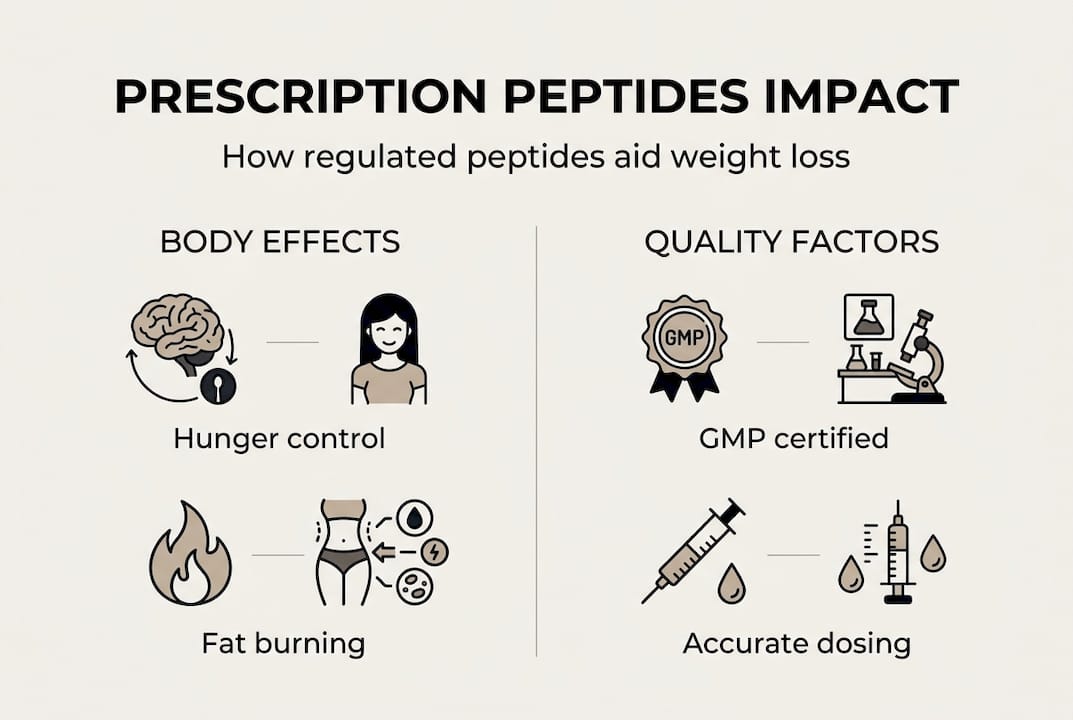
Two of the most studied examples right now are semaglutide and tirzepatide. Semaglutide is a GLP-1 receptor agonist, meaning it mimics glucagon-like peptide-1, a hormone your gut releases after eating. This hormone signals fullness, slows gastric emptying, and reduces appetite. Tirzepatide goes further by acting on both GLP-1 and GIP receptors, giving it a dual mechanism that improves insulin sensitivity and fat metabolism simultaneously. Semaglutide and tirzepatide mimic natural hormones to reduce appetite and improve fat metabolism.
For fitness-focused individuals, the key benefits of these mechanisms include:
- Reduced caloric intake without white-knuckling hunger
- Improved insulin sensitivity, which supports better nutrient partitioning
- Accelerated fat oxidation, particularly visceral fat
- Faster recovery in peptides targeting growth hormone pathways
- Preserved metabolic rate compared to crash dieting
Understanding bioactive peptides benefits can help you see why these molecules are so different from typical protein powders or fat burners. The science behind them is also evolving fast, with peptide research trends pointing toward even more targeted applications in the near future.
Pro Tip: Ask your prescribing provider which specific receptor pathway your peptide targets. Knowing this helps you align your diet and training to amplify the peptide’s mechanism, not work against it.
Why prescription status matters: Safety, quality, and regulation
Having learned how prescription peptides work, let’s look at the reasons their regulated status is so crucial for safety and results.
When a peptide requires a prescription, it means it’s gone through a regulatory process that verifies its safety profile, manufacturing standards, and appropriate medical use. That’s not a formality. That’s the difference between a product you can trust and one you’re essentially gambling on.
Pharmaceutical-grade peptides are manufactured under Good Manufacturing Practice (GMP) guidelines, which govern everything from raw ingredient sourcing to final product sterility. Prescription peptides offer pharmaceutical-grade quality, GMP manufacturing, purity, sterility, and dosing accuracy, while unregulated research peptides carry real risks of contamination, impurities, and incorrect dosing.

Here’s a direct comparison:
| Feature | Prescription peptides | Research/unregulated peptides |
|---|---|---|
| Manufacturing standard | GMP certified | Varies, often unknown |
| Purity verification | Third-party tested | Rarely guaranteed |
| Dosing accuracy | Clinically calibrated | Frequently inconsistent |
| Contamination risk | Minimal | Moderate to high |
| Medical oversight | Required | None |
| Legal status | Fully legal with Rx | Gray area or illegal |
| Adverse event tracking | FDA monitored | No tracking |
The FDA has logged hundreds of adverse events linked to compounded or unregulated peptides, including infections, hospitalizations, and dosing errors that led to serious complications. These aren’t edge cases. They’re predictable outcomes when manufacturing oversight is removed.
The other issue is effectiveness. Even if a research peptide doesn’t cause harm, it may simply not work. Incorrect peptide folding, degraded active compounds, or wrong concentrations can make a product biologically inert. You spend money, see no results, and assume peptides don’t work. The problem wasn’t the peptide class. It was the source.
Learning about GMP peptide quality standards gives you a clearer picture of what separates a product that performs from one that just looks the part.
Pro Tip: Always verify that your peptide source can provide a Certificate of Analysis (COA) from an independent lab. If they can’t or won’t, that’s a red flag worth taking seriously.
Prescription peptides vs common weight loss approaches
With a clear understanding of prescription-grade safety, it’s important to see how prescription peptides actually perform against traditional weight loss strategies.
The clinical data here is striking. In trials, semaglutide users lost an average of 14.9% of their body weight over 68 weeks. Tirzepatide pushed that further, with participants losing up to 22.5% of body weight in some cohorts. Compare that to the typical 3-5% seen with most over-the-counter supplements, or the 5-8% average from caloric restriction alone. GLP-1 therapies have shown superior outcomes compared to prior therapies, with significant user adoption and a market that now exceeds $50 billion.
More than 40 million Americans have used GLP-1 based therapies, which tells you something important: this isn’t a niche experiment anymore. It’s a mainstream clinical tool.
But the numbers come with important context. Here’s how the approaches stack up:
- OTC fat burners: Minimal clinical evidence, often rely on stimulants, no hormonal mechanism
- Caloric restriction alone: Effective short-term but often triggers metabolic adaptation and muscle loss
- Low-carb or ketogenic diets: Strong for some, but compliance rates drop significantly after 6 months
- Prescription peptides (GLP-1s): Superior fat loss, appetite regulation, and metabolic improvement backed by large-scale trials
One critical consideration: peptides and proteins work differently in the body, and understanding this helps explain why 25-40% of weight lost during GLP-1 therapy can be lean tissue if resistance training is neglected. That’s not a small number. Losing muscle while dropping scale weight is a recipe for a slower metabolism and worse long-term outcomes.
“The most common side effects of GLP-1 agonists include nausea (up to 44%) and diarrhea (up to 30%), particularly during dose escalation. These are usually transient but should be managed proactively with your provider.”
Knowing these realities upfront lets you plan for them, rather than being blindsided.
Best practices: Using prescription peptides safely and effectively
Now, to ensure you get the benefits of prescription peptides without unnecessary risks, let’s cover some key best practices.
Starting with the most important one: never self-prescribe. This isn’t about gatekeeping. It’s about the fact that dosing, timing, and peptide selection are highly individual. A qualified provider will assess your metabolic health, body composition goals, and any contraindications before recommending a protocol. Proper use of prescription peptides with medical supervision, consistent exercise, and careful reconstitution are key for optimal outcomes and safety.
Here’s a practical checklist for using prescription peptides effectively:
- Work with a licensed provider who specializes in metabolic health or sports medicine
- Integrate resistance training at least 3 times per week to protect lean mass during fat loss
- Follow reconstitution protocols exactly, since improper mixing can degrade the peptide’s effectiveness. Reviewing a safe peptide preparation guide before your first dose is worth the time
- Store peptides correctly, typically refrigerated and away from light, to maintain potency
- Start at the lowest effective dose and titrate up slowly to reduce gastrointestinal side effects
- Track your progress with body composition metrics, not just scale weight, to catch any lean mass loss early
- Communicate side effects to your provider promptly rather than pushing through them alone
Nausea is the most reported issue, especially in the first few weeks. Eating smaller, lower-fat meals and staying hydrated can significantly reduce its intensity. Diarrhea, when it occurs, often responds well to dietary fiber adjustments.
Pro Tip: Schedule a DEXA scan or InBody assessment at the start of your peptide protocol and again at 12 weeks. This gives you objective data on fat loss versus muscle retention, which is far more useful than the number on your bathroom scale.
A new era for advanced supplementation: Our take
With that practical advice, let’s close with a broader look at how prescription peptides signal a major shift in fitness and wellness approaches.
For decades, the supplement industry ran on hype. Bold claims, proprietary blends, and before-and-after photos sold products that often delivered little beyond a placebo effect. Prescription peptides change that dynamic entirely. They bring measurable, reproducible outcomes into a space that desperately needed them.
What most people miss, though, is that the peptide itself is only part of the equation. The real breakthrough happens when pharmaceutical science meets personal accountability. A GLP-1 agonist won’t compensate for a sedentary lifestyle or a diet built on processed food. It will, however, give you a significant physiological advantage when you’re already doing the work.
We also think the conversation around future of therapeutic peptides is just getting started. The next generation of peptide therapies will likely target muscle preservation, cognitive performance, and metabolic flexibility with even greater precision. The people who understand how these tools work now will be the ones positioned to benefit most as the science matures.
Cutting corners with unregulated sources isn’t a shortcut. It’s a detour that often leads nowhere good.
Discover prescription peptide options with confidence
If you’re ready to explore the benefits of prescription peptides with expert support, here’s how you can start.
Real results come from choosing quality, safety, and science over convenience and low prices. PrimeGen Labs provides access to regulated peptide solutions backed by rigorous standards, so you’re never guessing about what’s actually in your protocol.

Whether you’re just starting to research your options or ready to take action, the comprehensive peptide guide is a strong first step for understanding what’s available and why it works. You can also see peptide options directly, or explore the broader peptide wellness benefits to match your goals with the right approach. Quality and transparency aren’t optional when it comes to your health.
Frequently asked questions
What are prescription peptides used for?
Prescription peptides like semaglutide and tirzepatide are used for fat loss, muscle preservation, metabolism support, and recovery, always under medical supervision to ensure safe and effective dosing.
Are prescription peptides safer than research peptides?
Yes. Prescription peptides are produced in GMP-certified facilities with verified purity and dosing accuracy, while research peptides carry real risks of contamination and inconsistent concentrations.
How do prescription peptides compare to diet pills or OTC supplements for weight loss?
GLP-1s have shown superior outcomes in clinical trials compared to prior therapies, but pairing them with resistance training is essential to maximize fat loss while protecting lean mass.
What are the side effects of prescription peptides like GLP-1s?
GLP-1 agonists are associated with nausea (up to 44%) and diarrhea (up to 30%) as the most common side effects, particularly during the dose escalation phase, though these typically improve over time.
Can prescription peptides cause muscle loss?
Yes, 25-40% of weight loss from GLP-1s can come from lean mass if resistance training isn’t part of your routine, making exercise a non-negotiable part of any peptide protocol.
One thought on “Why prescription peptides matter for weight loss gains”