

Peptide regulations 2026: What’s changed and what’s at stake


TL;DR:
- US peptide regulations now vary by size, use, and classification, creating a complex compliance landscape.
- The proposed reclassification of 14 peptides could restore legal compounding access, pending final approval.
- EU regulations focus on manufacturing standards for therapeutic peptides, with research peptides held to different criteria.
The peptide industry entered 2026 facing one of its most consequential regulatory moments in years. The FDA’s evolving compounding categories, a high-profile HHS reclassification announcement affecting 14 widely used peptides, and the EU’s new EMA manufacturing guideline effective June 1 have all landed within months of each other. For suppliers, compounding pharmacies, and research institutions, the stakes are real: market access, legal exposure, and product sourcing are all in flux. This article breaks down exactly what has changed, what is still pending, and what your business or lab needs to know to stay on the right side of an increasingly active regulatory environment.
Table of Contents
- US peptide regulations in 2026: Breaking down the categories
- Regulatory changes and the pending peptide reclassification
- European Union peptide regulations: 2026 EMA guideline and contrasts
- Research peptides and the gray market: What’s legal and what’s risky in 2026
- Perspective: Why peptide regulation in 2026 is still a moving target
- Where to find up-to-date peptide support and products
- Frequently asked questions
Key Takeaways
| Point | Details |
|---|---|
| US regulations split | Peptides are regulated differently in the US depending on their structure, use, and approval status. |
| Reclassification pending | A major regulatory change for many peptides is still awaiting official implementation as of April 2026. |
| EU raises the bar | The European Union introduced strict manufacturing guidelines for pharmaceutical peptides effective June 2026. |
| Gray market risks | Research-use peptides remain in a legal gray area with heightened enforcement, particularly in the US. |
| Stay informed | Ongoing monitoring and trusted guidance are essential for legal compliance and business success in 2026. |
US peptide regulations in 2026: Breaking down the categories
The US regulatory framework for peptides is not a single rulebook. FDA uses different frameworks depending on peptide type and use, which means the same compound can face entirely different legal requirements based on its molecular size, intended application, and distribution channel.
The foundational split comes down to molecular size. Peptides of 40 amino acids or fewer are classified as drugs and regulated under the Federal Food, Drug, and Cosmetic Act. Anything above that threshold is classified as a biologic, subject to the Public Health Service Act and requiring a Biologics License Application. This distinction shapes every approval pathway a company can pursue.
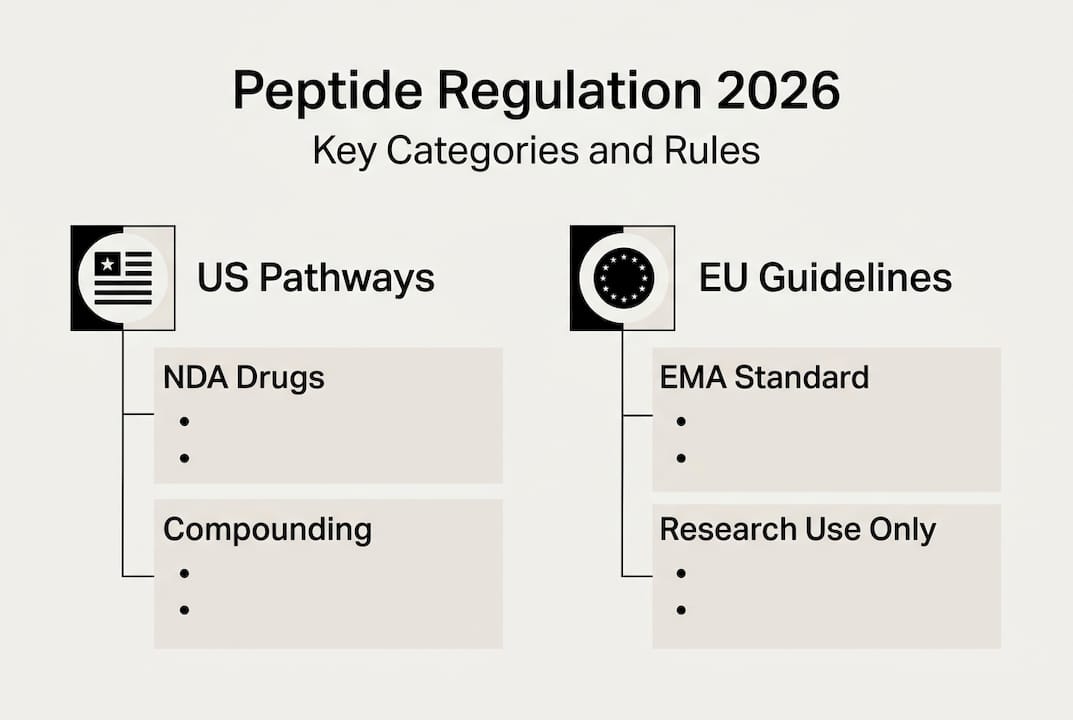
For FDA-approved drugs, the primary routes are the New Drug Application and the Biologics License Application. But the compounding pathway is where most of the current industry tension lives. The 503A and 503B distinctions matter enormously here. Section 503A covers traditional compounding pharmacies filling individual prescriptions. Section 503B applies to outsourcing facilities producing larger batches without patient-specific prescriptions, subject to Current Good Manufacturing Practice standards.
The FDA’s compounding category system further subdivides which peptides can be legally compounded:
- Category 1: Peptides that can be compounded under 503A or 503B
- Category 2: Peptides restricted from compounding, often due to safety concerns or commercial availability
- Category 3: Peptides under review, status pending further data
Some of the most commercially relevant peptides, including BPC-157, CJC-1295, and Ipamorelin, have spent time in Category 2, effectively cutting off legal compounding channels. For peptide research trends in 2026, this has created a significant bottleneck between clinical interest and legal supply.
Enforcement has also intensified. The FDA issued multiple warning letters in 2024 and 2025 targeting compounders and vendors operating outside these category restrictions. Suppliers who ignored category designations faced product seizures and injunctions. The message from regulators is clear: category classifications are not suggestions.
| Pathway | Who it applies to | Key requirement |
|---|---|---|
| NDA | Small molecule drugs (peptides ≤40 AA) | Clinical trial data, safety/efficacy |
| BLA | Biologics (peptides >40 AA) | Licensure, manufacturing standards |
| 503A | Traditional compounders | Individual patient prescription |
| 503B | Outsourcing facilities | CGMP compliance, no Rx required |
Pro Tip: If you source or distribute peptides through compounding channels, verify each compound’s current category status before every procurement cycle. Category assignments can shift without broad public notice, and acting on outdated information creates real legal exposure.
For a deeper look at how specific peptides perform in research contexts, the peptide guide for growth and recovery offers useful background on the compounds most affected by these regulatory categories.
Regulatory changes and the pending peptide reclassification
The biggest regulatory story of early 2026 is the proposed reclassification of 14 peptides from Category 2 to Category 1. In February 2026, HHS announced its intent to reclassify 14 peptides, including BPC-157, Ipamorelin, Thymosin Alpha-1, GHK-Cu, and CJC-1295, with the status still pending as of April 2026.
If finalized, this move would restore legal compounding access for some of the most in-demand peptides in functional medicine and sports performance research. That is a significant shift. These compounds were pushed into Category 2 restrictions that effectively banned their compounding, and the market responded predictably.

Category 2 restrictions drove demand directly into gray markets, where unregulated vendors filled the void left by compliant pharmacies. The reclassification proposal is partly a response to that reality: regulators recognized that prohibition without alternatives does not eliminate demand, it just removes oversight.
Here is what the reclassification process looks like in practice:
- HHS or FDA publishes a proposed rule or policy update
- A public comment period opens (typically 30 to 90 days)
- The agency reviews submissions and publishes a final determination
- Compounders and suppliers must update their practices accordingly
As of April 2026, step 3 has not been completed. The announcement was made, but formal publication in the Federal Register has not occurred. This matters because until that publication happens, Category 2 restrictions remain legally in force. Operating as if the reclassification is already final is a compliance trap.
The compounding bulk substances list remains the authoritative reference for what is currently permissible. Businesses should check it directly rather than relying on secondhand summaries.
For peptides that remain in Category 2, the restrictions are not arbitrary. Compounds stay restricted when safety data is insufficient, when a commercially available FDA-approved alternative exists, or when clinical evidence does not support the risk-benefit profile for compounding. Peptides like Selank and some growth hormone secretagogues remain in restricted status for these reasons.
The practical market effect right now is a gray area that is wider than it should be. Some vendors are marketing reclassified peptides as already available through compounding, which is legally premature. Researchers and buyers who practice safe peptide handling and source carefully are in a better position than those chasing availability without verifying compliance status.
European Union peptide regulations: 2026 EMA guideline and contrasts
Looking beyond the US, the EU’s new regulatory framework reshapes peptide manufacturing and legal expectations across borders. The European Medicines Agency’s updated guideline on the development and manufacture of synthetic peptides became effective June 1, 2026, and it sets a new standard for pharmaceutical-grade peptides in the EU market.
The EMA’s 2026 guideline focuses on manufacturing process controls, impurity profiling, and lifecycle management for synthetic peptides intended as medicines. It applies to marketing authorization applications and requires manufacturers to demonstrate control over synthesis steps, reagent quality, and degradation pathways. This is not a light-touch update. It demands rigorous documentation and process validation.
Key requirements under the EMA guideline include:
- Detailed characterization of synthetic routes and critical process parameters
- Impurity identification and qualification thresholds aligned with ICH standards
- Stability data covering the full product lifecycle
- Specific controls for protecting peptide integrity during manufacturing and storage
Critically, the guideline explicitly excludes research peptides. Compounds used in non-clinical or early research settings are not subject to these pharmaceutical manufacturing requirements. This is a meaningful contrast with the US approach, where FDA enforcement has increasingly targeted research-use vendors regardless of their stated non-clinical purpose.
“The EU is more stable for research peptides but enforces stricter standards for pharmaceutical applications than many suppliers currently meet.”
For global businesses, this creates a split strategy. EU-based researchers working with non-clinical peptides face less immediate regulatory pressure than their US counterparts. But any company seeking EU marketing authorization for a peptide therapeutic must now meet a higher manufacturing bar than existed under previous guidelines.
Pro Tip: If your organization operates in both the US and EU markets, map each peptide product to its regulatory category in each jurisdiction separately. A compound that qualifies as a research peptide in the EU may simultaneously face active FDA enforcement in the US.
For context on how bioactive peptide benefits are driving demand that regulators are now trying to manage, the underlying science helps explain why these compounds attract both commercial interest and regulatory attention.
Research peptides and the gray market: What’s legal and what’s risky in 2026
With pharmaceutical and compounding rules in place, research-use peptides occupy a uniquely risky corner of the market, especially in 2026. The “research use only” label has long served as a legal workaround, but its protection is narrowing fast.
RUO status means a compound is sold strictly for laboratory or non-clinical research, not for human administration. Legally, this limits how vendors can market the product and how buyers can use it. The problem is that the actual use of many RUO peptides has drifted far from bench research. Research peptides exist in a legal gray area, and FDA scrutiny has increased noticeably from 2024 through 2026.
FDA enforcement actions in this period have targeted vendors whose marketing language implied human use, even when the product label said “not for human use.” Website copy referencing dosing protocols, before-and-after testimonials, or condition-specific language has been enough to trigger warning letters and product seizures.
Risk factors that attract enforcement attention include:
- Marketing language referencing human dosing or administration routes
- Customer testimonials describing personal use outcomes
- Selling to consumers rather than verified research institutions
- Bundling peptides with bacteriostatic water or syringes in ways that imply injection use
The EU takes a more tolerant stance toward research peptides, provided they are not marketed as medicines. A compound sold clearly for laboratory use, without therapeutic claims, faces far less regulatory friction in most EU member states than in the US.
For vendors and researchers in the US, risk management in 2026 means strict marketing hygiene, verified buyer qualification, and documentation of research intent. Sourcing from suppliers who maintain transparent peptide product archives and clear compliance documentation reduces exposure significantly. The FDA status for peptides resource provides current enforcement context that every vendor and buyer should review.
Perspective: Why peptide regulation in 2026 is still a moving target
Given this tangle of rules, let’s step back and explore the deeper story behind peptide regulation in 2026. The honest answer to why this landscape feels so unstable is that it is not purely science-driven. No empirical benchmarks exist for many peptide compounding restrictions. Decisions often reflect political pressure, advocacy group influence, and institutional risk aversion as much as safety data.
The HHS reclassification announcement is a good example. It came from a policy environment shaped by vocal advocacy from functional medicine practitioners and patient groups, not from new clinical safety evidence. That does not make the reclassification wrong, but it does explain why the process is slow and uncertain. When policy moves faster than science, the regulatory framework becomes reactive rather than principled.
For businesses and researchers, the practical lesson is this: compliance in 2026 cannot be a static checklist. The rules are genuinely changing, and the change is driven by forces that are not always predictable. Flexibility and monitoring matter as much as legal knowledge. Companies that build regulatory tracking into their operations, rather than treating compliance as a one-time review, are the ones best positioned to adapt.
Global harmonization is a long-term possibility, but it is not close. The US and EU are moving on parallel tracks with different philosophies. Watching long-term peptide research trends and understanding why prescription peptides matter will help frame where the regulatory pressure is likely to land next.
Where to find up-to-date peptide support and products
With these regulatory realities in mind, here are reliable resources and next steps for your peptide business or laboratory.
Staying current with peptide regulation requires more than occasional news checks. It requires trusted sources, professionally documented products, and access to guidance that keeps pace with FDA and EMA developments. Whether you are managing a compounding pharmacy, running a research program, or supplying peptides to the market, the quality of your information and your supply chain matters more than ever in 2026. Explore our full peptide guide for science-backed product context, review the case for prescription peptide benefits, and browse all peptide solutions available through a compliant, professional source.
Frequently asked questions
Are there any FDA-approved peptides for human use in 2026?
Yes, several peptides hold FDA approval, but each required either an NDA or BLA depending on molecular size and therapeutic classification. FDA approves peptides through specific frameworks that most compounds currently in research or compounding channels have not completed.
Which peptides are affected by the 2026 reclassification announcement?
The proposed reclassification targets approximately 14 peptides including BPC-157, GHK-Cu, and CJC-1295, but 14 peptides from Category 2 have not yet received formal Federal Register publication as of April 2026, so current restrictions remain in effect.
How do EU regulations differ from US peptide policies in 2026?
The EU’s EMA guideline targets pharmaceutical manufacturing standards and leaves research peptides largely unaffected, while US escalates enforcement on research-use vendors regardless of their stated non-clinical purpose.
Can I legally buy research-use peptides in the US or EU in 2026?
Research-use peptides remain legal when not marketed for human use, but FDA action on research vendors has increased substantially since 2024, making marketing language and buyer verification critical compliance factors.
2 thoughts on “Peptide regulations 2026: What’s changed and what’s at stake”