

What are bioactive peptides? Benefits for muscle and wellness


Most people assume that eating more protein automatically means better recovery, leaner muscle, and improved health. But the real action happens at a smaller scale. Bioactive peptides, short chains of 2 to 30 amino acids, exert health effects that go well beyond basic nutrition. They interact directly with your body’s systems, influencing blood pressure, inflammation, immune response, and even appetite hormones. This guide breaks down the science, the realistic benefits, and what to watch out for when navigating a supplement market full of bold claims.
Table of Contents
- What are bioactive peptides?
- How are bioactive peptides produced and identified?
- Bioactive peptides in muscle recovery and athletic performance
- Role of bioactive peptides in weight management and wellness
- Current challenges and future directions for bioactive peptides
- A clear-eyed perspective: How to approach bioactive peptides in your routine
- Ready to learn more or try peptides safely?
- Frequently asked questions
Key Takeaways
| Point | Details |
|---|---|
| Bioactive peptides defined | Short amino acid chains from foods that provide health effects beyond basic nutrition. |
| Science-backed benefits | Research links peptides to muscle recovery, weight management, and immune support, but human evidence is still emerging. |
| Source and production matter | Enzymatic and food-based peptides offer the highest quality and bioactivity. |
| Application in wellness | Athletes and health-conscious users may benefit when peptides are used along with diet and training. |
| Evidence is evolving | Peptide claims should be approached with skepticism until stronger human trial data is published. |
What are bioactive peptides?
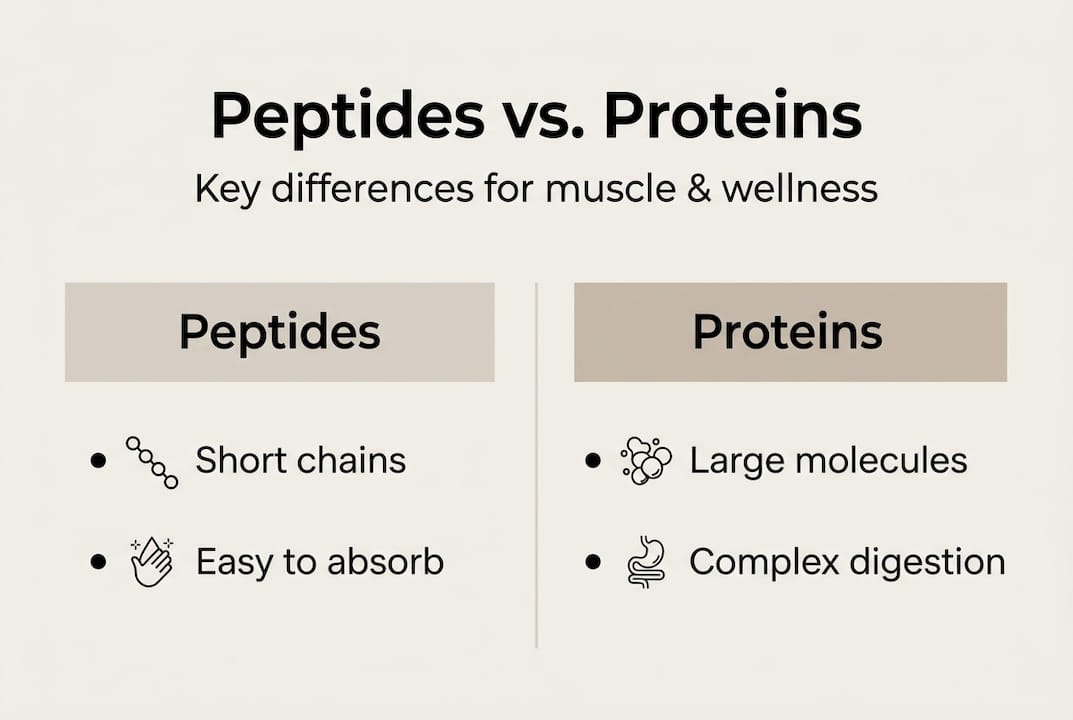
Proteins are long, complex chains of amino acids. Peptides are shorter fragments, typically 2 to 30 amino acids long. Bioactive peptides are a specific subset: fragments that trigger measurable physiological responses once they reach your tissues or bloodstream. They are not just building blocks. They act more like biological signals.
These peptides come from a wide range of food sources:
- Dairy proteins (casein and whey) are among the most studied
- Plant proteins from soy, pea, and rice
- Animal proteins including egg white, fish collagen, and meat
- Collagen from bovine and marine sources
The range of bioactive peptides cataloged in scientific databases now exceeds 5,000 unique sequences, each with distinct functional properties. These include antihypertensive effects (lowering blood pressure), antioxidant activity, anti-inflammatory action, antimicrobial defense, and immune modulation.
Understanding the peptide vs protein differences matters here because size determines function. A full protein molecule is too large to pass directly into circulation and signal cells. A bioactive peptide, being much smaller, can survive partial digestion and interact with receptors in the gut, cardiovascular system, and beyond.
Key stat: In one clinical study, casein-derived peptides lowered systolic blood pressure by approximately 9%, a meaningful result for a food-derived compound.
| Function | Example source | Mechanism |
|---|---|---|
| Antihypertensive | Casein (milk) | ACE inhibition |
| Antioxidant | Whey, plant proteins | Free radical scavenging |
| Anti-inflammatory | Collagen, fish protein | Cytokine modulation |
| Antimicrobial | Lactoferrin (milk) | Cell membrane disruption |
| Immunomodulatory | Soy, egg white | Immune cell activation |
How are bioactive peptides produced and identified?
Not every protein fragment qualifies as bioactive. Production method matters enormously, both for potency and for what ends up in your supplement.
The three main production methods are:
- Enzymatic hydrolysis: Specific enzymes break proteins into peptide fragments. This is the most common and controlled method, allowing manufacturers to target particular sequences with known bioactivity.
- Microbial fermentation: Bacteria or yeast produce enzymes that naturally hydrolyze proteins during fermentation. Yogurt and kefir are everyday examples where this occurs.
- In vivo digestion: Your own gastrointestinal enzymes release bioactive peptides from food proteins during normal digestion.
Once peptides are produced, fractionation techniques such as ultrafiltration and size exclusion chromatography isolate the most bioactive fractions by separating peptides based on size and electrical charge. This step separates effective sequences from inactive fragments.
Identification relies on lab-based bioassays, computational modeling (called in silico prediction), and increasingly, AI tools that scan protein databases to predict which sequences will be biologically active before any lab work begins. This is reshaping peptide research trends and accelerating discovery timelines significantly.
| Method | Control level | Common use |
|---|---|---|
| Enzymatic hydrolysis | High | Supplements, pharmaceuticals |
| Microbial fermentation | Moderate | Fermented foods, dairy |
| Chemical synthesis | Very high | Research only |
For anyone considering peptide supplements, the production method affects purity, consistency, and safety. Proper peptide reconstitution procedures also matter when working with research-grade products.
Pro Tip: When evaluating a peptide supplement, look for products that specify the protein source, the hydrolysis method used, and whether the specific peptide sequences have been studied in human trials.
Bioactive peptides in muscle recovery and athletic performance
For athletes and active individuals, the appeal of bioactive peptides centers on recovery. Here is what the current evidence actually supports.
Research-backed effects include:
- Reduced oxidative stress after intense training, particularly from whey and plant-derived peptides
- Lower inflammatory markers such as IL-6 and TNF-alpha following exercise
- Support for muscle protein synthesis through signaling pathways that complement leucine and other essential amino acids
- Improved metabolic recovery in animal models, with some positive signals in human studies
Plant and whey bioactive peptides show antioxidant and anti-inflammatory effects that assist muscle recovery, though they are not always superior to free amino acids in human trials. Rodent studies show impressive gains in endurance and muscle mass, but translating those findings to humans requires more rigorous clinical work.
Bioactive peptides offer a different mechanism than free amino acids. Rather than simply supplying raw material for muscle repair, they may modulate the inflammatory and oxidative environment that determines how quickly and completely recovery occurs.
Collagen peptides are gaining particular interest for connective tissue recovery, tendons, and joint health, areas where free amino acids have less targeted evidence. The S-10 peptide is one example of a research-supported option worth exploring in this space.

Browsing the full range of peptide products can help you match specific recovery goals with the right formulation.
Pro Tip: Bioactive peptides work best as part of a complete strategy. Combine them with adequate total protein intake, structured training, and sufficient sleep. No peptide overcomes a poor recovery foundation.
Role of bioactive peptides in weight management and wellness
Weight management is one of the more exciting and more overhyped areas of bioactive peptide research. Here is a grounded look at what the data says.
Collagen peptides in particular appear to influence appetite-regulating hormones. Studies show they can increase GLP-1 (a satiety hormone) and insulin while decreasing ghrelin (the hunger hormone) and leptin resistance. In practical terms, this means you may feel fuller after meals and eat less overall.
Key stat: In a randomized controlled trial, collagen peptides reduced ad libitum energy intake by approximately 10% after exercise in female participants.
Real-world applications include:
- Supporting satiety between meals to reduce snacking
- Improving diet adherence by reducing hunger-driven overeating
- Contributing to metabolic support alongside a structured nutrition plan
| Hormone | Effect of collagen peptides | Practical result |
|---|---|---|
| GLP-1 | Increased | Greater satiety |
| Ghrelin | Decreased | Reduced hunger signals |
| Insulin | Modulated | Better glucose response |
| Leptin | Improved sensitivity | More accurate hunger cues |
However, peptide effects on fat loss are consistently stronger in rodent studies than in human clinical trials. The honest takeaway: bioactive peptides can support a weight management strategy, but they are not a shortcut. The protein vs peptide for wellness distinction matters here too, since whole protein sources still provide the bulk of satiety and metabolic benefit.
Be cautious of supplements that promise dramatic fat loss from peptides alone. The human evidence is promising but modest.
Current challenges and future directions for bioactive peptides
The science is moving fast, but real barriers remain between exciting lab findings and reliable consumer products.
Current challenges include:
- Poor oral bioavailability: Many peptides are broken down further during digestion before reaching target tissues
- Limited human clinical data: Most robust studies are still in animal models
- Stability issues: Peptides can degrade during processing, storage, and digestion
- Dosage inconsistencies: Effective doses vary widely across studies and products
- Regulatory gaps: Supplement labeling standards for peptides lag behind pharmaceutical-grade requirements
AI and in silico tools are now accelerating peptide discovery by predicting bioactive sequences from protein databases before any lab synthesis occurs. Nano-encapsulation technology is being developed to protect peptides from degradation and improve delivery to target tissues. These innovations could significantly close the gap between preclinical enthusiasm and clinical reality.
For now, the peptide research outlook is genuinely exciting, but the field is still maturing. Clinical validation is lagging behind the pace of product launches.
Pro Tip: Scrutinize supplement labels carefully. Look for transparency on the peptide source, the specific sequences or hydrolysate used, the dose per serving, and whether the product cites human clinical trials, not just animal studies.
A clear-eyed perspective: How to approach bioactive peptides in your routine
Here is something the supplement industry rarely admits: most of the dramatic bioactive peptide results you read about come from rodent studies or in vitro experiments. That does not make the science fake. It means the human story is still being written.
What we know with confidence is that food-derived bioactive peptides from dairy, collagen, and plant proteins are safe, increasingly well-characterized, and show real physiological activity. What we do not yet know is the optimal dose, timing, and formulation for specific outcomes in specific populations.
The protein vs peptide guide makes one thing clear: peptides are not a replacement for whole food protein. They are a potential enhancement layer. Age, training status, and sex all appear to influence how well peptides work, which means a blanket recommendation is less useful than a personalized approach.
Our position: build your foundation first. Whole food protein, consistent training, and quality sleep deliver the majority of recovery and wellness benefits. Bioactive peptides are a worthwhile addition for those who have already optimized the basics and want to explore what the emerging science offers.
Ready to learn more or try peptides safely?
If this breakdown has you thinking seriously about adding bioactive peptides to your routine, the next step is education, not impulse buying.

At PrimeGen Labs, we prioritize transparency and research integrity. Whether you want to understand formulation details, explore peptide vs protein differences for your specific goals, or find a starting point with a product like the S-10 peptide, we have the resources to guide your decision. You can also browse our full peptide catalog to find options backed by real research. Start with knowledge. The right peptide strategy follows from there.
Frequently asked questions
Are bioactive peptides safe for daily use?
Bioactive peptides from food sources like milk, collagen, and plant proteins are considered safe at typical supplemental doses. Always choose products from reputable brands that disclose their source and manufacturing standards.
What are the most reliable sources of bioactive peptides?
Milk proteins, collagen, and plant proteins processed through enzymatic hydrolysis are the best-studied and most reliable sources, offering consistent peptide profiles and strong safety records.
How soon can athletes notice benefits from bioactive peptide supplementation?
Muscle recovery effects from bioactive peptides typically emerge after several weeks of consistent use. Results vary based on training intensity, total diet quality, and individual physiology.
Do bioactive peptides help with weight loss?
Collagen peptides may reduce appetite and calorie intake modestly, but human evidence for significant fat loss remains limited and variable compared to animal study results.
7 thoughts on “What are bioactive peptides? Benefits for muscle and wellness”